
![Papers of the Interdepartmental Conference on Middle Eastern Affairs [‎28r] (55/290)](https://iiif.qdl.qa/iiif/images/81055/vdc_100000001491.0x0002a9/Mss Eur F112_275_0055.jp2/full/!1200,1200/0/default.jpg "Papers of the Interdepartmental Conference on Middle Eastern Affairs [‎28r] (55/290)")
Papers of the Interdepartmental Conference on Middle Eastern Affairs [28r] (55/290)
The record is made up of 1 file (145 folios). It was created in 7 Jan 1919-7 Dec 1920. It was written in English. The original is part of the British Library: India Office The department of the British Government to which the Government of India reported between 1858 and 1947. The successor to the Court of Directors. Records and Private Papers Documents collected in a private capacity. .
Transcription
This transcription is created automatically. It may contain errors.
5
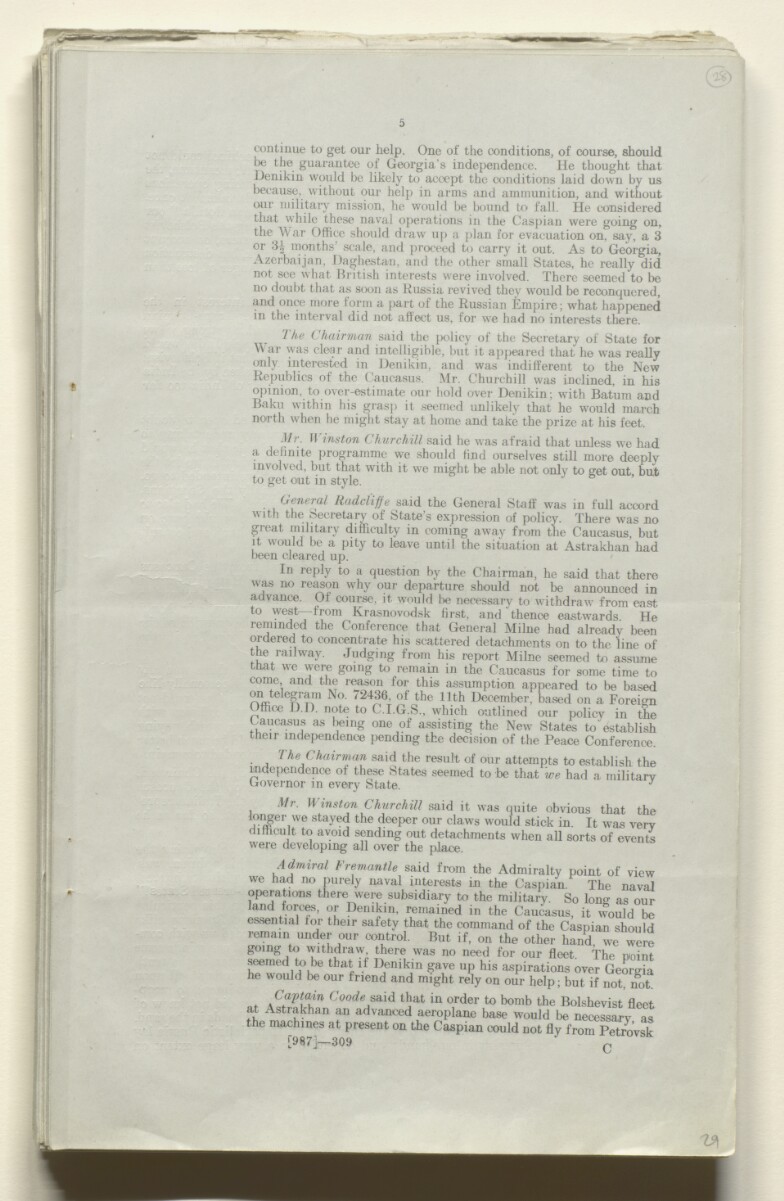
continue to get our help. One of the conditions, of course, should
be the guarantee of Georgia’s independence. He thought that
Henikin would be likely to accept the conditions laid down by us
because, without our help in arms and ammunition, and without
our military mission, he would be bound to fall. He considered
that while these naval operations in the Caspian were going on,
the W ar Office should draw up a plan for evacuation on, say, a 3
or 3-i months’ scale, and proceed to carry it out. As to Georgia,
Azerbaijan, Daghestan, and the other small States, he really did
not see what British interests were involved. There seemed to be
no doubt that as soon as Russia revived they would be reconquered,
and once more form a part of the Russian Empire; what happened
in the interval did not affect us, for we had no interests there.
1 h,e ( hairman said the policy of the Secretary of State for
W ar was clear and intelligible, but it appeared that he was really
only interested in Denikin, and was indifferent to the New
Republics of the Caucasus. Mr. Churchill was inclined, in his
opinion, to over-estimate our hold over Denikin; with Batum and
Baku within his grasp it seemed unlikely that he would march
north when he might stay at home and take the prize at his feet.
Mi'. 11 inston ( hurchill said he was afraid that unless we had
a definite programme we should find ourselves still more deeply
involved, but that with it we might be able not only to get out but
to get out in style.
General Radcliffe said the General Staff was in full accord
with the Secretary of State’s expression of policy. There was no
great military difficulty in coming away from the Caucasus, but
it would be a pity to leave until the situation at Astrakhan had
been cleared up.
In reply to a question by the Chairman, he said that there
was no reason why our departure should not be announced in
advance. Of course, it would be necessary to withdraw from east
to west--from Krasnovodsk first, and ^ thence eastwards He
reminded the Conference that General Milne had already been
ordered to concentrate his scattered detachments on to the line of
the railway. Judging from his report Milne seemed to assume
that we were going to remain in the Caucasus for some time to
come and the reason for this assumption appeared to be based
on telegram No. <2436, of the 11th December, based on a Foreign
Office D.D. note to C.I.G.S., which outlined our policy in the
Caucasus as being one of assisting the New States to'establish
their independence pending the decision of the Peace Conference.
'Ike Chairman said the result of our attempts to establish the
independence of these States seemed to be that we had a military
Governor in every State. J
Mr. M inston Churchill said it was quite obvious that the
1 ™'? e, ', we st ayed the deeper our claws would stick in. It was very
ditncult to avoid sending out detachments when all sorts of events
were developing all over the place.
Admiral Fremantle said from the Admiralty point of view
we had no purely naval interests in the Caspian. The naval
operations there were subsidiary to the military. So long as our
land forces, or Denikin, remained in the Caucasus, it would be
essential for their safety that the command of the Caspian should
remain under our control. But if, on the other hand, we were
going to withdraw there was no need for our fleet. The noint
seemed to be that it Denikin gave up his aspirations over Georgia
he would be our friend and might rely on our help; but if not. not.
Captain CWe said that in order to bomb the Bolshevist fleet
at Astrakhan an advanced aeroplane base would be necessarv as
the machines at present on the Caspian could not fly from Petrovsk
[987}—309 c
About this item
- Content
This file is composed of papers produced by the Foreign Office's Interdepartmental Conference on Middle Eastern Affairs. It consists entirely of printed minutes of meetings of the conference, most of which are chaired by George Curzon.
Those attending include senior representatives of the Foreign Office, the India Office The department of the British Government to which the Government of India reported between 1858 and 1947. The successor to the Court of Directors. (most notably the Secretary of State for India), the War Office, the Admiralty, the Air Ministry, and the Treasury (including the Chancellor of the Exchequer). Other notable figures attending include Harry St John Bridger Philby and Gertrude Margaret Lowthian Bell.
The meetings concern British policy in the Middle East, and mainly cover the following geographical areas: Mesopotamia, Kurdistan, Trans-Caspia, Trans-Caucasia, the Caspian Sea, Palestine, Persia, Hejaz, and Afghanistan. Some of the meetings also touch on matters beyond the Middle East (e.g. wireless telegraphy in Tibet, ff 79-80).
Recurring topics of discussion include railways (chiefly in relation to Mesopotamia), Bolshevik influence in the Middle East (particularly in Persia and Trans-Caspia), and relations between King Hussein [Ḥusayn bin ‘Alī al-Hāshimī] and Ibn Saud [‘Abd al-‘Azīz bin ‘Abd al-Raḥmān bin Fayṣal Āl Sa‘ūd].
Several sets of minutes also contain related memoranda as appendices.
- Extent and format
- 1 file (145 folios)
- Arrangement
The papers are arranged in approximate chronological order from the front to the rear of the file.
- Physical characteristics
Foliation: the foliation sequence (used for referencing) commences at the first folio with 1, and terminates at the last folio with 145, these numbers are written in pencil, are circled, and are located in the top right corner of the recto The front of a sheet of paper or leaf, often abbreviated to 'r'. side of each folio.
- Written in
- English in Latin script View the complete information for this record
Use and share this item
- Share this item
Papers of the Interdepartmental Conference on Middle Eastern Affairs [28r] (55/290), British Library: India Office Records and Private Papers, Mss Eur F112/275, in Qatar Digital Library <https://www.qdl.qa/archive/81055/vdc_100070539234.0x000038> [accessed 9 June 2026]
https://www.qdl.qa/en/archive/81055/vdc_100070539234.0x000038
Copy and paste the code below into your web page where you would like to embed the image.
<meta charset="utf-8"><a href="https://www.qdl.qa/en/archive/81055/vdc_100070539234.0x000038">Papers of the Interdepartmental Conference on Middle Eastern Affairs [‎28r] (55/290)</a> <a href="https://www.qdl.qa/en/archive/81055/vdc_100070539234.0x000038"> <img src="https://iiif.qdl.qa/iiif/images/81055/vdc_100000001491.0x0002a9/Mss Eur F112_275_0055.jp2/full/!280,240/0/default.jpg" alt="" /> </a>
This record has a IIIF manifest available as follows. If you have a compatible viewer you can drag the icon to load it.https://www.qdl.qa/en/iiif/81055/vdc_100000001491.0x0002a9/manifestOpen in Universal viewerOpen in Mirador viewerMore options for embedding images
Copyright: How to use this content
- Reference
- Mss Eur F112/275
- Title
- Papers of the Interdepartmental Conference on Middle Eastern Affairs
- Pages
- front, front-i, 2r:144v, back-i, back
- Author
- East India Company, the Board of Control, the India Office, or other British Government Department
- Usage terms
- Open Government Licence