
![Papers written by Curzon on the Near and Middle East [‎81v] (162/348)](https://iiif.qdl.qa/iiif/images/81055/vdc_100000001491.0x00028c/Mss Eur F112_278_0162.jp2/full/!1200,1200/0/default.jpg "Papers written by Curzon on the Near and Middle East [‎81v] (162/348)")
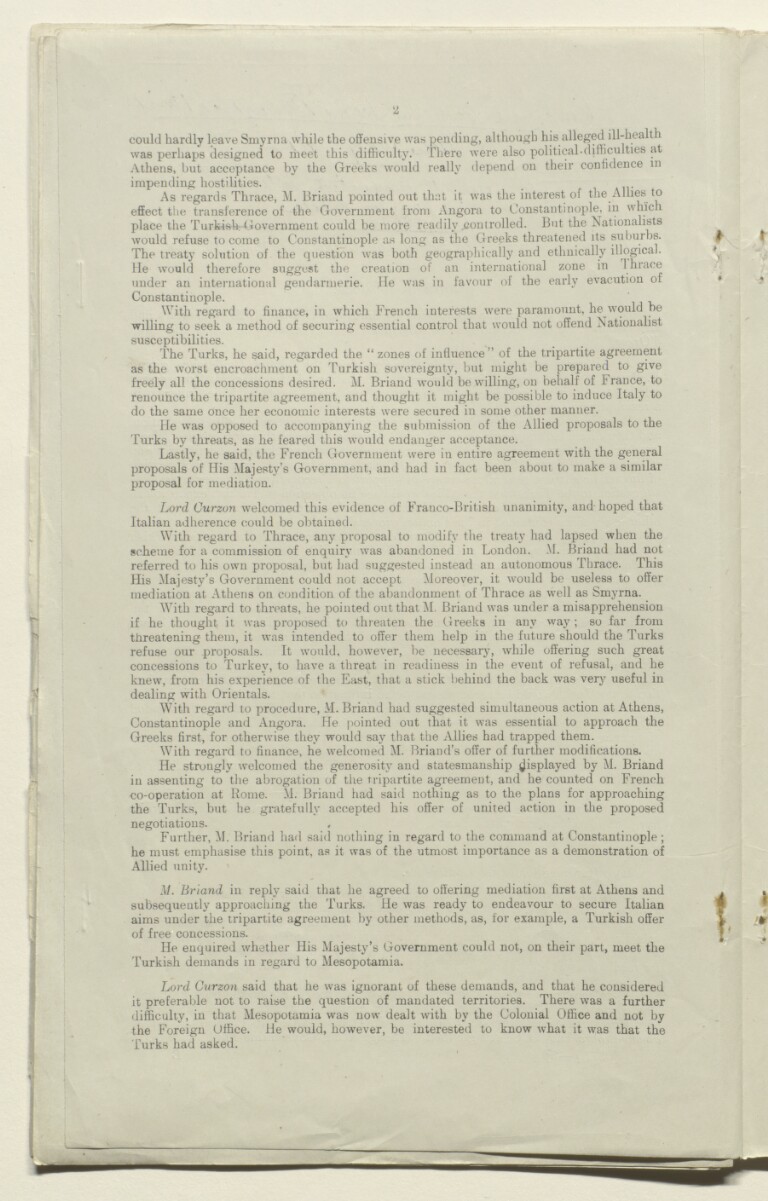
Papers written by Curzon on the Near and Middle East [81v] (162/348)
The record is made up of 1 file (174 folios). It was created in 16 Nov 1917-17 Jan 1924. It was written in English and French. The original is part of the British Library: India Office The department of the British Government to which the Government of India reported between 1858 and 1947. The successor to the Court of Directors. Records and Private Papers Documents collected in a private capacity. .
Transcription
This transcription is created automatically. It may contain errors.
could hardly leave Smyrna while the offensive was pending, although his alleged ill-healt i
was perhaps designed to meet this difficulty. There were also political-difficulties at
Athens, but acceptance by the Greeks would really depend on their conti denee m
impending hostilities.
As regards Thrace, M. Briand pointed out that it was the interest of the Allies to
effect the transference of the Government from Angora to Constantinople, in which
place the Turkisk-Government could be more readily ..controlled. But the Nationalists
would refuse to come to Constantinople as long as the Greeks threatened its suburbs.
The treaty solution of the question was both geographically and ethnically illogical.
He would therefore suggest the creat ion of an international zone in 1 hi ace
under an international gendarmerie. He was in favour of the early evacution of
Constantinople. ‘
With regard to finance, in which French interests were paramount, he would he
willing to seek a method of securing essential control that would not offend Nationalist
susceptibilities.
The Turks, he said, regarded the “ zones of influence” of the tripartite agreement
as the worst encroachment on Turkish sovereignty, but might be prepared to give
freely all the concessions desired. M. Briand would be willing, on behalf of France, to
renounce the tripartite agreement, and thought it might be possible to induce Italy to
do the same once her economic interests were secured in some other manner.
He was opposed to accompanying the submission of the Allied proposals to the
Turks by threats, as he feared this would endanger acceptance.
Lastly, he said, the French Government were in entire agreement with the general
proposals of His Majesty’s Government, and had in fact been about to make a similar
proposal for mediation.
Lord Curzon welcomed this evidence of Franeo-British unanimity, and-hoped that
Italian adherence could be obtained.
With regard to Thrace, any proposal to modify the treaty had lapsed when the
scheme for a commission of enquiry was abandoned in London. M. Briand had not
referred to his own proposal, but had suggested instead an autonomous Thrace. This
His Majesty’s Government could not accept Moreover, it would be useless to offer
mediation at Athens on condition of the abandonment of Thrace as well as Smyrna.
With regard to threats, he pointed out that M. Briand was under a misapprehension
if he thought it was proposed to threaten the Greeks in any way ; so far from
threatening them, it was intended to offer them help in the future should the Turks
refuse our proposals. It would, however, be necessary, while offering such great
concessions to Turkey, to have a threat in readiness in the event of refusal, and he
knew, from his experience of the East, that a stick behind the back w r as very useful in
dealing with Orientals.
With regard to procedure, M. Briand had suggested simultaneous action at Athens,
Constantinople and Angora. He pointed out that it was essential to approach the
Greeks first, for otherwise they would say that the Allies had trapped them.
With regard to finance, he welcomed M. Briand’s offer of further modifications.
He strongly welcomed the generosity and statesmanship displayed by M. Briand
in assenting to the abrogation of the tripartite agreement, and he counted on French
co-operation at Rome. M. Briand had said nothing as to the plans for approaching
the Turks, but he gratefully accepted his offer of united action in the proposed
negotiations.
Further, M. Briand had said nothing in regard to the command at Constantinople ;
he must emphasise this point, as it was of the utmost importance as a demonstration of
Allied unity. '
M. Briand in reply said that he agreed to offering mediation first at Athens and
subsequently approaching the Turks. He was ready to endeavour to secure Italian
aims under the tripartite agreement by other methods, as, for example, a Turkish offer
of free concessions.
He enquired whether His Majesty’s Government could not, on their part, meet the
Turkish demands in regard to Mesopotamia.
Lord Curzon said that he was ignorant of these demands, and that he considered
it preferable not to raise the question of mandated territories. There was a further
difficulty, in that Mesopotamia was now dealt with by the Colonial Office and not by
the Foreign Office. He would, however, be interested to know what it was that the
Turks had asked.
About this item
- Content
The file contains correspondence, memoranda, maps, and notes on various subjects connected to the Near and Middle East. The majority of the papers are written by George Curzon himself and concern the settlement of former territories of the Ottoman Empire following its break up after the First World War. Matters such as the Greek occupation of Smyrna, the division of Thrace, the Greco-Turkish War, Georgian independence, and the Treaties of Sèvres and Lausanne are all discussed.
Other matters covered by the file include those concerning the Arab territories of the former Ottoman Empire, American advisers in Persia, and the future of Palestine, including a report by the Committee on Palestine (Colonial Office) dated 27 July 1923 (folios 168-171).
Correspondence within the file is mostly between Curzon and representatives of the other Allied Powers, as well as officials from other governmental departments and diplomatic offices.
- Extent and format
- 1 file (174 folios)
- Arrangement
The file is arranged in chronological order from the front to the back.
- Physical characteristics
Foliation: the foliation sequence (used for referencing) commences at the first folio with 1, and terminates at the last folio with 174; these numbers are written in pencil, are circled, and are located in the top right corner of the recto The front of a sheet of paper or leaf, often abbreviated to 'r'. side of each folio.
- Written in
- English and French in Latin script View the complete information for this record
Use and share this item
- Share this item
Papers written by Curzon on the Near and Middle East [81v] (162/348), British Library: India Office Records and Private Papers, Mss Eur F112/278, in Qatar Digital Library <https://www.qdl.qa/archive/81055/vdc_100076917035.0x0000a3> [accessed 9 June 2026]
https://www.qdl.qa/en/archive/81055/vdc_100076917035.0x0000a3
Copy and paste the code below into your web page where you would like to embed the image.
<meta charset="utf-8"><a href="https://www.qdl.qa/en/archive/81055/vdc_100076917035.0x0000a3">Papers written by Curzon on the Near and Middle East [‎81v] (162/348)</a> <a href="https://www.qdl.qa/en/archive/81055/vdc_100076917035.0x0000a3"> <img src="https://iiif.qdl.qa/iiif/images/81055/vdc_100000001491.0x00028c/Mss Eur F112_278_0162.jp2/full/!280,240/0/default.jpg" alt="" /> </a>
This record has a IIIF manifest available as follows. If you have a compatible viewer you can drag the icon to load it.https://www.qdl.qa/en/iiif/81055/vdc_100000001491.0x00028c/manifestOpen in Universal viewerOpen in Mirador viewerMore options for embedding images
Copyright: How to use this content
- Reference
- Mss Eur F112/278
- Title
- Papers written by Curzon on the Near and Middle East
- Pages
- 2r:12v, 15r:48v, 54r:93v, 95r:105v, 118r:145r, 147v:153r, 154v, 156r:161v, 163r:173v, back, back-i
- Author
- East India Company, the Board of Control, the India Office, or other British Government Department
- Usage terms
- Open Government Licence