
![Letters and Papers Concerning the Trans-Persian Railway and Other Railways in Persia [‎177r] (353/442)](https://iiif.qdl.qa/iiif/images/81055/vdc_100000001491.0x0001bd/Mss Eur F112_252_0357.jp2/full/!1200,1200/0/default.jpg "Letters and Papers Concerning the Trans-Persian Railway and Other Railways in Persia [‎177r] (353/442)")
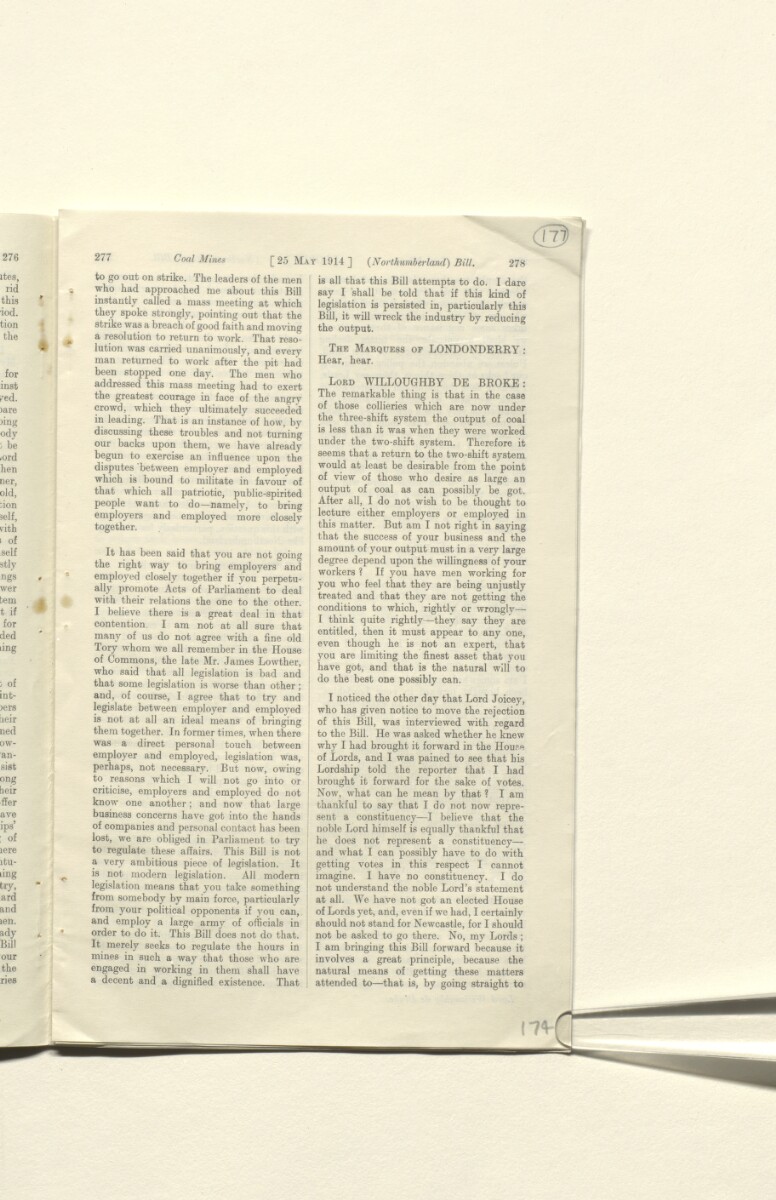
Letters and Papers Concerning the Trans-Persian Railway and Other Railways in Persia [177r] (353/442)
The record is made up of 1 file (221 folios). It was created in Nov 1911-Mar 1917. It was written in English. The original is part of the British Library: India Office The department of the British Government to which the Government of India reported between 1858 and 1947. The successor to the Court of Directors. Records and Private Papers Documents collected in a private capacity. .
Transcription
This transcription is created automatically. It may contain errors.
277
Coal Mines
[25 May 1914] {Northumberland) Bill. 278
to go out on strike. The leaders of the men
who had approached me about this Bill
instantly called a mass meeting at which
they spoke strongly, pointing out that the
strike was a breach of good faith and moving
a resolution to return to work. That reso
lution was carried unanimously, and every
man returned to work after the pit had
been stopped one day. The men who
addressed this mass meeting had to exert
the greatest courage in face of the angry
crowd, which they ultimately succeeded
in leading. 1 hat is an instance of how, by
discussing these troubles and not turning
our backs upon them, we have already
begun to exercise an influence upon the
disputes between employer and employed
which is bound to militate in favour of
that which all patriotic, public-spirited
people want to do—namely, to bring
employers and employed more closely
together.
It has been said that you are not going
the right way to bring employers and
employed closely together if you perpetu
ally promote Acts of Parliament to deal
with their relations the one to the other.
I believe there is a great deal in that
contention. I am not at all sure that
many of us do not agree with a fine old
Tory whom we all remember in the House
of Commons, the late Mr. James Lowther,
who said that all legislation is bad and
that some legislation is worse than other ; ‘
and, of course, I agree that to try and
legislate between employer and employed
is not at all an ideal means of bringing
them together. In former times, when there
was a direct personal touch between
employer and employed, legislation was,
perhaps, not necessary. But now, owing
to reasons which I will not go into or
criticise, employers and employed do not
know one another; and now that large
business concerns have got into the hands
of companies and personal contact has been
lost, we are obliged in Parliament to try
to regulate these affairs. This Bill is not
a very ambitious piece of legislation. It
is not modern legislation. All modern
legislation means that you take something
from somebody by main force, particularly
from your political opponents if you can,
and employ a large army of officials in
order to do it. This Bill does not do that.
It merely seeks to regulate the hours in
mines in such a way that those who are
engaged in working in them shall have
a decent and a dignified existence. That
is all that this Bill attempts to do. I dare
say I shall be told that if this kind of
legislation is persisted in, particularly this
Bill, it will wreck the industry by reducing
the output.
The Marquess of LONDONDERRY:
Hear, hear.
Lord WILLOUGHBY DE BROKE:
The remarkable thing is that in the case
of those collieries which are now under
the three-shift system the output of coal
is less than it was when they were worked
under the two-shift system. Therefore it
seems that a return to the two-shift system
would at least be desirable from the point
of view of those who desire as large an
output of coal as can possibly be got.
After all, I do not wish to be thought to
lecture either employers or employed in
this matter. But am I not right in saying
that the success of your business and the
amount of your output must in a very large
degree depend upon the willingness of your
workers ? If you have men working for
you who feel that they are being unjustly
treated and that they are not getting the
conditions to which, rightly or wrongly—
I think quite rightly—they say they are
entitled, then it must appear to any one,
even though he is not an expert, that
you are limiting the finest asset that you
have got, and that is the natural will to
do the best one possibly can.
I noticed the other day that Lord Joicey,
who has given notice to move the rejection
of this Bill, was interviewed with regard
to the Bill. He was asked whether he knew
why I had brought it forward in the House
of Lords, and I was pained to see that bis
Lordship told the reporter that I had
brought it forward for the sake of votes.
Now, what can he mean by that ? I am
thankful to say that I do not now repre
sent a constituency—I believe that the
noble Lord himself is equally thankful that
he does not represent a constituency—
and what I can possibly have to do with
getting votes in this respect I cannot
imagine. I have no constituency. I do
not understand the noble Lord’s statement
at all. We have not got an elected House
of Lords yet, and, even if we had, I certainly
should not stand for Newcastle, for I should
not be asked to go there. No, my Lords ;
I am bringing this Bill forward because it
involves a great principle, because the
natural means of getting these matters
attended to—that is, by going straight to
About this item
- Content
The file contains correspondence, memoranda, and other papers relating to railway projects in Persia [Iran] and the surrounding region. The papers deal with the proposals for, planning, and progress of, several railway lines, including one from the Mediterranean to India, the Trans-Persian Railway, the Baghdad Railway, and the Nushki and Dalbandin extension from Quetta. The documents discuss the merits and flaws of the proposals, technical issues such as gauge sizes, and the impact of such projects on Britain's relations with Russia, Germany, France, and Turkey.
At the back of the file are a number of official reports on Parliamentary debates within the House of Commons, dating from 10 July 1912 to 25 May 1914, all of which feature railways (folios 128-218). Also at the rear of the file are three maps:
- General Map of Asia with proposed British, German, and Russian rail lines added by hand
- War Office map of the Middle East, showing railways and railway projects
- As above with further rail lines added and details of gauges given.
Correspondents include: Arthur Campbell Yate, army Officer; Henry McNiel; Francis Richard Maunsell, army officer; George Lloyd, politician; Lieutenant-Colonel Charles à Court Repington, army officer and war correspondent; Lord Robert Offley Ashburton Crewe-Milnes, Leader of the House of Lords; Henry Charles Keith Petty-Fitzmaurice (Lord Lansdowne), statesman; Lucien Wolf, journalist and historian; Charles Staniforth, businessman and railway investor; Charles Prestwich Scott, Editor of the Manchester Guardian; Hugh Shakespear Barnes, Director, Imperial Bank of Persia; and Colonel Frank Cooke Webb Ware, former Political Agent A mid-ranking political representative (equivalent to a Consul) from the diplomatic corps of the Government of India or one of its subordinate provincial governments, in charge of a Political Agency. , Chagai.
- Extent and format
- 1 file (221 folios)
- Arrangement
The file is arranged in chronological order from the front to the rear.
- Physical characteristics
Foliation: the foliation sequence (used for referencing) commences at the first folio with 1, and terminates at the last folio with 221; these numbers are written in pencil, are circled, and are located in the top right corner of the recto The front of a sheet of paper or leaf, often abbreviated to 'r'. side of each folio.
- Written in
- English in Latin script View the complete information for this record
Use and share this item
- Share this item
Letters and Papers Concerning the Trans-Persian Railway and Other Railways in Persia [177r] (353/442), British Library: India Office Records and Private Papers, Mss Eur F112/252, in Qatar Digital Library <https://www.qdl.qa/mirador/81055/vdc_100075113116.0x00009a> [accessed 30 June 2026]
https://www.qdl.qa/en/archive/81055/vdc_100075113116.0x00009a
Copy and paste the code below into your web page where you would like to embed the image.
<meta charset="utf-8"><a href="https://www.qdl.qa/en/archive/81055/vdc_100075113116.0x00009a">Letters and Papers Concerning the Trans-Persian Railway and Other Railways in Persia [‎177r] (353/442)</a> <a href="https://www.qdl.qa/en/archive/81055/vdc_100075113116.0x00009a"> <img src="https://iiif.qdl.qa/iiif/images/81055/vdc_100000001491.0x0001bd/Mss Eur F112_252_0357.jp2/full/!280,240/0/default.jpg" alt="" /> </a>
This record has a IIIF manifest available as follows. If you have a compatible viewer you can drag the icon to load it.https://www.qdl.qa/en/iiif/81055/vdc_100000001491.0x0001bd/manifestOpen in Universal viewerOpen in Mirador viewerMore options for embedding images
Copyright: How to use this content
- Reference
- Mss Eur F112/252
- Title
- Letters and Papers Concerning the Trans-Persian Railway and Other Railways in Persia
- Pages
- 87r:90v, 95r:221v
- Author
- East India Company, the Board of Control, the India Office, or other British Government Department
- Usage terms
- Open Government Licence