Overview
Sulayman al-Baruni was a member of the last Ottoman parliament. His political journey took him from the Amazigh Ibadhi communities in North Africa to Oman, as he fought against European colonialism and promoted independence for the people of North Africa and the Middle East. A member of a minority within a minority, he strategically shifted his political allegiances. Initially opposed to but later aligned with Ottoman rule, he resisted the Italian invasion of Libya and championed unity and independence across the region. This shift reflected the complexities of colonial resistance and regional politics. Al-Baruni navigated between Ottoman, Libyan, Amazigh, and Ibadhi identities, ultimately settling as an adviser and confidante in the Sultanate of Muscat and Oman. There he worked for both the Imam in the mountainous interior 1924-32, and the British-backed Sultan on the coast in the late 1930s.
Archive items in this article



Early Education and Political Career
Al-Baruni was born in 1872 in Jadu, in the Jabal Nafusah mountain range, inhabited by Amazigh groups of Tripolitania. He descended from a prominent family that observed the Ibadhi sect of Islam. He was educated first by his father, Abdullah, and then in Tunisia (Al-Zaytuna), Egypt (Al-Azhar), and M'zab in Algeria, which was at the heart of Ibadhi teachings and culture. On his return to Tripolitania, the Ottoman authorities accused him of subversion and sent him to prison after several trials. They released him into house confinement in Tripoli before finally granting him amnesty.
Coming under Ottoman suspicion again for seditious activity, he took refuge in Egypt in 1906. There he started the Al-Asad al-Islami newspaper, which was banned in the Ottoman provinces. Political developments helped al-Baruni gain a seat in the Ottoman parliament, when the Committee for Union and Progress forced Sultan ‘Abd al-Hamid II to reinstate the Constitution in 1908. As part of this, all provinces in the empire sent delegates to the Ottoman parliament in Istanbul. Hailing from a notable family, al-Baruni was unsurprisingly elected to represent Jabal Nafusah, and he had to learn Turkish quickly to fulfil the constitutional requirement for the post.
During this first parliamentary session, he became closely connected to the Committee for Union and Progress and urged for more Ottoman troops to be stationed in the Libyan provinces as Italian forces began to advance. Al-Baruni was in Jadu when the first Italian troops landed, so he organised the Libyan resistance, which was trained by Turks.

The Treaty of Ouchy (October 1912), which ended the Italian-Ottoman war, included a provision stipulating that the Ottoman government recognise the autonomy of the Libyan provinces. On 8 November 1912, al-Baruni proclaimed the birth of the Republic of Yefren, named after its capital in the Amazigh mountains, with territories spanning the surrounding region and western Tripolitania. However, Yefren’s existence was short-lived, as it was occupied by Italian troops on 27 March 1913. Al-Baruni refused to accept the occupation, crossing to Tunisia, then Europe, and eventually Istanbul, where he was appointed as a senator in the Ottoman parliament.
The End of the First World War
While defending Tripolitania against Italian troops, al-Baruni worked closely with Enver Bey (later known as Enver Pasha An Ottoman title used after the names of certain provincial governors, high-ranking officials and military commanders. ), a scion of the Committee of Union and Progress and commander of the Ottoman troops. In August 1913, the Special Organisation (Teshkilat-ı mahsusa) for covert operations was founded under Enver Bey, who had become the Ottoman Minister of War. Historian Federico Cresti contends that it is likely al-Baruni was a member. At the outbreak of the First World War, al-Baruni was sent to Cyrenaica to persuade Ahmad al-Sharif al-Sanusi, the principal shaikh (Shaikh al-Kabir), to support the plans of the Ottoman High Command. These plans envisaged Sanusi supporting troops led by German officers who were preparing an attack on the Suez Canal. Al-Baruni found his way to al-Sharif’s encampment but was summarily imprisoned and later released.
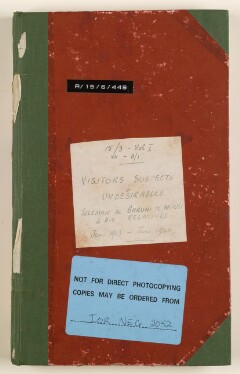
In subsequent years, and in the midst of shifting wartime allegiances, al-Baruni actively tried to secure greater rights for the Amazighs and Libyans, negotiating with both Italian and Ottoman authorities. With the end of the war and the collapse of the Ottoman Empire, al-Baruni shifted his focus to explore opportunities arising from the post-war settlement and attended the Lausanne peace conference. In November, al-Baruni wrote to Sultan Sa‘id bin Taymur, asking for help with travelling to Muscat, and by December that his options were becoming limited due to French, Italian, and British hostility towards him. British officials in particular seemed irked by this fluid approach to nationalities, noting with suspicion that he ‘seems to claim three nationalities, Turkish, French and Italian’ (IOR/R/15/6/449, f. 2r).

Retaining their suspicions, the Government of India also wrote to Sa‘id bin Taymur in 1923 urging him not to admit al-Baruni to Oman. The telegram describes him as ‘a person whom His Highness the Sultan of Muscat would do well to refuse admittance to his country’ (IOR/R/15/6/449, f. 10r). Nevertheless, al-Baruni managed to enter Muscat, arriving on a pilgrim ship from Jeddah in 1924.
Al-Baruni Post-First World War
After the First World War, al-Baruni spent time in the Hijaz with Husayn bin ‘Ali, the Sharif of Mecca. In 1924, he visited Faysal bin al-Husayn bin ‘Ali, who had recently been installed by Britain as King Faysal I of the Hashemite monarchy of Iraq.
In 1938, Sa‘id bin Taymur wrote to the Political Agent A mid-ranking political representative (equivalent to a Consul) from the diplomatic corps of the Government of India or one of its subordinate provincial governments, in charge of a Political Agency. in Muscat asking him to facilitate a visa in Iraq for al-Baruni and his son to travel to the Sultanate. On entering the Sultanate, al-Baruni accepted a supervisory position in the Sultan’s administration. British officials remained suspicious that the Sultan wanted al-Baruni as ‘part of an ambitious project’ to expel the Imam and resume control over the whole of Muscat (IOR/R/15/6/449, f. 123r).
Related Articles





Wartime Correspondence and Ongoing Legacy
British authorities continued to monitor al-Baruni. From September 1939 to April 1940, they intercepted his correspondence with other members of the Tripolitania diaspora. This group of exiles envisaged a Tripoli free of Italian colonial rule, which included supporting Idris al-Sanusi, who would later become Libya’s first king when it gained independence in 1951.
Sulayman al-Baruni died in May 1940 on his way to Mumbai with Sa‘id bin Taymur.