
!['Administration Reports 1905-1910' [‎89r] (182/616)](https://iiif.qdl.qa/iiif/images/81055/vdc_100000000193.0x0002ac/IOR_R_15_1_710_0183.jp2/full/!1200,1200/0/default.jpg "'Administration Reports 1905-1910' [‎89r] (182/616)")
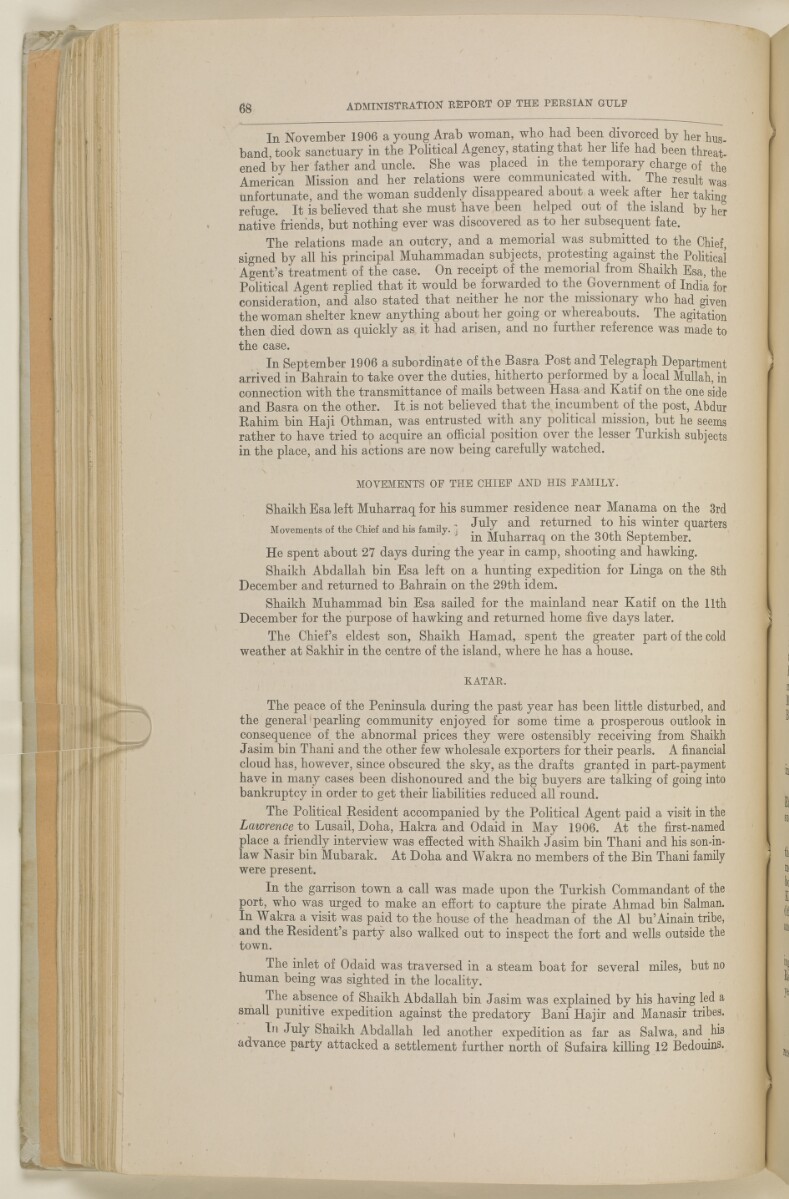
'Administration Reports 1905-1910' [89r] (182/616)
The record is made up of 1 volume (304 folios). It was created in 1907-1911. It was written in English. The original is part of the British Library: India Office The department of the British Government to which the Government of India reported between 1858 and 1947. The successor to the Court of Directors. Records and Private Papers Documents collected in a private capacity. .
Transcription
This transcription is created automatically. It may contain errors.
political
residency
An office of the East India Company and, later, of the British Raj, established in the provinces and regions considered part of, or under the influence of, British India.
sou 1906-1907. 67
In consequence of Shaikh Esa's apparent objections to supporting his nephew
suitably in Bombay on an allowance of Rs. 600 per mensem, which he wished to
diminish by half , and also owing to the apprehension of the
Government of Bombay
From c. 1668-1858, the East India Company’s administration in the city of Bombay [Mumbai] and western India. From 1858-1947, a subdivision of the British Raj. It was responsible for British relations with the Gulf and Red Sea regions.
lest the detenu should abscond, the Chief was asked in July 1906 whether he could
suggest a satisfactory alternative rendering Shaikh Ali's evil influence inoperative.
When thus confronted with the possibility of his nephew's return to Bahrain,
the Chief emphatically expressed his disinclination to have him back, and withdrew
all objections to subscribing the monthly allowance required by the Government
of Bombay.
The question of the status of the Jews in Bahrain gave rise to some friction In
April 1906. There are only about 50 members of this community in Bahrain, all
of whom have come to the islands temporarily for purposes of trade during the last
ten years. On the advice of a Mullah the Chief informed the
Political Agent
A mid-ranking political representative (equivalent to a Consul) from the diplomatic corps of the Government of India or one of its subordinate provincial governments, in charge of a Political Agency.
that
he proposed to levy a special tax from the community, as was done in certain other
parts of the world.
The Government of India decided that these foreign Jews were entitled to
receive as much British protection as was accorded to their fellow subjects of the
Christian and Muhammadan religions, and the proposal was therefore disallowed.
The Chief accepted unhesitatingly the Government's decision.
In May 1906 the Chief consulted the
Political Agent
A mid-ranking political representative (equivalent to a Consul) from the diplomatic corps of the Government of India or one of its subordinate provincial governments, in charge of a Political Agency.
as to whether the Govern"
ment of India would object to his raising a flag-staff on the open square to the east
of the sequestrated house formerly occupied by Shaikh Ali bin Ahmad, and in lieu
of the stafl which had formerly stood on the top of the said house. He was
promptly informed that there was no objection to his proposal.
Subscriptions were then invited from the public of Bahrain, and an imposing
flag-staff, a few feet taller than the British staff, was erected in July 1906 during
the time of the
Political Agent
A mid-ranking political representative (equivalent to a Consul) from the diplomatic corps of the Government of India or one of its subordinate provincial governments, in charge of a Political Agency.
's absence in India. The first occasion of flying the
flag was observed with great rejoicings by the Arabs, the ceremony being presided
over by Shaikh Hamad bin Esa, and a salute of guns being fired.
The farm to the Hindu Syndicate of the one per cent duty of the Customs
expired on 25th May 1906. The Chief thereupon authorized the Syndicated
Manager to continue collecting the revenue on his behalf, until the farm of the four
per cent duty should also lapse in January 1908A
It. is understood that the Chief has not profited at all by this arrangement.
German commercial activities in Bahrain have received a considerable impetus
from the periodical calling of steamers oi the Hamburg-Amerika line at the port,
and the appointment of Messrs. R. Wonckhaus & Co. as Agents for the line. With
out this relief it is doubtful whether the firm would have continued much longer
to do business here, as they feel the competition of Messrs. Gray Paul & Co. very
severely. Even now, Messrs. Wonckhaus have not found it necessary to add any
Europeans to their staff of one in the place.
In June 1906 Mr. Sturken, Managing Partner of Messrs. Traun Stiirken & Co.,
visited Bahrain with Mr. Wonckhaus in the course of a trip of inspection round the
Gulf.
These gentlemen called on the Chief of Bahrain in company with Mr. Eisenhut,
the local representative of the firm. Mr. Sturken afterwards proceeded homewards
through Tehran.
The first Hamburg-Amerika Steamer Canadia called at Bahrain on the 26th
August 1906 ; she was followed by six other vessels from Europe during the year
under report, the average number of packages brought being only 738.
Three of these vessels also called on the homeward run, taking a few pilgrims,
some dates for Jedda and some mother-of-pearl shells for Hamburg. The
German Consul from Bushire, Dr. Listemann, visited Bahrain twice, coming in
the first steamer in August 1906 and again in the same vessel on the 22nd January
1907. On the first occasion the Consul seemed to entertain some idea of inter
viewing Shaikh Esa in support of Messrs. Wonckhaus' application for permission to
fly the Hamburg-Amerika Line's flag on a mast over their house, the second visit
seemed only to have been made for the purpose of inspecting the Tumuli and
excavations at 'Ali. On neither occasion did he call upon the Chief, having evi
dently discovered the first time that Shaikh Esa was quite resolved not to allow
unofficial foreigners to erect flag-staffs over their houses.
3147 F. D. k 2
About this item
- Content
The volume contains Administration Report on the Persian Gulf The historical term used to describe the body of water between the Arabian Peninsula and Iran. Political Residency An office of the East India Company and, later, of the British Raj, established in the provinces and regions considered part of, or under the influence of, British India. for 1905-1906 (Calcutta: Office of the Superintendent of Government Printing, India, 1907); Administration Report on the Persian Gulf The historical term used to describe the body of water between the Arabian Peninsula and Iran. Political Residency An office of the East India Company and, later, of the British Raj, established in the provinces and regions considered part of, or under the influence of, British India. and Maskat Political Agency An office of the East India Company and, later, of the British Raj, headed by an agent. for 1906-1907 (Calcutta: Superintendent Government Printing, India, 1908); Administration Report of the Persian Gulf The historical term used to describe the body of water between the Arabian Peninsula and Iran. Political Residency An office of the East India Company and, later, of the British Raj, established in the provinces and regions considered part of, or under the influence of, British India. and the Maskat Political Agency An office of the East India Company and, later, of the British Raj, headed by an agent. for 1907-1908 (Calcutta: Superintendent Government Printing, India, 1909); Administration Report of the Persian Gulf The historical term used to describe the body of water between the Arabian Peninsula and Iran. Political Residency An office of the East India Company and, later, of the British Raj, established in the provinces and regions considered part of, or under the influence of, British India. and the Maskat Political Agency An office of the East India Company and, later, of the British Raj, headed by an agent. for April-December1908 (Calcutta: Superintendent Government Printing, India, 1909); Administration Report of the Persian Gulf The historical term used to describe the body of water between the Arabian Peninsula and Iran. Political Residency An office of the East India Company and, later, of the British Raj, established in the provinces and regions considered part of, or under the influence of, British India. for the Year Ending 31st December 1909 (Calcutta: Superintendent Government Printing, India, 1911); and Administration Report of the Persian Gulf The historical term used to describe the body of water between the Arabian Peninsula and Iran. Political Residency An office of the East India Company and, later, of the British Raj, established in the provinces and regions considered part of, or under the influence of, British India. for the Year 1910 (Calcutta: Superintendent Government Printing, India, 1911).
The Reports contain reviews by the Political Resident A senior ranking political representative (equivalent to a Consul General) from the diplomatic corps of the Government of India or one of its subordinate provincial governments, in charge of a Political Residency. and chapters on each of the consulates, agencies, and other administrative regions that made up the Persian Gulf The historical term used to describe the body of water between the Arabian Peninsula and Iran. Residency An office of the East India Company and, later, of the British Raj, established in the provinces and regions considered part of, or under the influence of, British India. . The Reports contain information on political developments, territorial divisions, local administration, principal tribes, British personnel and appointments, trade and commerce, naval and marine matters, communications, judicial matters, archaeology, pearl fisheries, the slave trade, arms and ammunition traffic, medical matters and public health, oil, notable visitors and events, meteorological data, and related topics.
- Extent and format
- 1 volume (304 folios)
- Arrangement
There is a list of contents at the front of each Report.
- Physical characteristics
Foliation: the foliation sequence commences at 1 on the front cover and terminates at 306 on the back cover. These numbers are written in pencil, are circled, and can be found in the top right hand corner of the recto The front of a sheet of paper or leaf, often abbreviated to 'r'. page of each folio. The following folios need to be folded out to be read: ff. 40, 261.
- Written in
- English in Latin script View the complete information for this record
Use and share this item
- Share this item
'Administration Reports 1905-1910' [89r] (182/616), British Library: India Office Records and Private Papers, IOR/R/15/1/710, in Qatar Digital Library <https://www.qdl.qa/archive/81055/vdc_100023487519.0x0000b7> [accessed 13 June 2026]
https://www.qdl.qa/en/archive/81055/vdc_100023487519.0x0000b7
Copy and paste the code below into your web page where you would like to embed the image.
<meta charset="utf-8"><a href="https://www.qdl.qa/en/archive/81055/vdc_100023487519.0x0000b7">'Administration Reports 1905-1910' [‎89r] (182/616)</a> <a href="https://www.qdl.qa/en/archive/81055/vdc_100023487519.0x0000b7"> <img src="https://iiif.qdl.qa/iiif/images/81055/vdc_100000000193.0x0002ac/IOR_R_15_1_710_0183.jp2/full/!280,240/0/default.jpg" alt="" /> </a>
This record has a IIIF manifest available as follows. If you have a compatible viewer you can drag the icon to load it.https://www.qdl.qa/en/iiif/81055/vdc_100000000193.0x0002ac/manifestOpen in Universal viewerOpen in Mirador viewerMore options for embedding images
Copyright: How to use this content
- Reference
- 'Administration Reports 1905-1910'
- Title
- front,back,spine,edge,head,tail,front-i,2r:9v,11r:39v,41r:120v,122r:260v,262r:305v,back-i
- Pages
- East India Company, the Board of Control, the India Office, or other British Government Department
- Author
- Usage terms
- Open Government Licence