
!['Travels in Assyria, Media, and Persia, including a journey from Bagdad by Mount Zagros, to Hamadan, the ancient Ecbatana, researches in Ispahan and the ruins of Persepolis, and journey from thence by Shiraz and Shapoor to the sea-shore. Description of Bussorah, Bushire, Bahrein, Ormuz, and Muscat, narrative of an expedition against the pirates of the Persian Gulf, with illustrations of the voyage of Nearchus, and passage by the Arabian Sea to Bombay.' [‎282] (313/582)](https://iiif.qdl.qa/iiif/images/81055/vdc_100023554058.0x000001/567.g.5._0315.jp2/full/!1200,1200/0/default.jpg "'Travels in Assyria, Media, and Persia, including a journey from Bagdad by Mount Zagros, to Hamadan, the ancient Ecbatana, researches in Ispahan and the ruins of Persepolis, and journey from thence by Shiraz and Shapoor to the sea-shore. Description of Bussorah, Bushire, Bahrein, Ormuz, and Muscat, narrative of an expedition against the pirates of the Persian Gulf, with illustrations of the voyage of Nearchus, and passage by the Arabian Sea to Bombay.' [‎282] (313/582)")
'Travels in Assyria, Media, and Persia, including a journey from Bagdad by Mount Zagros, to Hamadan, the ancient Ecbatana, researches in Ispahan and the ruins of Persepolis, and journey from thence by Shiraz and Shapoor to the sea-shore. Description of Bussorah, Bushire, Bahrein, Ormuz, and Muscat, narrative of an expedition against the pirates of the Persian Gulf, with illustrations of the voyage of Nearchus, and passage by the Arabian Sea to Bombay.' [282] (313/582)
The record is made up of 1 volume (545 pages). It was created in 1829. It was written in English. The original is part of the British Library: Printed Collections.
Transcription
This transcription is created automatically. It may contain errors.
282
VISIT TO THE RUINS OF PERSEPOLIS.
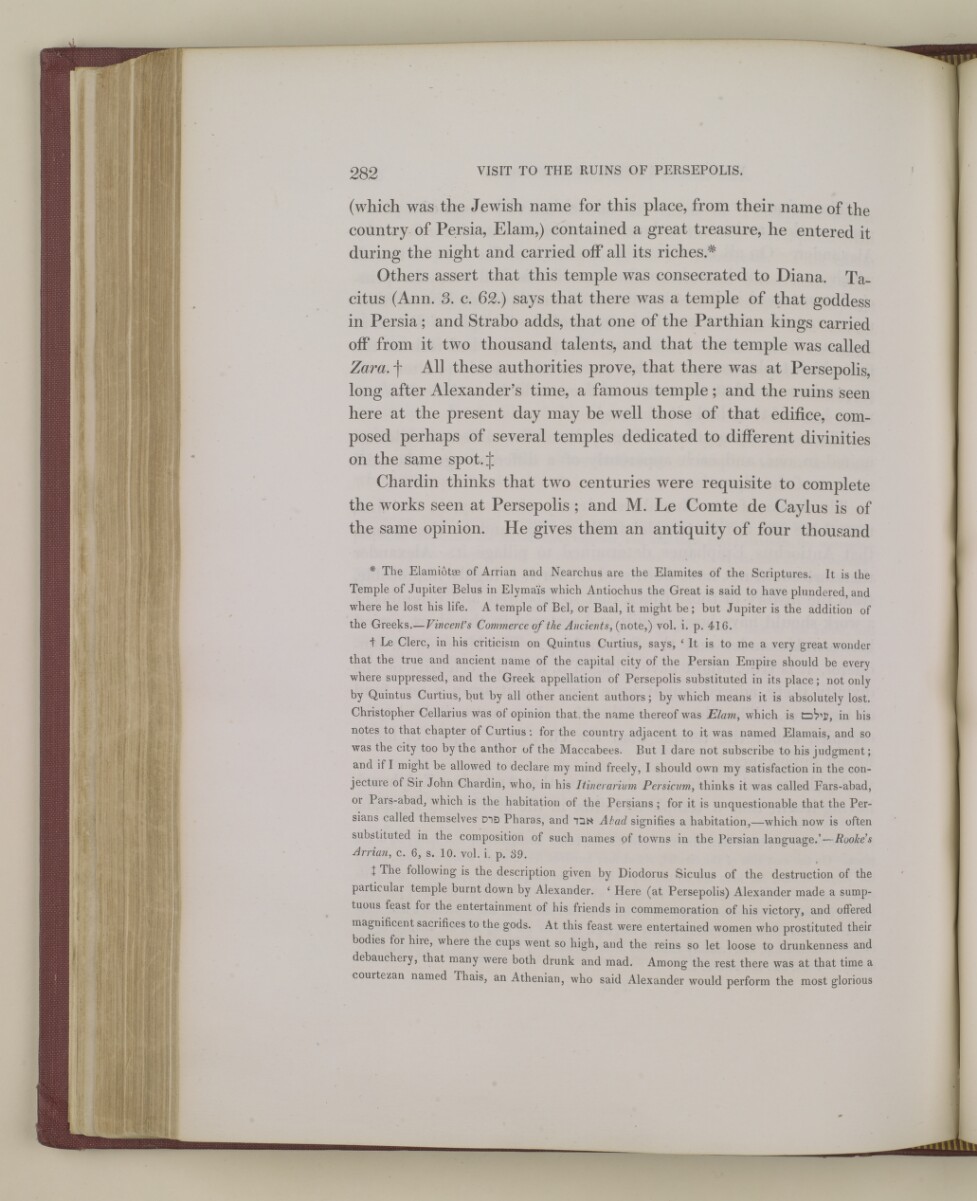
(which was the Jewish name for this place, from their name of the
country of Persia, Elam,) contained a great treasure, he entered it
during the night and carried off all its riches. #
Others assert that this temple was consecrated to Diana. Ta
citus (Ann. 3. c. 62.) says that there was a temple of that goddess
in Persia; and Strabo adds, that one of the Parthian kings carried
off from it two thousand talents, and that the temple was called
Zara. f All these authorities prove, that there was at Persepolis,
long after Alexander's time, a famous temple; and the ruins seen
here at the present day may be well those of that edifice, com
posed perhaps of several temples dedicated to different divinities
on the same spot. J
Chardin thinks that two centuries were requisite to complete
the works seen at Persepolis ; and M. Le Comte de Caylus is of
the same opinion. He gives them an antiquity of four thousand
* The Elamiotse of Arrian and Nearchus are the Elamites of the Scriptures. It is the
Temple of Jupiter Belus in Elymais which Antiochus the Great is said to have plundered, and
where he lost his life. A temple of Bel, or Baal, it might be; but Jupiter is the addition of
the Greeks.— Vincent's Commerce of the Ancients, {note,) vol. i. p. 416.
t Le Clerc, in his criticism on Quintus Curtius, says, ' It is to me a very great wonder
that the true and ancient name of the capital city of the Persian Empire should be every
where suppressed, and the Greek appellation of Persepolis substituted in its place; not only
by Quintus Curtius, but by all other ancient authors; by which means it is absolutely lost.
Christopher Cellarius was of opinion that, the name thereof was Elam, which is C d V ' 1 )?, in his
notes to that chapter of Curtius: for the country adjacent to it was named Elamais, and so
was the city too by the author of the Maccabees. But I dare not subscribe to his judgment;
and if I might be allowed to declare my mind freely, I should own my satisfaction in the con
jecture of Sir John Chardin, who, in his Itinerarium Persicnm, thinks it was called Fars-abad,
or Pars-abad, which is the habitation of the Persians; for it is unquestionable that the Per
sians called themselves did Pharas, and trm Abad signifies a habitation,—which now is often
substituted in the composition of such names of towns in the Persian language.'— Rooke's
Arrian, c. 6, s. 10. vol. i. p. S9.
J The following is the description given by Diodorus Siculus of the destruction of the
particular temple burnt down by Alexander. ' Here (at Persepolis) Alexander made a sump
tuous feast for the entertainment of his friends in commemoration of his victory, and offered
magnificent sacrifices to the gods. At this feast were entertained women who prostituted their
bodies for hire, where the cups went so high, and the reins so let loose to drunkenness and
debauchery, that many were both drunk and mad. Among the rest there was at that time a
courtezan named Thais, an Athenian, who said Alexander would perform the most glorious
About this item
- Content
Travels in Assyria, Media, and Persia, including a journey from Bagdad by Mount Zagros, to Hamadan, the ancient Ecbatana, researches in Ispahan and the ruins of Persepolis, and journey from thence by Shiraz and Shapoor to the sea-shore. Description of Bussorah, Bushire, Bahrein, Ormuz, and Muscat, narrative of an expedition against the pirates of the Persian Gulf The historical term used to describe the body of water between the Arabian Peninsula and Iran. , with illustrations of the voyage of Nearchus, and passage by the Arabian Sea to Bombay.
The book is written by James Silk Buckingham and contains illustrations and a map at the beginning, entitled "General map of Persia, with the routes pursued by Mr Buckingham in his travels from Bagdad across the mountains of Zagros, through Assyria, Media & Persia, incuding the chief positions of all the ancient cities & modern towns, from the banks of the Tigris to the shores of the Persian Gulf The historical term used to describe the body of water between the Arabian Peninsula and Iran. " and signed "Sidy. Hall, sculpt."
Buckingham is identified on title page as "author of Travels in Palestine and the countries east of the Jordan; Travels among the Arab tribes; and Travels in Mesopotamia; member of the Literary Societies of Bombay and Madras, and of the Asiatic Society of Bengal." Name of manufacturer from p. ii. Portrait of the author signed as follows: "Drawn and Etched by W.H. Brooke, A.R.H.A." and "Aquatinted by R. Havell Jnr." Dedication to Sir Charles Forbes on p. v. Vignette on p. 545. With publication announcement of the second edition of Buckingham's Travels in Mesopotamia on last unnumbered page.
Publication Details: London : Henry Colburn, New Burlington Street, 1829. Printed by S. and R. Bentley, Dorset Street, Fleet Street.
- Extent and format
- 1 volume (545 pages)
- Arrangement
There is a table of contents at the beginning (vii-xvi) and an index at the end of the volume (539-545).
- Physical characteristics
Dimensions: 283 mm x 220 mm.
Pagination: xvi, 545, [1] p., [2] leaves of plates (1 folded).
- Written in
- English in Latin script View the complete information for this record
Use and share this item
- Share this item
'Travels in Assyria, Media, and Persia, including a journey from Bagdad by Mount Zagros, to Hamadan, the ancient Ecbatana, researches in Ispahan and the ruins of Persepolis, and journey from thence by Shiraz and Shapoor to the sea-shore. Description of Bussorah, Bushire, Bahrein, Ormuz, and Muscat, narrative of an expedition against the pirates of the Persian Gulf, with illustrations of the voyage of Nearchus, and passage by the Arabian Sea to Bombay.' [282] (313/582), British Library: Printed Collections, 567.g.5., in Qatar Digital Library <https://www.qdl.qa/archive/81055/vdc_100023859737.0x000072> [accessed 13 July 2026]
https://www.qdl.qa/en/archive/81055/vdc_100023859737.0x000072
Copy and paste the code below into your web page where you would like to embed the image.
<meta charset="utf-8"><a href="https://www.qdl.qa/en/archive/81055/vdc_100023859737.0x000072">'Travels in Assyria, Media, and Persia, including a journey from Bagdad by Mount Zagros, to Hamadan, the ancient Ecbatana, researches in Ispahan and the ruins of Persepolis, and journey from thence by Shiraz and Shapoor to the sea-shore. Description of Bussorah, Bushire, Bahrein, Ormuz, and Muscat, narrative of an expedition against the pirates of the Persian Gulf, with illustrations of the voyage of Nearchus, and passage by the Arabian Sea to Bombay.' [‎282] (313/582)</a> <a href="https://www.qdl.qa/en/archive/81055/vdc_100023859737.0x000072"> <img src="https://iiif.qdl.qa/iiif/images/81055/vdc_100023554058.0x000001/567.g.5._0315.jp2/full/!280,240/0/default.jpg" alt="" /> </a>
This record has a IIIF manifest available as follows. If you have a compatible viewer you can drag the icon to load it.https://www.qdl.qa/en/iiif/81055/vdc_100023554058.0x000001/manifestOpen in Universal viewerOpen in Mirador viewerMore options for embedding images
Copyright: How to use this content
- Reference
- 567.g.5.
- Title
- 'Travels in Assyria, Media, and Persia, including a journey from Bagdad by Mount Zagros, to Hamadan, the ancient Ecbatana, researches in Ispahan and the ruins of Persepolis, and journey from thence by Shiraz and Shapoor to the sea-shore. Description of Bussorah, Bushire, Bahrein, Ormuz, and Muscat, narrative of an expedition against the pirates of the Persian Gulf, with illustrations of the voyage of Nearchus, and passage by the Arabian Sea to Bombay.'
- Pages
- front, back, spine, edge, head, tail, front-i, i-r:iii-v, 1:18, 1:546, iv-r:v-v, back-i
- Author
- Buckingham, James Silk
- Usage terms
- Public Domain