
!['Travels in Assyria, Media, and Persia, including a journey from Bagdad by Mount Zagros, to Hamadan, the ancient Ecbatana, researches in Ispahan and the ruins of Persepolis, and journey from thence by Shiraz and Shapoor to the sea-shore. Description of Bussorah, Bushire, Bahrein, Ormuz, and Muscat, narrative of an expedition against the pirates of the Persian Gulf, with illustrations of the voyage of Nearchus, and passage by the Arabian Sea to Bombay.' [‎430] (461/582)](https://iiif.qdl.qa/iiif/images/81055/vdc_100023554058.0x000001/567.g.5._0463.jp2/full/!1200,1200/0/default.jpg "'Travels in Assyria, Media, and Persia, including a journey from Bagdad by Mount Zagros, to Hamadan, the ancient Ecbatana, researches in Ispahan and the ruins of Persepolis, and journey from thence by Shiraz and Shapoor to the sea-shore. Description of Bussorah, Bushire, Bahrein, Ormuz, and Muscat, narrative of an expedition against the pirates of the Persian Gulf, with illustrations of the voyage of Nearchus, and passage by the Arabian Sea to Bombay.' [‎430] (461/582)")
'Travels in Assyria, Media, and Persia, including a journey from Bagdad by Mount Zagros, to Hamadan, the ancient Ecbatana, researches in Ispahan and the ruins of Persepolis, and journey from thence by Shiraz and Shapoor to the sea-shore. Description of Bussorah, Bushire, Bahrein, Ormuz, and Muscat, narrative of an expedition against the pirates of the Persian Gulf, with illustrations of the voyage of Nearchus, and passage by the Arabian Sea to Bombay.' [430] (461/582)
The record is made up of 1 volume (545 pages). It was created in 1829. It was written in English. The original is part of the British Library: Printed Collections.
Transcription
This transcription is created automatically. It may contain errors.
430
VOYAGE FROM BUSHIRE
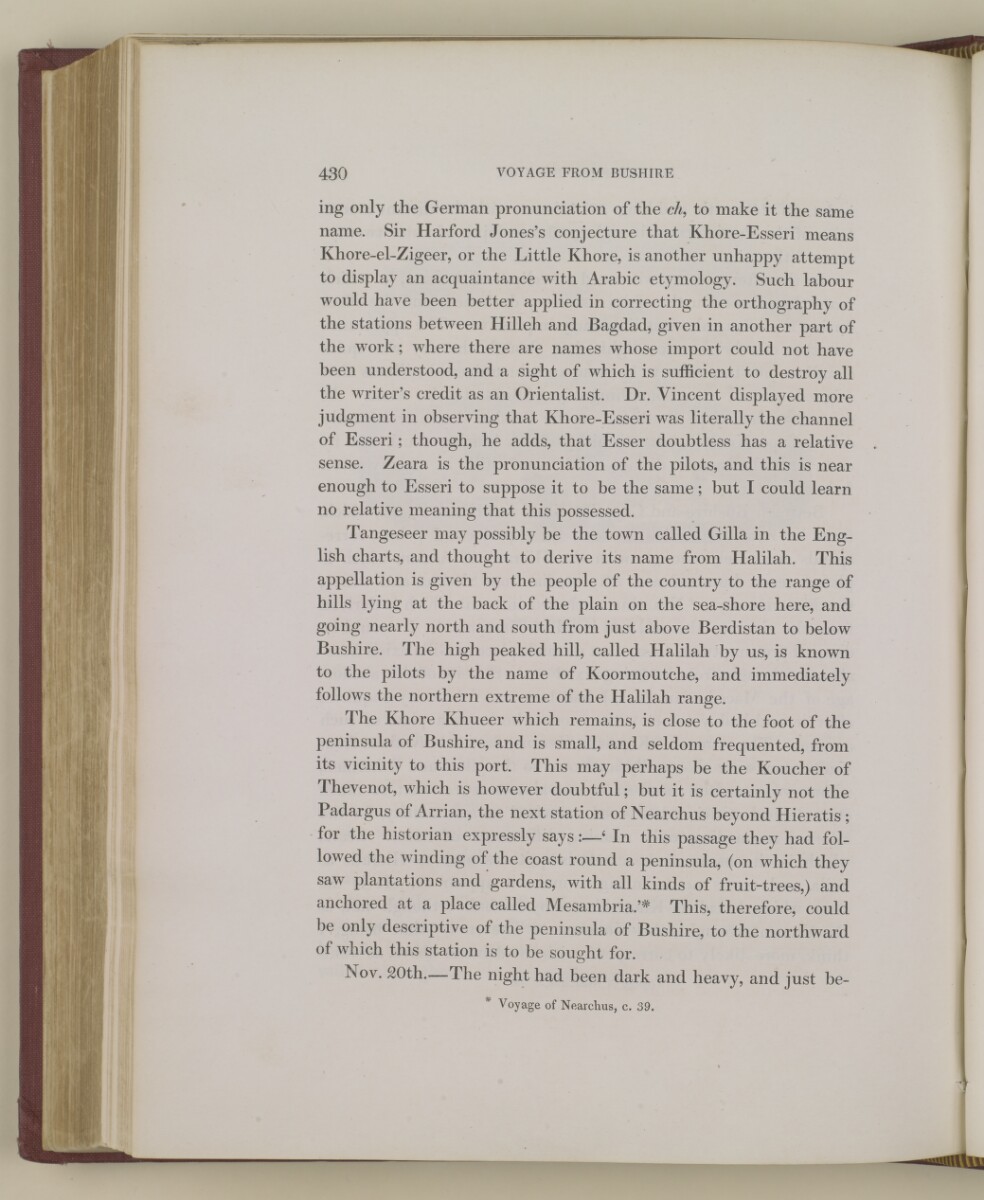
ing only the German pronunciation of the ch, to make it the same
name. Sir Harford Jones's conjecture that Khore-Esseri means
Khore-el-Zigeer, or the Little Khore, is another unhappy attempt
to display an acquaintance with Arabic etymology. Such labour
would have been better applied in correcting the orthography of
the stations between Hilleh and Bagdad, given in another part of
the work; where there are names whose import could not have
been understood, and a sight of which is sufficient to destroy all
the
writer
The lowest of the four classes into which East India Company civil servants were divided. A Writer’s duties originally consisted mostly of copying documents and book-keeping.
's credit as an Orientalist. Dr. Vincent displayed more
judgment in observing that Khore-Esseri was literally the channel
of Esseri; though, he adds, that Esser doubtless has a relative
sense. Zeara is the pronunciation of the pilots, and this is near
enough to Esseri to suppose it to be the same; but I could learn
no relative meaning that this possessed.
Tangeseer may possibly be the town called Gilla in the Eng
lish charts, and thought to derive its name from Halilah. This
appellation is given by the people of the country to the range of
hills lying at the back of the plain on the sea-shore here, and
going nearly north and south from just above Berdistan to below
Bushire. The high peaked hill, called Halilah by us, is known
to the pilots by the name of Koormoutche, and immediately
follows the northern extreme of the Halilah range.
The Khore Khueer which remains, is close to the foot of the
peninsula of Bushire, and is small, and seldom frequented, from
its vicinity to this port. This may perhaps be the Koucher of
Thevenot, which is however doubtful; but it is certainly not the
Padargus of Arrian, the next station of Nearchus beyond Hieratis;
for the historian expressly says:—' In this passage they had fol
lowed the winding of the coast round a peninsula, (on which they
saw plantations and gardens, with all kinds of fruit-trees,) and
anchored at a place called Mesambria.' # This, therefore, could
be only descriptive of the peninsula of Bushire, to the northward
of which this station is to be sought for.
Nov. 20th.—The night had been dark and heavy, and just be-
* Voyage of Nearchus, c. 39.
About this item
- Content
Travels in Assyria, Media, and Persia, including a journey from Bagdad by Mount Zagros, to Hamadan, the ancient Ecbatana, researches in Ispahan and the ruins of Persepolis, and journey from thence by Shiraz and Shapoor to the sea-shore. Description of Bussorah, Bushire, Bahrein, Ormuz, and Muscat, narrative of an expedition against the pirates of the Persian Gulf The historical term used to describe the body of water between the Arabian Peninsula and Iran. , with illustrations of the voyage of Nearchus, and passage by the Arabian Sea to Bombay.
The book is written by James Silk Buckingham and contains illustrations and a map at the beginning, entitled "General map of Persia, with the routes pursued by Mr Buckingham in his travels from Bagdad across the mountains of Zagros, through Assyria, Media & Persia, incuding the chief positions of all the ancient cities & modern towns, from the banks of the Tigris to the shores of the Persian Gulf The historical term used to describe the body of water between the Arabian Peninsula and Iran. " and signed "Sidy. Hall, sculpt."
Buckingham is identified on title page as "author of Travels in Palestine and the countries east of the Jordan; Travels among the Arab tribes; and Travels in Mesopotamia; member of the Literary Societies of Bombay and Madras, and of the Asiatic Society of Bengal." Name of manufacturer from p. ii. Portrait of the author signed as follows: "Drawn and Etched by W.H. Brooke, A.R.H.A." and "Aquatinted by R. Havell Jnr." Dedication to Sir Charles Forbes on p. v. Vignette on p. 545. With publication announcement of the second edition of Buckingham's Travels in Mesopotamia on last unnumbered page.
Publication Details: London : Henry Colburn, New Burlington Street, 1829. Printed by S. and R. Bentley, Dorset Street, Fleet Street.
- Extent and format
- 1 volume (545 pages)
- Arrangement
There is a table of contents at the beginning (vii-xvi) and an index at the end of the volume (539-545).
- Physical characteristics
Dimensions: 283 mm x 220 mm.
Pagination: xvi, 545, [1] p., [2] leaves of plates (1 folded).
- Written in
- English in Latin script View the complete information for this record
Use and share this item
- Share this item
'Travels in Assyria, Media, and Persia, including a journey from Bagdad by Mount Zagros, to Hamadan, the ancient Ecbatana, researches in Ispahan and the ruins of Persepolis, and journey from thence by Shiraz and Shapoor to the sea-shore. Description of Bussorah, Bushire, Bahrein, Ormuz, and Muscat, narrative of an expedition against the pirates of the Persian Gulf, with illustrations of the voyage of Nearchus, and passage by the Arabian Sea to Bombay.' [430] (461/582), British Library: Printed Collections, 567.g.5., in Qatar Digital Library <https://www.qdl.qa/archive/81055/vdc_100023859738.0x00003e> [accessed 17 July 2026]
https://www.qdl.qa/en/archive/81055/vdc_100023859738.0x00003e
Copy and paste the code below into your web page where you would like to embed the image.
<meta charset="utf-8"><a href="https://www.qdl.qa/en/archive/81055/vdc_100023859738.0x00003e">'Travels in Assyria, Media, and Persia, including a journey from Bagdad by Mount Zagros, to Hamadan, the ancient Ecbatana, researches in Ispahan and the ruins of Persepolis, and journey from thence by Shiraz and Shapoor to the sea-shore. Description of Bussorah, Bushire, Bahrein, Ormuz, and Muscat, narrative of an expedition against the pirates of the Persian Gulf, with illustrations of the voyage of Nearchus, and passage by the Arabian Sea to Bombay.' [‎430] (461/582)</a> <a href="https://www.qdl.qa/en/archive/81055/vdc_100023859738.0x00003e"> <img src="https://iiif.qdl.qa/iiif/images/81055/vdc_100023554058.0x000001/567.g.5._0463.jp2/full/!280,240/0/default.jpg" alt="" /> </a>
This record has a IIIF manifest available as follows. If you have a compatible viewer you can drag the icon to load it.https://www.qdl.qa/en/iiif/81055/vdc_100023554058.0x000001/manifestOpen in Universal viewerOpen in Mirador viewerMore options for embedding images
Copyright: How to use this content
- Reference
- 567.g.5.
- Title
- 'Travels in Assyria, Media, and Persia, including a journey from Bagdad by Mount Zagros, to Hamadan, the ancient Ecbatana, researches in Ispahan and the ruins of Persepolis, and journey from thence by Shiraz and Shapoor to the sea-shore. Description of Bussorah, Bushire, Bahrein, Ormuz, and Muscat, narrative of an expedition against the pirates of the Persian Gulf, with illustrations of the voyage of Nearchus, and passage by the Arabian Sea to Bombay.'
- Pages
- front, back, spine, edge, head, tail, front-i, i-r:iii-v, 1:18, 1:546, iv-r:v-v, back-i
- Author
- Buckingham, James Silk
- Usage terms
- Public Domain