
!['Military report on Tehran and adjacent Provinces of North-West Persia (including the Caspian Littoral)' [‎246r] (496/610)](https://iiif.qdl.qa/iiif/images/81055/vdc_100000000239.0x00013d/IOR_L_MIL_17_15_23_0496.jp2/full/!1200,1200/0/default.jpg "'Military report on Tehran and adjacent Provinces of North-West Persia (including the Caspian Littoral)' [‎246r] (496/610)")
'Military report on Tehran and adjacent Provinces of North-West Persia (including the Caspian Littoral)' [246r] (496/610)
The record is made up of 1 volume (301 folios). It was created in 1922. It was written in English. The original is part of the British Library: India Office The department of the British Government to which the Government of India reported between 1858 and 1947. The successor to the Court of Directors. Records and Private Papers Documents collected in a private capacity. .
Transcription
This transcription is created automatically. It may contain errors.
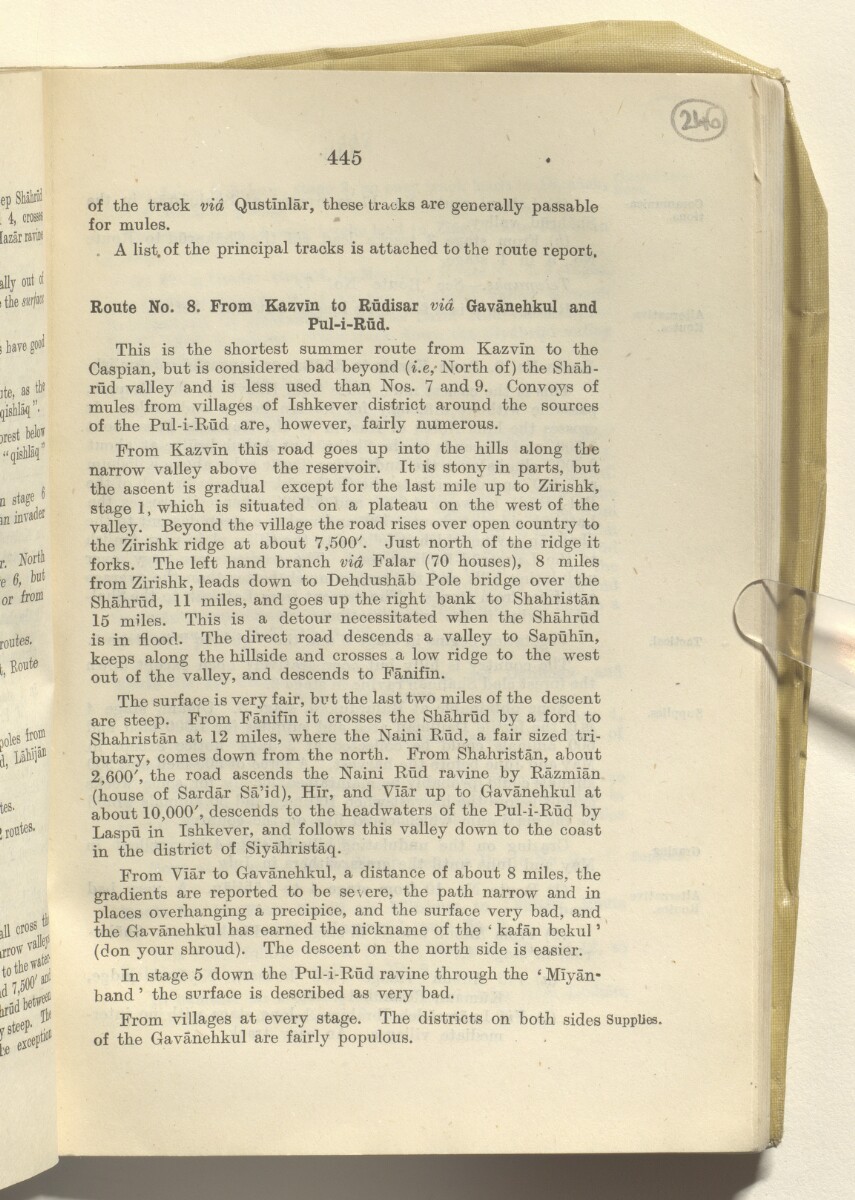
of the track via Qustlnlar, these tracks are generally passable
for mules.
A list, of the principal tracks is attached to the route report.
Route No. 8. From Kazvin to Rudisar via Gavanehkul and
Pul-i-Rud.
This is the shortest summer route from Kazvin to the
Caspian, but is considered bad beyond (i.e,-North of) the Shah-
rud valley and is less used than Nos. 7 and 9. Convoys of
mules from villages of Ishkever district around the sources
of the Pul-i-Rud are, however, fairly numerous.
From Kazvin this road goes up into the hills along the
narrow valley above the reservoir. It is stony in parts, but
the ascent is gradual except for the last mile up to Zirishk,
stage 1 , which is situated on a plateau on the west of the
valley. Beyond the village the road rises over open country to
the Zirishk ridge at about 7,500'. Just north of the ridge it
forks. The left hand branch via Falar (70 houses), 8 miles
from Zirishk, leads down to Dehdushab Pole bridge over the
Shahrud, 11 miles, and goes up the right bank to Shahristan
15 miles. This is a detour necessitated when the Shahrud
is in flood. The direct road descends a valley to Sapuhin,
keeps along the hillside and crosses a low ridge to the west
out of the valley, and descends to Fanifin.
The surface is very fair, but the last two miles of the descent
are steep. From Fanifin it crosses the Shahrud by a ford to
Shahristan at 12 miles, where the Naini Rud, a fair sized tri
butary, comes down from the north. From Shahristan, about
2,600', the road ascends the Naini Rud ravine by Razmian
(house of
Sardar
Leader of a tribe or a polity; also refers to a military rank or title given to a commander of an army or division.
Sa’id), Hir, and Viar up to Gavanehkul at
about 10,000', descends to the headwaters of the Pul-i-Rud by
Laspu in Ishkever, and follows this valley down to the coast
in the district of Siyahristaq.
From Viar to Gavanehkul, a distance of about 8 miles, the
gradients are reported to be severe, the path narrow and in
places overhanging a precipice, and the surface very bad, and
the Gavanehkul has earned the nickname of the ‘ kafan bekul ’
(don your shroud). The descent on the north side is easier.
In stage 5 down the Pul-i-Rud ravine through the £ Miyan-
band ’ the surface is described as very bad.
From villages at every stage. The districts on both sides Supplies,
of the Gavanehkul are fairly populous.
About this item
- Content
Military report compiled by Captain LS Fortescue of the General Staff of the Mesopotamia Expeditionary Force and printed in Calcutta at the Superintendent Government Printing, India, 1922.
The volume begins with a statement defining the geographical area covered by the report. The report is divided into ten chapters, plus appendices, each concerning a different subject, as follows:
- Chapter 1: History
- Chapter 2: Geography
- Chapter 3: Climate, Water, Medical and Aviation
- Chapter 4: Ethnography
- Chapter 5: Administration (including a table of provinces with administrative details (folios 123-30)
- Chapter 6: Armed Forces of the Persian Government
- Chapter 7: Economic Resources
- Chapter 8: Tribes
- Chapter 9: Personalities
- Chapter 10: Communications
- Appendices: Glossary of terms; Weights, measures and coinage; Bibliography; Historical sketch (Chapter 1) continued from June 1920 to the end of 1921
At the back of the volume (folio 302) is a map to illustrate the report.
- Extent and format
- 1 volume (301 folios)
- Arrangement
There is a contents page (folio 5) and list of illustrations (folio 6) at the front of the volume and an index at the back (folios 270-300). All refer to the volume's original pagination. The index also includes map references of all places marked on the map.
- Physical characteristics
Foliation: the foliation sequence (used for referencing) commences at the front cover with 1, and terminates at the inside back cover with 303; these numbers are written in pencil, are circled, and are located in the top right corner of the recto The front of a sheet of paper or leaf, often abbreviated to 'r'. side of each folio.
Pagination: the file also contains an original printed pagination sequence.
- Written in
- English in Latin script View the complete information for this record
Use and share this item
- Share this item
'Military report on Tehran and adjacent Provinces of North-West Persia (including the Caspian Littoral)' [246r] (496/610), British Library: India Office Records and Private Papers, IOR/L/MIL/17/15/23, in Qatar Digital Library <https://www.qdl.qa/archive/81055/vdc_100059348672.0x000061> [accessed 9 July 2026]
https://www.qdl.qa/en/archive/81055/vdc_100059348672.0x000061
Copy and paste the code below into your web page where you would like to embed the image.
<meta charset="utf-8"><a href="https://www.qdl.qa/en/archive/81055/vdc_100059348672.0x000061">'Military report on Tehran and adjacent Provinces of North-West Persia (including the Caspian Littoral)' [‎246r] (496/610)</a> <a href="https://www.qdl.qa/en/archive/81055/vdc_100059348672.0x000061"> <img src="https://iiif.qdl.qa/iiif/images/81055/vdc_100000000239.0x00013d/IOR_L_MIL_17_15_23_0496.jp2/full/!280,240/0/default.jpg" alt="" /> </a>
This record has a IIIF manifest available as follows. If you have a compatible viewer you can drag the icon to load it.https://www.qdl.qa/en/iiif/81055/vdc_100000000239.0x00013d/manifestOpen in Universal viewerOpen in Mirador viewerMore options for embedding images
Copyright: How to use this content
- Reference
- IOR/L/MIL/17/15/23
- Title
- 'Military report on Tehran and adjacent Provinces of North-West Persia (including the Caspian Littoral)'
- Pages
- front, back, spine, edge, head, tail, front-i, 2r:301v, back-i
- Author
- East India Company, the Board of Control, the India Office, or other British Government Department
- Usage terms
- Open Government Licence