
![Letters and Papers Concerning the Trans-Persian Railway and Other Railways in Persia [‎150v] (300/442)](https://iiif.qdl.qa/iiif/images/81055/vdc_100000001491.0x0001bd/Mss Eur F112_252_0304.jp2/full/!1200,1200/0/default.jpg "Letters and Papers Concerning the Trans-Persian Railway and Other Railways in Persia [‎150v] (300/442)")
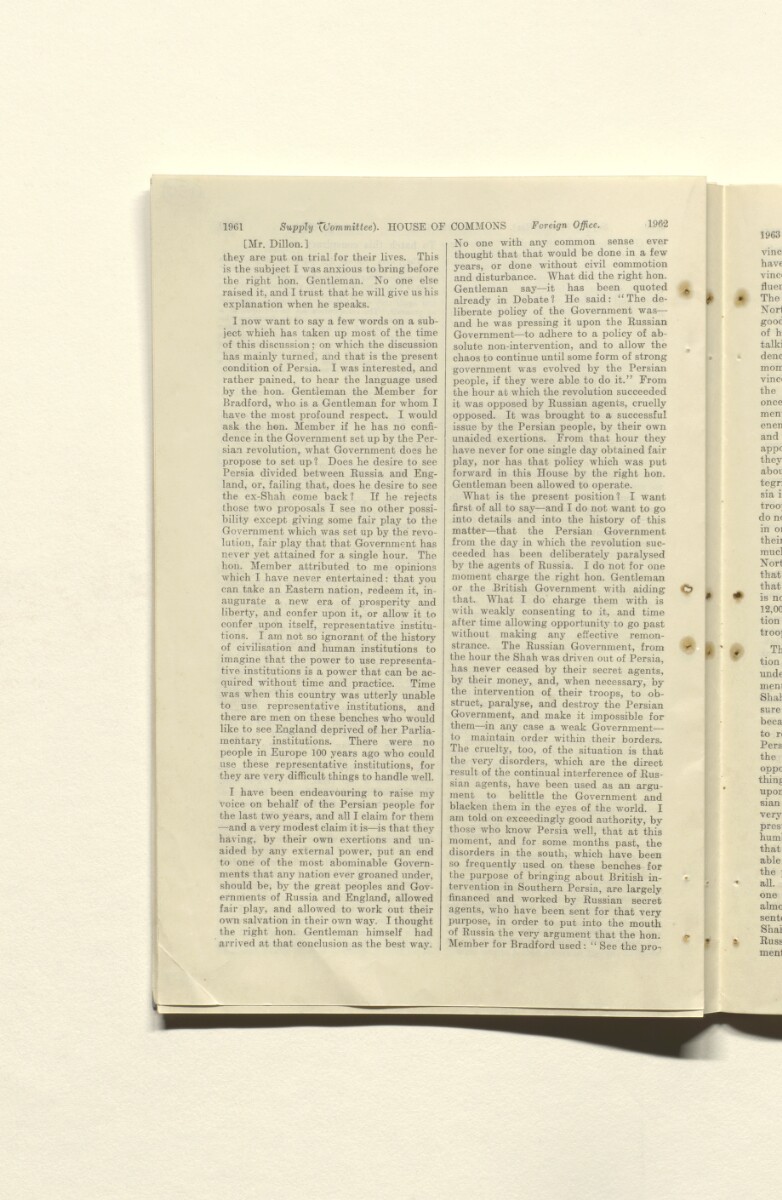
Letters and Papers Concerning the Trans-Persian Railway and Other Railways in Persia [150v] (300/442)
The record is made up of 1 file (221 folios). It was created in Nov 1911-Mar 1917. It was written in English. The original is part of the British Library: India Office The department of the British Government to which the Government of India reported between 1858 and 1947. The successor to the Court of Directors. Records and Private Papers Documents collected in a private capacity. .
Transcription
This transcription is created automatically. It may contain errors.
1961
1962
Supply XVommittee). HOUSE OF COMMONS Foreign Office.
[Mr. Dillon.]
they are put on trial for their lives. This
is the subject I was anxious to bring before
the right hon. Gentleman. No one else
raised it, and I trust that he will give us his
explanation when he speaks.
I now want to say a few words on a sub
ject which has taken up most of the time
of this discussion; on which the discussion
has mainly turned, and that is the present
condition of Persia. I was interested, and
rather pained, to hear the language used
by the hon. Gentleman the Member for
Bradford, who is a Gentleman for whom I
have the most profound respect. I would
ask the hon. Member if he has no confi
dence in the Government set up by the Per
sian revolution, what Government does he
propose to set up ? Does he desire to see
Persia divided between Russia and Eng
land, or, failing that, does he desire to see
the ex-Shah come back? If he rejects
those two proposals I see no other possi
bility except giving some fair play to the
Government which was set up by the revo
lution, fair play that that Government has
never yet attained for a single hour. The
hon. Member attributed to me opinions
which I have never entertained: that you
can take an Eastern nation, redeem it, in
augurate a new era of prosperity and
liberty, and confer upon it, or allow it to
confer upon itself, representative institu
tions. I am not so ignorant of the history
of civilisation and human institutions to
imagine that the power to use representa
tive institutions is a power that can be ac
quired without time and practice. Time
was when this country was utterly unable
to use representative institutions, and
there are men on these benches who would
like to see England deprived of her Parlia
mentary institutions. There were no
people in Europe 100 years ago who could
use these representative institutions, for
they are very difficult things to handle well.
I have been endeavouring to raise my
voice on behalf of the Persian people for
the last two years, and all I claim for them
—and a very modest claim it is—is that they
having, by their own exertions and un
aided by any external power, put an end
to one of the most abominable Govern
ments that any nation ever groaned under,
should be, by the great peoples and Gov
ernments of Russia and England, allowed
fair play, and allowed to work out their
own salvation in their own way. I thought
the right hon. Gentleman himself had
arrived at that conclusion as the best way.
No one with any common sense ever
thought that that would be done in a few
years, or done without civil commotion
and disturbance. What did the right hon.
Gentleman say—it has been quoted
already in Debate? He said: “The de
liberate policy of the Government was—
and he was pressing it upon the Russian
Government—to adhere to a policy of ab
solute non-intervention, and to allow the
chaos to continue until some form of strong
government was evolved by the Persian
people, if they were able to do it.” From
the hour at which the revolution succeeded
it was opposed by Russian agents, cruelly
opposed. It was brought to a successful
issue by the Persian people, by their own
unaided exertions. From that hour they
have never for one single day obtained fair
play, nor has that policy which was put
forward in this House by the right hon.
Gentleman been allowed to operate.
What is the present position? I want
first of all to say—and I do not want to go
into details and into the history of this
matter—that the Persian Government
from the day in which the revolution suc
ceeded has been deliberately paralysed
by the agents of Russia. I do not for one
moment charge the right hon. Gentleman
or the British Government with aiding
that. What I do charge them with is
with weakly consenting to it, and time
after time allowing opportunity to go past
without making any effective remon
strance. The Russian Government, from
the hour the Shah was driven out of Persia,
has never ceased by their secret agents,
by their money, and, when necessary, by
the intervention of their troops, to ob
struct, paralyse, and destroy the Persian
Government, and make it impossible for
them—in any case a weak Government—
to maintain order within their borders.
The cruelty, too, of the situation is that
the very disorders, which are the direct
result of the continual interference of Rus
sian agents, have been used as an argu
ment to belittle the Government and
blacken them in the eyes of the world. I
am told on exceedingly good authority, by
those who know Persia well, that at this
moment, and for some months past, the
disorders in the south, which have been
so frequently used on these benches for
the purpose of bringing about British in
tervention in Southern Persia, are largely
financed and worked by Russian secret
agents, who have been sent for that very
purpose, in order to put into the mouth
of Russia the very argument that the hon.
Member for Bradford used: “ See the pro
ir
About this item
- Content
The file contains correspondence, memoranda, and other papers relating to railway projects in Persia [Iran] and the surrounding region. The papers deal with the proposals for, planning, and progress of, several railway lines, including one from the Mediterranean to India, the Trans-Persian Railway, the Baghdad Railway, and the Nushki and Dalbandin extension from Quetta. The documents discuss the merits and flaws of the proposals, technical issues such as gauge sizes, and the impact of such projects on Britain's relations with Russia, Germany, France, and Turkey.
At the back of the file are a number of official reports on Parliamentary debates within the House of Commons, dating from 10 July 1912 to 25 May 1914, all of which feature railways (folios 128-218). Also at the rear of the file are three maps:
- General Map of Asia with proposed British, German, and Russian rail lines added by hand
- War Office map of the Middle East, showing railways and railway projects
- As above with further rail lines added and details of gauges given.
Correspondents include: Arthur Campbell Yate, army Officer; Henry McNiel; Francis Richard Maunsell, army officer; George Lloyd, politician; Lieutenant-Colonel Charles à Court Repington, army officer and war correspondent; Lord Robert Offley Ashburton Crewe-Milnes, Leader of the House of Lords; Henry Charles Keith Petty-Fitzmaurice (Lord Lansdowne), statesman; Lucien Wolf, journalist and historian; Charles Staniforth, businessman and railway investor; Charles Prestwich Scott, Editor of the Manchester Guardian; Hugh Shakespear Barnes, Director, Imperial Bank of Persia; and Colonel Frank Cooke Webb Ware, former Political Agent A mid-ranking political representative (equivalent to a Consul) from the diplomatic corps of the Government of India or one of its subordinate provincial governments, in charge of a Political Agency. , Chagai.
- Extent and format
- 1 file (221 folios)
- Arrangement
The file is arranged in chronological order from the front to the rear.
- Physical characteristics
Foliation: the foliation sequence (used for referencing) commences at the first folio with 1, and terminates at the last folio with 221; these numbers are written in pencil, are circled, and are located in the top right corner of the recto The front of a sheet of paper or leaf, often abbreviated to 'r'. side of each folio.
- Written in
- English in Latin script View the complete information for this record
Use and share this item
- Share this item
Letters and Papers Concerning the Trans-Persian Railway and Other Railways in Persia [150v] (300/442), British Library: India Office Records and Private Papers, Mss Eur F112/252, in Qatar Digital Library <https://www.qdl.qa/archive/81055/vdc_100075113116.0x000065> [accessed 26 August 2026]
https://www.qdl.qa/en/archive/81055/vdc_100075113116.0x000065
Copy and paste the code below into your web page where you would like to embed the image.
<meta charset="utf-8"><a href="https://www.qdl.qa/en/archive/81055/vdc_100075113116.0x000065">Letters and Papers Concerning the Trans-Persian Railway and Other Railways in Persia [‎150v] (300/442)</a> <a href="https://www.qdl.qa/en/archive/81055/vdc_100075113116.0x000065"> <img src="https://iiif.qdl.qa/iiif/images/81055/vdc_100000001491.0x0001bd/Mss Eur F112_252_0304.jp2/full/!280,240/0/default.jpg" alt="" /> </a>
This record has a IIIF manifest available as follows. If you have a compatible viewer you can drag the icon to load it.https://www.qdl.qa/en/iiif/81055/vdc_100000001491.0x0001bd/manifestOpen in Universal viewerOpen in Mirador viewerMore options for embedding images
Copyright: How to use this content
- Reference
- Mss Eur F112/252
- Title
- Letters and Papers Concerning the Trans-Persian Railway and Other Railways in Persia
- Pages
- 87r:90v, 95r:221v
- Author
- East India Company, the Board of Control, the India Office, or other British Government Department
- Usage terms
- Open Government Licence