
!['General information on Persia for any future edition, 1895' [‎32r] (57/211)](https://iiif.qdl.qa/iiif/images/81055/vdc_100000001491.0x00033d/Mss Eur F111_67_0059.jp2/full/!1200,1200/0/default.jpg "'General information on Persia for any future edition, 1895' [‎32r] (57/211)")
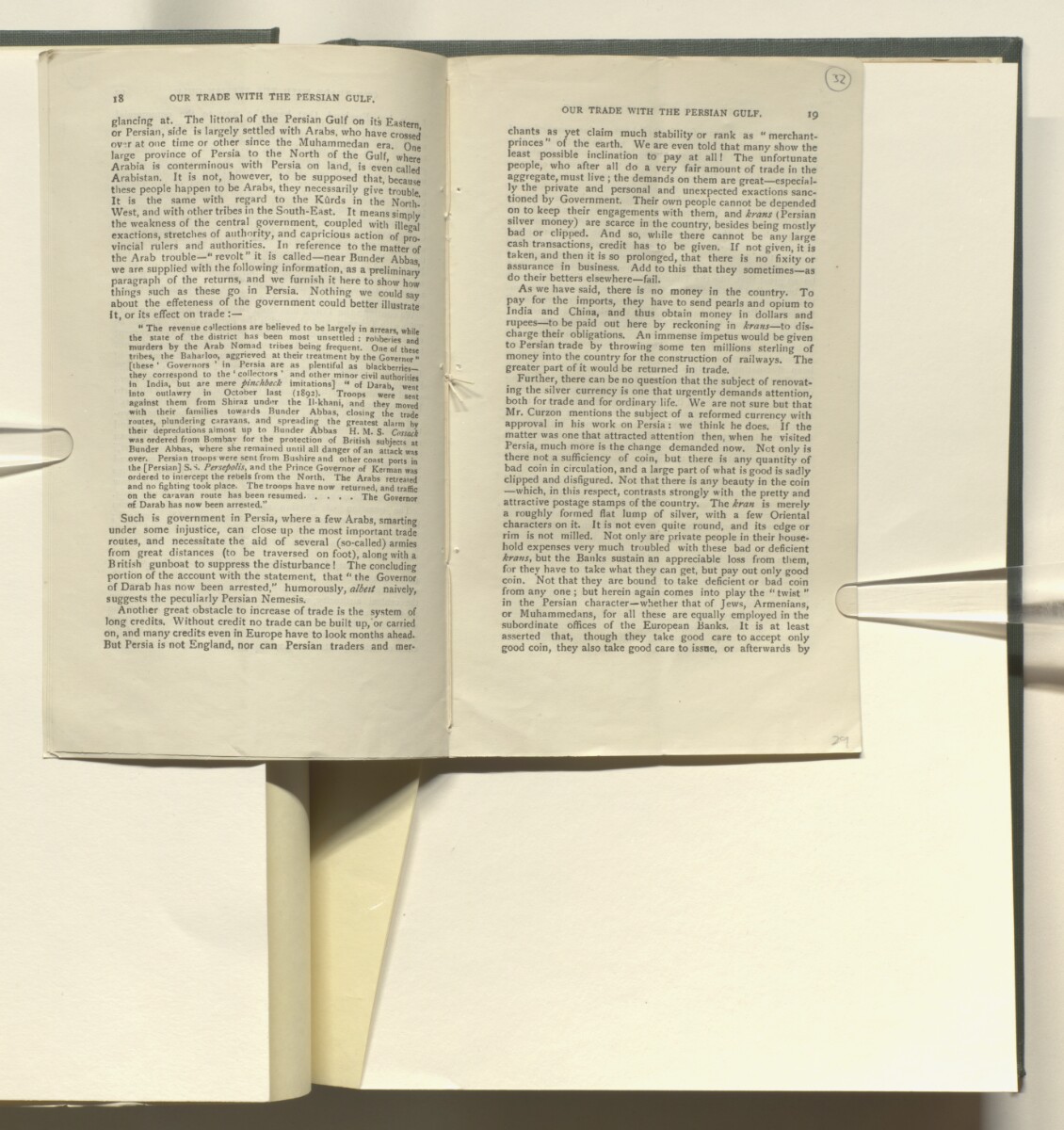
'General information on Persia for any future edition, 1895' [32r] (57/211)
The record is made up of 1 volume (109 folios). It was created in c 1892-1895. It was written in English. The original is part of the British Library: India Office The department of the British Government to which the Government of India reported between 1858 and 1947. The successor to the Court of Directors. Records and Private Papers Documents collected in a private capacity. .
Transcription
This transcription is created automatically. It may contain errors.
i8
OUR TRADE WITH THE
PERSIAN GULF
The historical term used to describe the body of water between the Arabian Peninsula and Iran.
.
glancing at. The littoral of the
Persian Gulf
The historical term used to describe the body of water between the Arabian Peninsula and Iran.
on its Eastern
or Persian, side is largely settled with Arabs, who have crossed
ov^r at one time or other since the Muhammedan era. One
large province of Persia to the North of the Gulf, where
Arabia is conterminous with Persia on land, is even called
Arabistan. It is not, however, to be supposed that, because
these people happen to be Arabs, they necessarily give trouble
It is the same with regard to the Ktirds in the North-
West, and with other tribes in the South-East. It means simply
the weakness of the central government, coupled with illegal
exactions, stretches of authority, and capricious action of pro
vincial rulers and authorities. In reference to the matter of
the Arab trouble—“ revolt ” it is called—near Bunder Abbas
we are supplied with the following information, as a preliminary
paragraph of the returns, and we furnish it here to show how
things such as these go in Persia. Nothing we could say
about the effeteness of the government could better illustrate
it, or its effect on trade :—
“ The revemie collections are believed to be largely in arrears, while
the state of the district has been most unsettled : robberies and
murders by the Arab Nomad tribes being frequent. One of these
tribes, the Baharloo, aggrieved at their treatment by the Governor ^
[these * Governors ’ in Persia are as plentiful as blackberries—
they correspond to the ‘ collectors ’ and other minor civil authorities
in India, but are mere pinchbeck imitations] “ of Darab, went
into outlawry in October last (1892). Troops were sent
against them from Shiraz und<?r the Il-khani, and they moved
with their families towards Bunder Abbas, closing th e trade
routes, plundering caravans, and spreading the greatest alarm bv
their depredations almost up to Bunder Abbas H. M. S- Cossack
was ordered from Bombay for the protection of British subjects at
Bunder Abbas, where she remained until all danger of an attack was
over. Persian troops were sent from Bushire and other coast ports in
the [Persian] S.S. Persepolis, and the
Prince Governor
A Prince of the Royal line who also acted as Governor of a large Iranian province during the Qājār period (1794-1925).
of Kerman was
ordered to intercept the rebels from the North. The Arabs retreated
and no fighting took place. The troops have now returned, and traffic
on the caravan route has been resumed The Governor
of Darab has now been arrested.”
Such is government in Persia, where a few Arabs, smarting
under some injustice, can close up the most important trade
routes, and necessitate the aid of several (so-called) armies
from great distances (to be traversed on foot), along with a
British gunboat to suppress the disturbance ! The concluding
portion of the account with the statement, that “ the Governor
of Darab has now been arrested," humorously, albeit naively,
suggests the peculiarly Persian Nemesis.
Another great obstacle to increase of trade is the system of
long credits. Without credit no trade can be built up, or carried
on, and many credits even in Europe have to look months ahead.
But Persia is not England, nor can Persian traders and mer-
OUR TRADE WITH THE
PERSIAN GULF
The historical term used to describe the body of water between the Arabian Peninsula and Iran.
. 19
chants as yet claim much stability or rank as M merchant-
princes of the earth. We are even told that many show the
least possible inclination to pay at all I The unfortunate
people, who after all do a very fair amount of trade in the
mu st live ; the demands on them are great—especial-
ly the private and personal and unexpected exactions sanc
tioned by Government. Their own people cannot be depended
on to keep their engagements with them, and/W j (Persian
silver money) are scarce in the country, besides being mostly
bad or clipped. And so, while there cannot be any large
cash transactions, credit has to be given. If not given, it is
taken, and then it is so prolonged, that there is no fixity or
assurance in business. Add to this that they sometimes—as
do their betters elsewhere—fail.
As we have said, there is no money in the country. To
pay for the imports, they have to send pearls and opium to
India and China, and thus obtain money in dollars and
rupees—to be paid out here by reckoning in krans —to dis
charge their obligations. An immense impetus would be given
to Persian trade by throwing some ten millions sterling of
money into the country for the construction of railways. The
greater part of it would be returned in trade.
Further, there can be no question that the subject of renovat
ing the silver currency is one that urgently demands attention,
both for trade and for ordinary life. We are not sure but that
Mr. Curzon mentions the subject of a reformed currency with
approval in his work on Persia: we think he does. If the
matter was one that attracted attention then, when he visited
Persia, much more is the change demanded now. Not only is
there not a sufficiency of coin, but there is any quantity of
bad coin in circulation, and a large part of what is good is sadly
clipped and disfigured. Not that there is any beauty in the coin
—which, in this respect, contrasts strongly with the pretty and
attractive postage stamps of the country. The kran is merely
a roughly formed flat lump of silver, with a few Oriental
characters on it. It is not even quite round, and its edge or
rim is not milled. Not only are private people in their house
hold expenses very much troubled with these bad or deficient
krans, but the Banks sustain an appreciable loss from them,
for they have to take what they can get, but pay out only good
coin. Not that they are bound to take deficient or bad coin
from any one ; but herein again comes into play the “ twist ”
in the Persian character—whether that of Jews, Armenians,
or Muhammedans, for all these are equally employed in the
subordinate offices of the European Banks. It is at least
asserted that, though they take good care to accept only
good coin, they also take good care to issue, or afterwards by
About this item
- Content
This volume consists of an envelope of notes and printed papers that make up some ancillary materials collected by George Curzon at the time of the publication of his book, Persia and the Persian Question . The notes consist of official correspondence on Persia from the British Government, archaeological surveys, and more recent published material on the trade and regional affairs of Persia, particularly the ports of the Persian Gulf The historical term used to describe the body of water between the Arabian Peninsula and Iran. and its trade with India. The papers were originally kept in a large envelope, which is found at the back of the volume.
- Extent and format
- 1 volume (109 folios)
- Arrangement
The papers appear in no discernible order.
- Physical characteristics
Foliation: the foliation sequence (used for referencing) commences at the inside front cover with 1, and terminates at the inside back cover with 111; these numbers are written in pencil, are circled, and are located in the top right corner of the recto The front of a sheet of paper or leaf, often abbreviated to 'r'. side of each folio.
- Written in
- English in Latin script View the complete information for this record
Use and share this item
- Share this item
'General information on Persia for any future edition, 1895' [32r] (57/211), British Library: India Office Records and Private Papers, Mss Eur F111/67, in Qatar Digital Library <https://www.qdl.qa/archive/81055/vdc_100076639076.0x00003a> [accessed 19 June 2026]
https://www.qdl.qa/en/archive/81055/vdc_100076639076.0x00003a
Copy and paste the code below into your web page where you would like to embed the image.
<meta charset="utf-8"><a href="https://www.qdl.qa/en/archive/81055/vdc_100076639076.0x00003a">'General information on Persia for any future edition, 1895' [‎32r] (57/211)</a> <a href="https://www.qdl.qa/en/archive/81055/vdc_100076639076.0x00003a"> <img src="https://iiif.qdl.qa/iiif/images/81055/vdc_100000001491.0x00033d/Mss Eur F111_67_0059.jp2/full/!280,240/0/default.jpg" alt="" /> </a>
This record has a IIIF manifest available as follows. If you have a compatible viewer you can drag the icon to load it.https://www.qdl.qa/en/iiif/81055/vdc_100000001491.0x00033d/manifestOpen in Universal viewerOpen in Mirador viewerMore options for embedding images
Copyright: How to use this content
- Reference
- Mss Eur F111/67
- Title
- 'General information on Persia for any future edition, 1895'
- Pages
- 23r, 24r:28r, 29r, 30r, 31r, 32r, 33r, 34r, 35r:35v
- Author
- The Calcutta Review
- Usage terms
- Public Domain