
![File of printed papers marked 'Egyptian negotiation' between Curzon and Adly Pasha and the Egyptian delegation [‎38v] (76/178)](https://iiif.qdl.qa/iiif/images/81055/vdc_100000001491.0x000296/Mss Eur F112_261_0076.jp2/full/!1200,1200/0/default.jpg "File of printed papers marked 'Egyptian negotiation' between Curzon and Adly Pasha and the Egyptian delegation [‎38v] (76/178)")
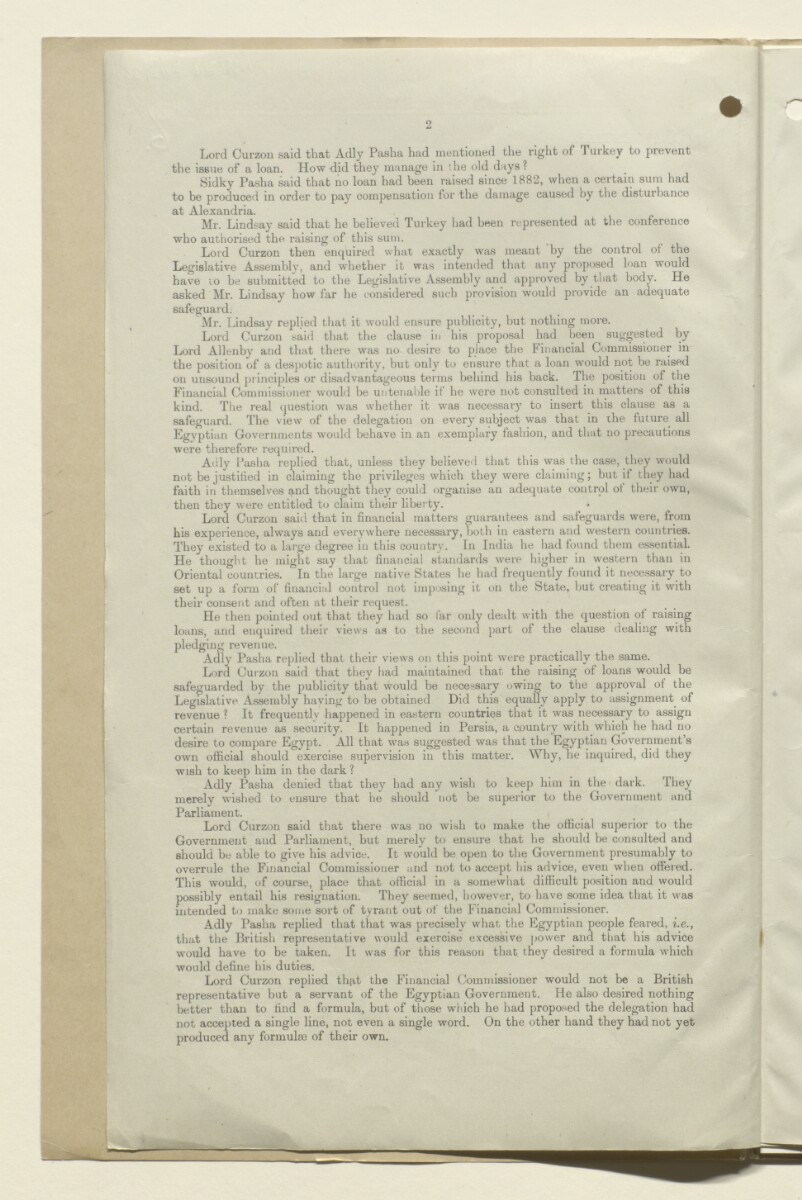
File of printed papers marked 'Egyptian negotiation' between Curzon and Adly Pasha and the Egyptian delegation [38v] (76/178)
The record is made up of 1 file (87 folios). It was created in 13 Jul 1921-4 Jan 1923. It was written in English. The original is part of the British Library: India Office The department of the British Government to which the Government of India reported between 1858 and 1947. The successor to the Court of Directors. Records and Private Papers Documents collected in a private capacity. .
Transcription
This transcription is created automatically. It may contain errors.
Lord Curzon said that Adly
Pasha
An Ottoman title used after the names of certain provincial governors, high-ranking officials and military commanders.
had mentioned the right of Turkey to prevent
the issue of a loan. How did they manage in die old days?
Sidky
Pasha
An Ottoman title used after the names of certain provincial governors, high-ranking officials and military commanders.
said that no loan had been raised since 188*2, when a certain sum had
to be produced in order to pay compensation for the damage caused by the disturbance
at Alexandria.
Mr. Lindsay said that he believed Turkey had been represented at the conference
who authorised the raising of this sum.
Lord Curzon then enquired what exactly was meant by the control of the
Legislative Assembly, and whether it was intended that any proposed loan would
have to be submitted to the Legislative Assembly and approved by tnat body. He
asked Mr. Lindsay how far he considered such provision would provide an adequate
safeguard.
Mr. Lindsay replied that it would ensure publicity, but nothing more.
Lord Curzon said that the clause in his proposal had been suggested by
Lord Allenby and that there was no desire to place the Financial Commissioner in
the position of a despotic authority, but only to ensure that a loan would not be raised
on unsound principles or disadvantageous terms behind his back. The position of the
Financial Commissioner would be untenable it he were not consulted in matters of this
kind. The real question was whether it was necessary to insert this clause as a
safeguard. The view of the delegation on every subject was that in the future all
Egyptian Governments would behave in an exemplary fashion, and that no precautions
were therefore required.
Adly
Pasha
An Ottoman title used after the names of certain provincial governors, high-ranking officials and military commanders.
replied that, unless they believed that this was the case, they would
not be justified in claiming the privileges which they were claiming; but if they had
faith in themselves and thought they could organise an adequate control of their own,
then they were entitled to claim their liberty.
Lord Curzon said that in financial matters guarantees and safeguards were, from
his experience, always and everywhere necessary, both in eastern and western countries.
They existed to a large degree in this country. In India he had found them essential.
He thought he might say that financial standards were higher in western than in
Oriental countries. In the large native States he had frequently found it necessary to
set up a form of financial control not imposing it on the State, but creating it with
their consent and often at their request.
He then pointed out that they had so far only dealt with the question of raising
loans, and enquired their views as to the second part of the clause dealing with
pledging revenue.
Adly
Pasha
An Ottoman title used after the names of certain provincial governors, high-ranking officials and military commanders.
replied that their views on this point were practically the same.
Lord Curzon said that they had maintained that the raising of loans would be
safeguarded by the publicity that would be necessary owing to the approval of the
Legislative Assembly having to be obtained Did this equally apply to assignment of
revenue ? It frequently happened in eastern countries that it was necessary to assign
certain revenue as security. It happened in Persia, a country with which he had no
desire to compare Egypt. All that was suggested was that the Egyptian Government’s
own official should exercise supervision in this matter. Why, he inquired, did they
wish to keep him in the dark ?
Adly
Pasha
An Ottoman title used after the names of certain provincial governors, high-ranking officials and military commanders.
denied that they had any wish to keep him in the dark. They
merely wished to ensure that he should not be superior to the Government and
Parliament.
Lord Curzon said that there was no wish to make the official superior to the
Government and Parliament, but merely to ensure that he should be consulted and
should be able to give his advice. It would be open to the Government presumably to
overrule the Financial Commissioner and not to accept his advice, even when offered.
This would, of course, place that official in a somewhat difficult position and would
possibly entail his resignation. They seemed, however, to have some idea that it was
intended to make some sort of tyrant out of the Financial Commissioner.
Adly
Pasha
An Ottoman title used after the names of certain provincial governors, high-ranking officials and military commanders.
replied that that was precisely what the Egyptian people feared, i.e.,
that the British representative would exercise excessive power and that his advice
would have to be taken. It was for this reason that they desired a formula which
would define his duties.
Lord Curzon replied that the Financial Commissioner would not be a British
representative but a servant of the Egyptian Government. He also desired nothing
better than to find a formula, but of those which he had proposed the delegation had
not accepted a single line, not even a single word. On the other hand they had not yet
produced any formulae of their own.
About this item
- Content
The file contains correspondence, minutes, and memoranda relating to negotiations between the British and Egyptian governments over Egyptian independence. Most of the file consists of minutes of conferences that took place at the Foreign Office during July and August 1921. These conferences involved an Egyptian delegation, led by Sir Adly Yeghen [Yakan] Pasha An Ottoman title used after the names of certain provincial governors, high-ranking officials and military commanders. , and the British, led by the Secretary of State for Foreign Affairs, Lord George Nathaniel Curzon. Matters covered in these meetings included: the termination of the British Protectorate, Britain's military presence, foreign relations, legislation, employment of foreign officials, financial and judicial control, Soudan [Sudan], the Suez Canal, communication rights, protection of minorities, retirement and compensation of British officials, and diplomatic relations between the two countries.
Also contained within the file are minutes by Ronald Charles Lindsay and John Murray, both Foreign Office officials, and correspondence between Curzon, Lindsay, Adly Pasha An Ottoman title used after the names of certain provincial governors, high-ranking officials and military commanders. , and Field Marshal Edmund Henry Hynman Allenby, High Commissioner for Egypt and Sudan. These papers all concern matters covered by the negotiations.
Documents of note include a copy of the Report of the Special Mission to Egypt, dated 9 December 1920 (folios 4-23), and a memorandum on the political situation in Egypt by John Murray, dated 4 January 1923 (folios 74-87).
- Extent and format
- 1 file (87 folios)
- Arrangement
The file is arranged in rough chronological order, from the front to the rear. On the inside front cover is a manuscript index with a numbered list of the file's contents.
- Physical characteristics
Foliation: the main foliation sequence (used for referencing) commences at the front cover with 1, and terminates at the inside back cover with 89; these numbers are written in pencil, are circled, and are located in the top right corner of the recto The front of a sheet of paper or leaf, often abbreviated to 'r'. side of each folio. An additional foliation sequence is present in parallel between ff 2-87; these numbers are also written in pencil, but are not circled.
Pagination: the file also contains an original printed pagination sequence.
- Written in
- English in Latin script View the complete information for this record
Use and share this item
- Share this item
File of printed papers marked 'Egyptian negotiation' between Curzon and Adly Pasha and the Egyptian delegation [38v] (76/178), British Library: India Office Records and Private Papers, Mss Eur F112/261, in Qatar Digital Library <https://www.qdl.qa/archive/81055/vdc_100077019155.0x00004d> [accessed 27 July 2026]
https://www.qdl.qa/en/archive/81055/vdc_100077019155.0x00004d
Copy and paste the code below into your web page where you would like to embed the image.
<meta charset="utf-8"><a href="https://www.qdl.qa/en/archive/81055/vdc_100077019155.0x00004d">File of printed papers marked 'Egyptian negotiation' between Curzon and Adly Pasha and the Egyptian delegation [‎38v] (76/178)</a> <a href="https://www.qdl.qa/en/archive/81055/vdc_100077019155.0x00004d"> <img src="https://iiif.qdl.qa/iiif/images/81055/vdc_100000001491.0x000296/Mss Eur F112_261_0076.jp2/full/!280,240/0/default.jpg" alt="" /> </a>
This record has a IIIF manifest available as follows. If you have a compatible viewer you can drag the icon to load it.https://www.qdl.qa/en/iiif/81055/vdc_100000001491.0x000296/manifestOpen in Universal viewerOpen in Mirador viewerMore options for embedding images
Copyright: How to use this content
- Reference
- Mss Eur F112/261
- Title
- File of printed papers marked 'Egyptian negotiation' between Curzon and Adly Pasha and the Egyptian delegation
- Pages
- front, front-i, 2r:24v, 27r:40v, 46r:53v, 55r:59v, 62r:62v, 64r, 65r, 66r:67v, 71r:85v, 88r:88v, back-i, back
- Author
- East India Company, the Board of Control, the India Office, or other British Government Department
- Usage terms
- Open Government Licence