
![Report of the Special Mission to Egypt under Lord Milner, and related papers [‎11v] (22/473)](https://iiif.qdl.qa/iiif/images/81055/vdc_100000001491.0x000295/Mss Eur F112_260_0022.jp2/full/!1200,1200/0/default.jpg "Report of the Special Mission to Egypt under Lord Milner, and related papers [‎11v] (22/473)")
Report of the Special Mission to Egypt under Lord Milner, and related papers [11v] (22/473)
The record is made up of 1 file (237 folios). It was created in 15 May 1920-14 Oct 1921. It was written in English. The original is part of the British Library: India Office The department of the British Government to which the Government of India reported between 1858 and 1947. The successor to the Court of Directors. Records and Private Papers Documents collected in a private capacity. .
Transcription
This transcription is created automatically. It may contain errors.
2
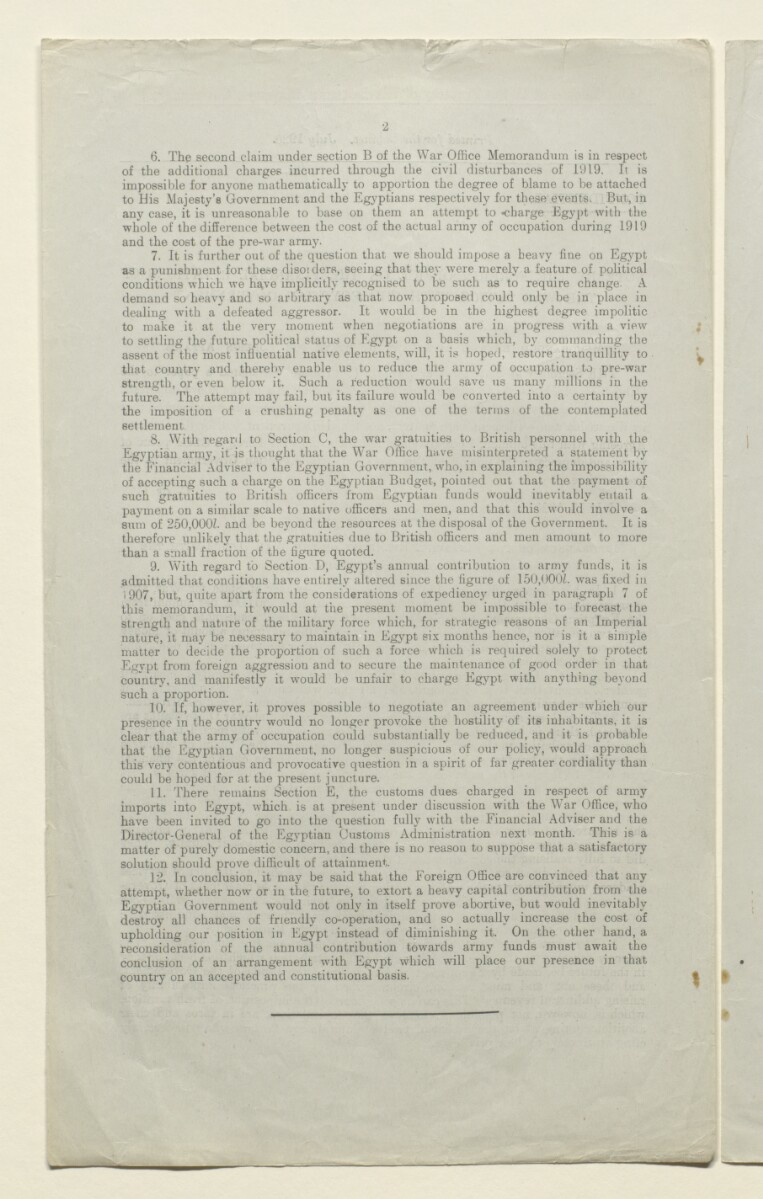
6. The second claim under section B of the War Office Memorandum is in respect
of the additional charges incurred through the civil disturbances of 1919. It is
impossible for anyone mathematically to apportion the degree of blame to be attached
to His Majesty’s Government and the Egyptians respectively for these events. But, in
any case, it is unreasonable to base on them an attempt to -charge Egypt with the
whole of the difference between the cost of the actual army of occupation during 1919
and the cost of the pre-war army.
7. It is further out of the question that we should impose a heavy fine on Egypt
as a punishment for these disoiders, seeing that they were merely a feature of political
conditions which we have implicitly recognised to be such as to require change. A
demand so heavy and so arbitrary as that now proposed could only be in place in
dealing with a defeated aggressor. It would be in the highest degree impolitic
to make it at the very moment when negotiations are in progress with a view
to settling the future political status of Egypt on a basis which, by commanding the
assent of the most influential native elements, will, it is hoped, restore tranquillity to
that country and thereby enable us to reduce the army of occupation to pre-war
strength, or even below it. Such a reduction would save us many millions in the
future. The attempt may fail, but its failure would be converted into a certainty by
the imposition of a crushing penalty as one of the terms of the contemplated
settlement.
8. With regard to Section C, the war gratuities to British personnel with the
Egyptian army, it is thought that the War Office have misinterpreted a statement by
the Financial Adviser to the Egyptian Government, who, in explaining the impossibility
of accepting such a charge on the Egyptian Budget, pointed out that the payment of
such gratuities to British officers from Egyptian funds would inevitably entail a
payment on a similar scale to native officers and men, and that this would involve a
sum of 250,000Z. and be beyond the resources at the disposal of the Government. It is
therefore unlikely that the gratuities due to British officers and men amount to more
than a small fraction of the figure quoted.
9. With regard to Section D, Egypt’s annual contribution to army funds, it is
admitted that conditions have entirely altered since the figure of 150,000Z. was fixed in
1907, but, quite apart from the considerations of expediency urged in paragraph 7 of
this memorandum, it would at the present moment be impossible to forecast the
strength and nature of the military force which, for strategic reasons of an Imperial
nature, it may be necessary to maintain in Egypt six months hence, nor is it a simple
matter to decide the proportion of such a force which is required solely to protect
Egypt from foreign aggression and to secure the maintenance of good order in that
country, and manifestly it would be unfair to charge Egypt with anything beyond
such a proportion.
10. If, however, it proves possible to negotiate an agreement under which our
presence in the country would no longer provoke the hostility of its inhabitants, it is
clear that the army of occupation could substantially be reduced, and it is probable
that the Egyptian Government, no longer suspicious of our policy, would approach
this very contentious and provocative question in a spirit of far greater cordiality than
could be hoped for at the present juncture.
11. There remains Section E, the customs dues charged in respect of army
imports into Egypt, which is at present under discussion with the W ar Office, who
have been invited to go into the question fully with the Financial Adviser and the
Director-General of the Egyptian Customs Administration next month. This is a
matter of purely domestic concern, and there is no reason to suppose that a satisfactory
solution should prove difficult of attainment.
12. In conclusion, it may be said that the Foreign Office are convinced that any
attempt, whether now or in the future, to extort a heavy capital contribution from the
Egyptian Government would not only in itself prove abortive, but would inevitably
destroy all chances of friendly co-operation, and so actually increase the cost of
upholding our position in Egypt instead of diminishing it. On the other hand, a
reconsideration of the annual contribution towards army funds must await the
conclusion of an arrangement with Egypt which will place our presence in that
country on an accepted and constitutional basis.
About this item
- Content
The file contains official correspondence, memoranda, and reports relating to political affairs in Egypt. The correspondents and authors are officials at the Foreign Office (Lord Curzon was Secretary of State for Foreign Affairs at the time), War Office, Air Ministry, Admiralty, Colonial Office, Board of Trade, Board of Education, as well as those within the Egyptian civil service.
The file contains copies of reports of the Special Mission to Egypt (folios 1-7, 75-93, and 175-194), led by Lord Alfred Milner, whose purpose was to investigate and advise following the Egyptian Revolution of 1919. Much of the content of the file is in response to the findings and recommendations of the Mission and discusses the possibilities of a political settlement with Egypt.
- Extent and format
- 1 file (237 folios)
- Arrangement
The file is arranged in chronological order, from the front to the rear.
- Physical characteristics
Foliation: the foliation sequence (used for referencing) commences at the front cover with 1, and terminates at the inside back cover with 235; these numbers are written in pencil, are circled, and are located in the top right corner of the recto The front of a sheet of paper or leaf, often abbreviated to 'r'. side of each folio. The file has one foliation anomaly, f 76a.
- Written in
- English in Latin script View the complete information for this record
Use and share this item
- Share this item
Report of the Special Mission to Egypt under Lord Milner, and related papers [11v] (22/473), British Library: India Office Records and Private Papers, Mss Eur F112/260, in Qatar Digital Library <https://www.qdl.qa/archive/81055/vdc_100080131819.0x000017> [accessed 4 June 2026]
https://www.qdl.qa/en/archive/81055/vdc_100080131819.0x000017
Copy and paste the code below into your web page where you would like to embed the image.
<meta charset="utf-8"><a href="https://www.qdl.qa/en/archive/81055/vdc_100080131819.0x000017">Report of the Special Mission to Egypt under Lord Milner, and related papers [‎11v] (22/473)</a> <a href="https://www.qdl.qa/en/archive/81055/vdc_100080131819.0x000017"> <img src="https://iiif.qdl.qa/iiif/images/81055/vdc_100000001491.0x000295/Mss Eur F112_260_0022.jp2/full/!280,240/0/default.jpg" alt="" /> </a>
This record has a IIIF manifest available as follows. If you have a compatible viewer you can drag the icon to load it.https://www.qdl.qa/en/iiif/81055/vdc_100000001491.0x000295/manifestOpen in Universal viewerOpen in Mirador viewerMore options for embedding images
Copyright: How to use this content
- Reference
- Mss Eur F112/260
- Title
- Report of the Special Mission to Egypt under Lord Milner, and related papers
- Pages
- front, front-i, 2r:39v, 42r:50v, 53r:76v, 76ar:76av, 77r:140v, 143r:143v, 144ar, 144r:235v
- Author
- East India Company, the Board of Control, the India Office, or other British Government Department
- Usage terms
- Open Government Licence