
![Report of the Special Mission to Egypt under Lord Milner, and related papers [‎28v] (56/473)](https://iiif.qdl.qa/iiif/images/81055/vdc_100000001491.0x000295/Mss Eur F112_260_0056.jp2/full/!1200,1200/0/default.jpg "Report of the Special Mission to Egypt under Lord Milner, and related papers [‎28v] (56/473)")
Report of the Special Mission to Egypt under Lord Milner, and related papers [28v] (56/473)
The record is made up of 1 file (237 folios). It was created in 15 May 1920-14 Oct 1921. It was written in English. The original is part of the British Library: India Office The department of the British Government to which the Government of India reported between 1858 and 1947. The successor to the Court of Directors. Records and Private Papers Documents collected in a private capacity. .
Transcription
This transcription is created automatically. It may contain errors.
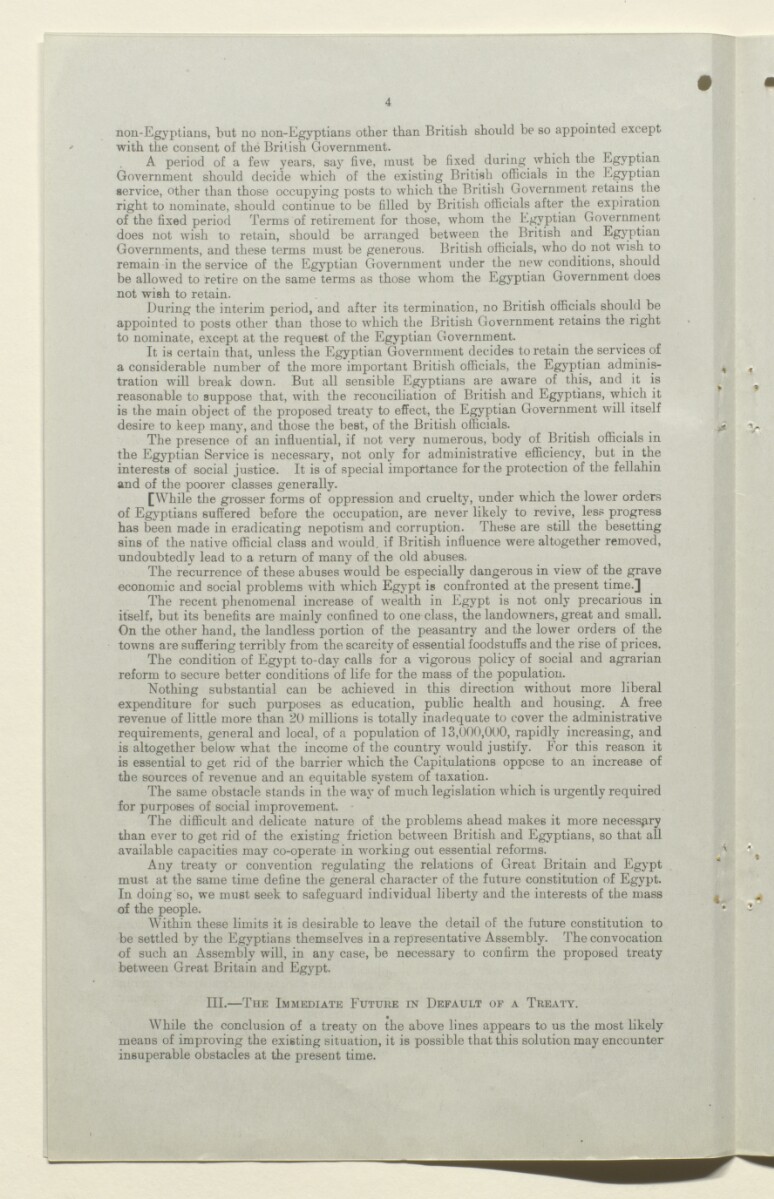
non-Egyptians, hut no non-Egyptians other than British should be so appointed except
with the consent of the British Government.
A period of a few years, say five, must be fixed during which the Egyptian
Government should decide which of the existing British officials in the Egyptian
service, other than those occupying posts to which the British Government retains the
right to nominate, should continue to be filled by British officials after the expiration
of the fixed period Terms of retirement for those, whom the Egyptian Government
does not wish to retain, should be arranged between the British and Egyptian
Governments, and these terms must be generous. British officials, who do not wish to
remain in the service of the Egyptian Government under the new conditions, should
be allowed to retire on the same terms as those whom the Egyptian Government does
not wish to retain.
During the interim period, and after its termination, no British officials should be
appointed to posts other than those to which the British Government retains the right
to nominate, except at the request of the Egyptian Government.
It is certain that, unless the Egyptian Government decides to retain the services of
a considerable number of the more important British officials, the Egyptian adminis
tration will break down. But all sensible Egyptians are aware of this, and it is
reasonable to suppose that, with the reconciliation of British and Egyptians, which it
is the main object of the proposed treaty to effect, the Egyptian Government will itself
desire to keep many, and those the best, of the British officials.
The presence of an influential, if not very numerous, body of British officials in
the Egyptian Service is necessary, not only for administrative efficiency, but in the
interests of social justice. It is of special importance for the protection of the
fellahin
Arabic for ‘peasant’. It was used by British officials to refer to agricultural workers or to members of a social class employed primarily in agricultural labour.
and of the poorer classes generally.
[While the grosser forms of oppression and cruelty, under which the lower orders
of Egyptians suffered before the occupation, are never likely to revive, less progress
has been made in eradicating nepotism and corruption. These are still the besetting
sins of the native official class and would, if British influence were altogether removed,
undoubtedly lead to a return of many of the old abuses.
The recurrence of these abuses would be especially dangerous in view of the grave
economic and social problems with which Egypt is confronted at the present time.]
The recent phenomenal increase of wealth in Egypt is not only precarious in
itself, but its benefits are mainly confined to one class, the landowners, great and small.
On the other hand, the landless portion of the peasantry and the lower orders of the
towns are suffering terribly from the scarcity of essential foodstuffs and the rise of prices.
The condition of Egypt to-day calls for a vigorous policy of social and agrarian
reform to secure better conditions of life for the mass of the population.
Nothing substantial can be achieved in this direction without more liberal
expenditure for such purposes as education, public health and housing. A free
revenue of little more than 20 millions is totally inadequate to cover the administrative
requirements, general and local, of a population of 13,000,000, rapidly increasing, and
is altogether below what the income of the country would justify. For this reason it
is essential to get rid of the barrier which the Capitulations oppose to an increase of
the sources of revenue and an equitable system of taxation.
The same obstacle stands in the way of much legislation which is urgently required
for purposes of social improvement.
The difficult and delicate nature of the problems ahead makes it more necessary
than ever to get rid of the existing friction between British and Egyptians, so that all
available capacities may co-operate in working out essential reforms.
Any treaty or convention regulating the relations of Great Britain and Egypt
must at the same time define the general character of the future constitution of Egypt.
In doing so, we must seek to safeguard individual liberty and the interests of the mass
of the people.
Within these limits it is desirable to leave the detail of the future constitution to
be settled by the Egyptians themselves in a representative Assembly. The convocation
of such an Assembly will, in any case, be necessary to confirm the proposed treaty
between Great Britain and Egypt.
III.— The Immediate Future in Default of a Treaty.
While the conclusion of a treaty on the above lines appears to us the most likely
means of improving the existing situation, it is possible that this solution may encounter
insuperable obstacles at the present time.
About this item
- Content
The file contains official correspondence, memoranda, and reports relating to political affairs in Egypt. The correspondents and authors are officials at the Foreign Office (Lord Curzon was Secretary of State for Foreign Affairs at the time), War Office, Air Ministry, Admiralty, Colonial Office, Board of Trade, Board of Education, as well as those within the Egyptian civil service.
The file contains copies of reports of the Special Mission to Egypt (folios 1-7, 75-93, and 175-194), led by Lord Alfred Milner, whose purpose was to investigate and advise following the Egyptian Revolution of 1919. Much of the content of the file is in response to the findings and recommendations of the Mission and discusses the possibilities of a political settlement with Egypt.
- Extent and format
- 1 file (237 folios)
- Arrangement
The file is arranged in chronological order, from the front to the rear.
- Physical characteristics
Foliation: the foliation sequence (used for referencing) commences at the front cover with 1, and terminates at the inside back cover with 235; these numbers are written in pencil, are circled, and are located in the top right corner of the recto The front of a sheet of paper or leaf, often abbreviated to 'r'. side of each folio. The file has one foliation anomaly, f 76a.
- Written in
- English in Latin script View the complete information for this record
Use and share this item
- Share this item
Report of the Special Mission to Egypt under Lord Milner, and related papers [28v] (56/473), British Library: India Office Records and Private Papers, Mss Eur F112/260, in Qatar Digital Library <https://www.qdl.qa/archive/81055/vdc_100080131819.0x000039> [accessed 31 July 2026]
https://www.qdl.qa/en/archive/81055/vdc_100080131819.0x000039
Copy and paste the code below into your web page where you would like to embed the image.
<meta charset="utf-8"><a href="https://www.qdl.qa/en/archive/81055/vdc_100080131819.0x000039">Report of the Special Mission to Egypt under Lord Milner, and related papers [‎28v] (56/473)</a> <a href="https://www.qdl.qa/en/archive/81055/vdc_100080131819.0x000039"> <img src="https://iiif.qdl.qa/iiif/images/81055/vdc_100000001491.0x000295/Mss Eur F112_260_0056.jp2/full/!280,240/0/default.jpg" alt="" /> </a>
This record has a IIIF manifest available as follows. If you have a compatible viewer you can drag the icon to load it.https://www.qdl.qa/en/iiif/81055/vdc_100000001491.0x000295/manifestOpen in Universal viewerOpen in Mirador viewerMore options for embedding images
Copyright: How to use this content
- Reference
- Mss Eur F112/260
- Title
- Report of the Special Mission to Egypt under Lord Milner, and related papers
- Pages
- front, front-i, 2r:39v, 42r:50v, 53r:76v, 76ar:76av, 77r:140v, 143r:143v, 144ar, 144r:235v
- Author
- East India Company, the Board of Control, the India Office, or other British Government Department
- Usage terms
- Open Government Licence