
![Report of the Special Mission to Egypt under Lord Milner, and related papers [‎84v] (170/473)](https://iiif.qdl.qa/iiif/images/81055/vdc_100000001491.0x000295/Mss Eur F112_260_0170.jp2/full/!1200,1200/0/default.jpg "Report of the Special Mission to Egypt under Lord Milner, and related papers [‎84v] (170/473)")
Report of the Special Mission to Egypt under Lord Milner, and related papers [84v] (170/473)
The record is made up of 1 file (237 folios). It was created in 15 May 1920-14 Oct 1921. It was written in English. The original is part of the British Library: India Office The department of the British Government to which the Government of India reported between 1858 and 1947. The successor to the Court of Directors. Records and Private Papers Documents collected in a private capacity. .
Transcription
This transcription is created automatically. It may contain errors.
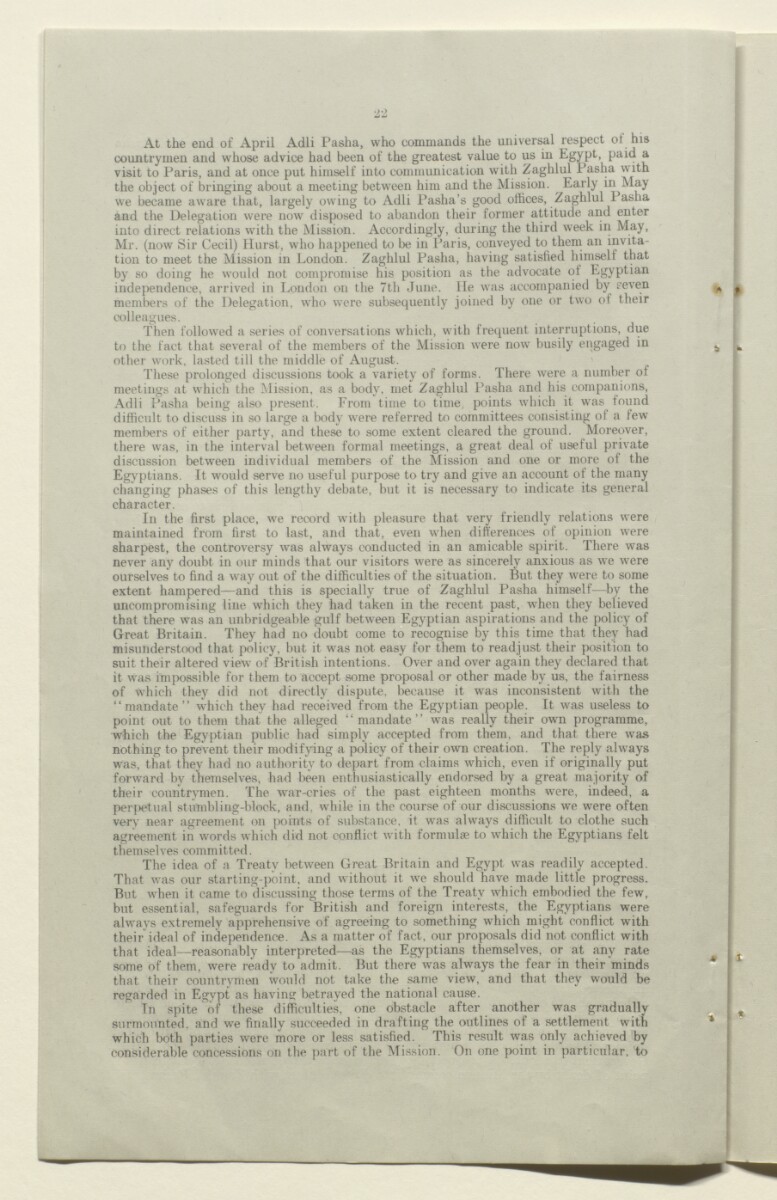
At the end of April Adli
Pasha
An Ottoman title used after the names of certain provincial governors, high-ranking officials and military commanders.
, who commands the universal respect ol his
countrymen and whose advice had been of the greatest value to us in Egypt, paid a
visit to Paris, and at once put himself into communication with Zaghlul
Pasha
An Ottoman title used after the names of certain provincial governors, high-ranking officials and military commanders.
\\ ith
the object of bringing about a meeting between him and the Mission. ^ Early in May
we became aware that, largely owing to Adli Pasha’s good offices, Zaghlul
Pasha
An Ottoman title used after the names of certain provincial governors, high-ranking officials and military commanders.
and the Delegation were now disposed to abandon their former attitude and enter
into direct relations with the Mission. Accordingly, during the third week in May,
Mr. (now Sir Cecil) Hurst, who happened to be in Paris, conveyed to them an invita
tion to meet the Mission in London. Zaghlul
Pasha
An Ottoman title used after the names of certain provincial governors, high-ranking officials and military commanders.
, having satisfied himself that
by so doing he would not compromise his position as the advocate of Egyptian
independence, arrived in London on the 7th June. He was accompanied by seven
members of the Delegation, who were subsequently joined by one or two ol their
colleagues.
Then followed a series of conversations which, with frequent interruptions, due
to the fact that several of the members of the Mission were now busily engaged in
other work, lasted till the middle of August. '
These prolonged discussions took a variety of forms. There were a number of
meetings at which the Mission, as a body, met Zaghlul
Pasha
An Ottoman title used after the names of certain provincial governors, high-ranking officials and military commanders.
and his companions,
Adli
Pasha
An Ottoman title used after the names of certain provincial governors, high-ranking officials and military commanders.
being also present. From time to time, points which it was found
difficult to discuss in so large a body were referred to committees consisting of a few
members of either party, and these to some extent cleared the ground. Moreover,
there was, in the interval between formal meetings, a great deal of useful private
discussion between individual members of the Mission and one or more of the
Egyptians. It would serve no useful purpose to try and give an account of the many
changing phases of this lengthy debate, but it is necessary to indicate its general
character.
In the first place, we record with pleasure that very friendly relations were
maintained from first to last, and that, even when differences of opinion were
sharpest, the controversy was always conducted in an amicable spirit. There was
never any doubt in our minds that our visitors were as sincerely anxious as we were
ourselves to find a way out of the difficulties of the situation. But they were to some
extent hampered—and this is specially true of Zaghlul
Pasha
An Ottoman title used after the names of certain provincial governors, high-ranking officials and military commanders.
himself—by the
uncompromising line which they had taken in the recent past, when they believed
that there was an unbridgeable gulf between Egyptian aspirations and the policy of
Great Britain. They had no doubt come to recognise by this time that they had
misunderstood that policy, but it was not easy for them to readjust their position to
suit their altered view of British intentions. Over and over again they declared that
it was impossible for them to accept some proposal or other made by us, the fairness
of which they did not directly dispute, because it was inconsistent with the
“mandate” which they had received from the Egyptian people. It was useless to
point out to them that the alleged “mandate” was really their own programme,
which the Egyptian public had simply accepted from them, and that there was
nothing to prevent their modifying a policy of their own creation. The reply always
was, that they had no authority to depart from claims which, even if originally put
forward by themselves, had been enthusiastically endorsed by a great majority of
their countrymen. The war-cries of the past eighteen months were, indeed, a
perpetual stumbling-block, and, while in the course of our discussions we were often
very near agreement on points of substance, it was always difficult to clothe such
agreement in words which did not conflict with formulae to which the Egyptians felt
themselves committed.
The idea of a Treaty between Great Britain and Egypt was readily accepted.
That was our starting-point, and without it we should have made little progress.
But when it came to discussing those terms of the Treaty which embodied the few,
but essential, safeguards for British and foreign interests, the Egyptians were
always extremely apprehensive of agreeing to something which might conflict with
their ideal of independence. As a matter of fact, our proposals did not conflict with
that ideal—reasonably interpreted—as the Egyptians themselves, or at any rate
some of them, were ready to admit. But there was always the fear in their minds
that their countrymen would not take the same view, and that they would be
regarded in Egypt as having betrayed the national cause.
In spite of these difficulties, one obstacle after another was gradually
surmounted, and we finally succeeded in drafting the outlines of a settlement with
which both parties were more or less satisfied. This result was only achieved by
considerable concessions on the part of the Mission. On one point in particular, to
About this item
- Content
The file contains official correspondence, memoranda, and reports relating to political affairs in Egypt. The correspondents and authors are officials at the Foreign Office (Lord Curzon was Secretary of State for Foreign Affairs at the time), War Office, Air Ministry, Admiralty, Colonial Office, Board of Trade, Board of Education, as well as those within the Egyptian civil service.
The file contains copies of reports of the Special Mission to Egypt (folios 1-7, 75-93, and 175-194), led by Lord Alfred Milner, whose purpose was to investigate and advise following the Egyptian Revolution of 1919. Much of the content of the file is in response to the findings and recommendations of the Mission and discusses the possibilities of a political settlement with Egypt.
- Extent and format
- 1 file (237 folios)
- Arrangement
The file is arranged in chronological order, from the front to the rear.
- Physical characteristics
Foliation: the foliation sequence (used for referencing) commences at the front cover with 1, and terminates at the inside back cover with 235; these numbers are written in pencil, are circled, and are located in the top right corner of the recto The front of a sheet of paper or leaf, often abbreviated to 'r'. side of each folio. The file has one foliation anomaly, f 76a.
- Written in
- English in Latin script View the complete information for this record
Use and share this item
- Share this item
Report of the Special Mission to Egypt under Lord Milner, and related papers [84v] (170/473), British Library: India Office Records and Private Papers, Mss Eur F112/260, in Qatar Digital Library <https://www.qdl.qa/archive/81055/vdc_100080131819.0x0000ab> [accessed 5 August 2026]
https://www.qdl.qa/en/archive/81055/vdc_100080131819.0x0000ab
Copy and paste the code below into your web page where you would like to embed the image.
<meta charset="utf-8"><a href="https://www.qdl.qa/en/archive/81055/vdc_100080131819.0x0000ab">Report of the Special Mission to Egypt under Lord Milner, and related papers [‎84v] (170/473)</a> <a href="https://www.qdl.qa/en/archive/81055/vdc_100080131819.0x0000ab"> <img src="https://iiif.qdl.qa/iiif/images/81055/vdc_100000001491.0x000295/Mss Eur F112_260_0170.jp2/full/!280,240/0/default.jpg" alt="" /> </a>
This record has a IIIF manifest available as follows. If you have a compatible viewer you can drag the icon to load it.https://www.qdl.qa/en/iiif/81055/vdc_100000001491.0x000295/manifestOpen in Universal viewerOpen in Mirador viewerMore options for embedding images
Copyright: How to use this content
- Reference
- Mss Eur F112/260
- Title
- Report of the Special Mission to Egypt under Lord Milner, and related papers
- Pages
- front, front-i, 2r:39v, 42r:50v, 53r:76v, 76ar:76av, 77r:140v, 143r:143v, 144ar, 144r:235v
- Author
- East India Company, the Board of Control, the India Office, or other British Government Department
- Usage terms
- Open Government Licence