
!['Extracts from Gazetteer of the Persian Gulf, Oman and Central Arabia by J G Lorimer CIE, Indian Civil Service' [‎6r] (16/180)](https://iiif.qdl.qa/iiif/images/81055/vdc_100000000193.0x0002bf/IOR_R_15_1_729_0016.jp2/full/!1200,1200/0/default.jpg "'Extracts from Gazetteer of the Persian Gulf, Oman and Central Arabia by J G Lorimer CIE, Indian Civil Service' [‎6r] (16/180)")
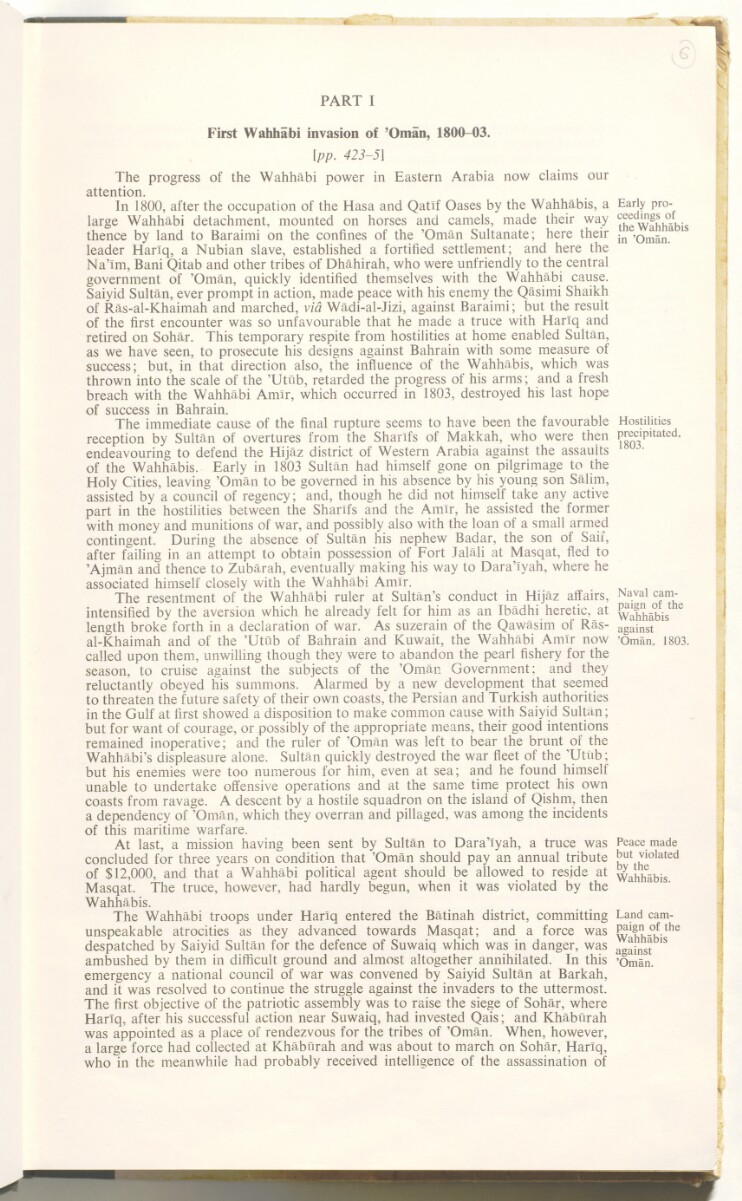
'Extracts from Gazetteer of the Persian Gulf, Oman and Central Arabia by J G Lorimer CIE, Indian Civil Service' [6r] (16/180)
The record is made up of 1 volume (86 folios). It was created in Early 20th century. It was written in English. The original is part of the British Library: India Office The department of the British Government to which the Government of India reported between 1858 and 1947. The successor to the Court of Directors. Records and Private Papers Documents collected in a private capacity. .
Transcription
This transcription is created automatically. It may contain errors.
o
PART I
First Wahhabi invasion of 'Oman, 1800-03.
[pp. 423-5\
The progress of the Wahhabi power in Eastern Arabia now claims our
attention.
In 1800, after the occupation of the Hasa and Qatif Oases by the Wahhabis, a
large Wahhabi detachment, mounted on horses and camels, made their way
thence by land to Baraimi on the confines of the 'Oman Sultanate; here their
leader Hariq, a Nubian slave, established a fortified settlement; and here the
Na'im, Bani Qitab and other tribes of Dhahirah, who were unfriendly to the central
government of 'Oman, quickly identified themselves with the Wahhabi cause.
Saiyid Sultan, ever prompt in action, made peace with his enemy the Qasimi Shaikh
of Ras-al-Khaimah and marched, via
Wadi
A seasonal or intermittent watercourse, or the valley in which it flows.
-al-Jizi, against Baraimi; but the result
of the first encounter was so unfavourable that he made a truce with Hanq and
retired on Sohar. This temporary respite from hostilities at home enabled Sultan,
as we have seen, to prosecute his designs against Bahrain with some measure of
success; but, in that direction also, the influence of the Wahhabis, which was
thrown into the scale of the 'Utub, retarded the progress of his arms; and a fresh
breach with the Wahhabi Amir, which occurred in 1803, destroyed his last hope
of success in Bahrain.
The immediate cause of the final rupture seems to have been the favourable
reception by Sultan of overtures from the Sharifs of Makkah, who were then
endeavouring to defend the Hijaz district of Western Arabia against the assaults
of the Wahhabis. Early in 1803 Sultan had himself gone on pilgrimage to the
Holy Cities, leaving 'Oman to be governed in his absence by his young son Salim,
assisted by a council of regency; and, though he did not himself take any active
part in the hostilities between the Sharifs and the Amir, he assisted the former
with money and munitions of war, and possibly also with the loan of a small armed
contingent. During the absence of Sultan his nephew Badar, the son of Saif,
after failing in an attempt to obtain possession of Fort Jalali at Masqat, fled to
'Ajman and thence to
Zubarah
18th-century town located 105 km from Doha.
, eventually making his way to Dara'tyah, where he
associated himself closely with the Wahhabi Amir.
The resentment of the Wahhabi ruler at Sultan's conduct in Hijaz affairs,
intensified by the aversion which he already felt for him as an Ibadhi heretic, at
length broke forth in a declaration of war. As suzerain of the
Qawasim
One of the ruling families of the United Arab Emirates; also used to refer to a confederation of seafaring Arabs led by the Qāsimī tribe from Ras al Khaima.
of Ras-
al-Khaimah and of the 'Utub of Bahrain and Kuwait, the Wahhabi Amir now
called upon them, unwilling though they were to abandon the pearl fishery for the
season, to cruise against the subjects of the 'Oman Government; and they
reluctantly obeyed his summons. Alarmed by a new development that seemed
to threaten the future safety of their own coasts, the Persian and Turkish authorities
in the Gulf at first showed a disposition to make common cause with Saiyid Sultan;
but for want of courage, or possibly of the appropriate means, their good intentions
remained inoperative; and the ruler of 'Oman was left to bear the brunt of the
Wahhabi's displeasure alone. Sultan quickly destroyed the war fleet of the 'Utub;
but his enemies were too numerous for him, even at sea; and he found himself
unable to undertake offensive operations and at the same time protect his own
coasts from ravage. A descent by a hostile squadron on the island of Qishm, then
a dependency of 'Oman, which they overran and pillaged, was among the incidents
of this maritime warfare.
At last, a mission having been sent by Sultan to Dara'iyah, a truce was
concluded for three years on condition that 'Oman should pay an annual tribute
of $12,000, and that a Wahhabi
political agent
A mid-ranking political representative (equivalent to a Consul) from the diplomatic corps of the Government of India or one of its subordinate provincial governments, in charge of a Political Agency.
should be allowed to reside at
Masqat. The truce, however, had hardly begun, when it was violated by the
Wahhabis.
The Wahhabi troops under Hariq entered the Batinah district, committing
unspeakable atrocities as they advanced towards Masqat; and a force was
despatched by Saiyid Sultan for the defence of Suwaiq which was in danger, was
ambushed by them in difficult ground and almost altogether annihilated. In this
emergency a national council of war was convened by Saiyid Sultan at Barkah,
and it was resolved to continue the struggle against the invaders to the uttermost.
The first objective of the patriotic assembly was to raise the siege of Sohar, where
Hariq, after his successful action near Suwaiq, had invested Qais; and Khaburah
was appointed as a place of rendezvous for the tribes of 'Oman. When, however,
a large force had collected at Khaburah and was about to march on Sohar, Hariq,
who in the meanwhile had probably received intelligence of the assassination of
Early pro
ceedings of
the Wahhabis
in 'Oman.
Hostilities
precipitated,
1803.
Naval cam
paign of the
Wahhabis
against
'Oman, 1803.
Peace made
but violated
by the
Wahhabis.
Land cam
paign of the
Wahhabis
against
'Oman.
About this item
- Content
The volume consists of approximately forty extracts from Volume I, Parts I and II, and Volume II of John Gordon Lorimer's Gazetteer. The reason for the compilation of this volume of extracts is unclear.
- Extent and format
- 1 volume (86 folios)
- Arrangement
There is a table of contents at the front of the volume.
- Physical characteristics
Foliation: the foliation sequence commences at 1 on the front cover and terminates at 88 on the back cover. These numbers are written in pencil, are circled, and can be found in the top right hand corner of the recto The front of a sheet of paper or leaf, often abbreviated to 'r'. page of each folio. There is also a printed pagination sequence covering most of the volume.
- Written in
- English in Latin script View the complete information for this record
Use and share this item
- Share this item
'Extracts from Gazetteer of the Persian Gulf, Oman and Central Arabia by J G Lorimer CIE, Indian Civil Service' [6r] (16/180), British Library: India Office Records and Private Papers, IOR/R/15/1/729, in Qatar Digital Library <https://www.qdl.qa/archive/81055/vdc_100022770472.0x000011> [accessed 8 July 2026]
https://www.qdl.qa/en/archive/81055/vdc_100022770472.0x000011
Copy and paste the code below into your web page where you would like to embed the image.
<meta charset="utf-8"><a href="https://www.qdl.qa/en/archive/81055/vdc_100022770472.0x000011">'Extracts from Gazetteer of the Persian Gulf, Oman and Central Arabia by J G Lorimer CIE, Indian Civil Service' [‎6r] (16/180)</a> <a href="https://www.qdl.qa/en/archive/81055/vdc_100022770472.0x000011"> <img src="https://iiif.qdl.qa/iiif/images/81055/vdc_100000000193.0x0002bf/IOR_R_15_1_729_0016.jp2/full/!280,240/0/default.jpg" alt="" /> </a>
This record has a IIIF manifest available as follows. If you have a compatible viewer you can drag the icon to load it.https://www.qdl.qa/en/iiif/81055/vdc_100000000193.0x0002bf/manifestOpen in Universal viewerOpen in Mirador viewerMore options for embedding images
Copyright: How to use this content
- Reference
- IOR/R/15/1/729
- Title
- 'Extracts from Gazetteer of the Persian Gulf, Oman and Central Arabia by J G Lorimer CIE, Indian Civil Service'
- Pages
- front, back, spine, edge, head, tail, front-i, 2r:87v, back-i
- Author
- East India Company, the Board of Control, the India Office, or other British Government Department
- Usage terms
- Open Government Licence