
![‘A collection of treaties, engagements and sanads relating to India and neighbouring countries [...] Vol XI containing the treaties, & c., relating to Aden and the south western coast of Arabia, the Arab principalities in the Persian Gulf, Muscat (Oman), Baluchistan and the North-West Frontier Province’ [‎62r] (132/822)](https://iiif.qdl.qa/iiif/images/81055/vdc_100000000884.0x0003bd/IOR_L_PS_20_G3_12_0132.jp2/full/!1200,1200/0/default.jpg "‘A collection of treaties, engagements and sanads relating to India and neighbouring countries [...] Vol XI containing the treaties, & c., relating to Aden and the south western coast of Arabia, the Arab principalities in the Persian Gulf, Muscat (Oman), Baluchistan and the North-West Frontier Province’ [‎62r] (132/822)")
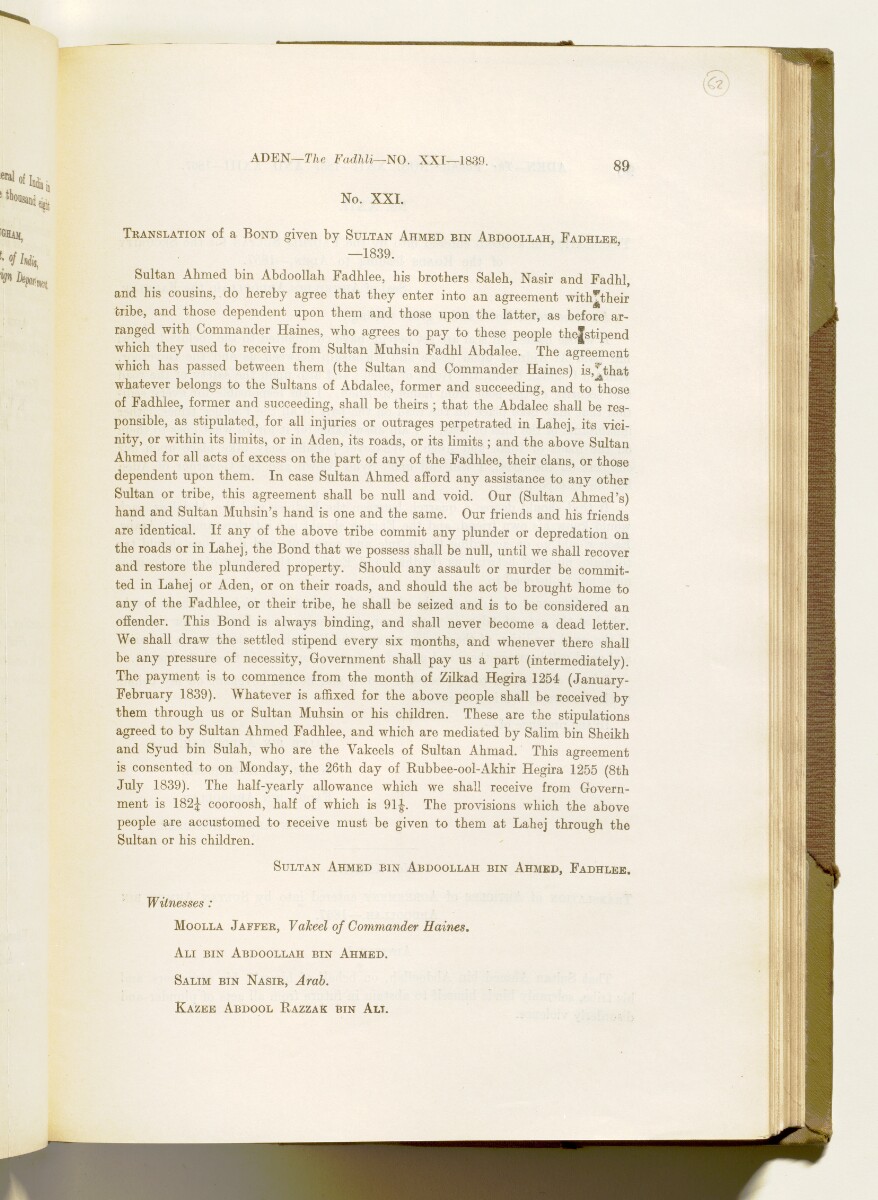
‘A collection of treaties, engagements and sanads relating to India and neighbouring countries [...] Vol XI containing the treaties, & c., relating to Aden and the south western coast of Arabia, the Arab principalities in the Persian Gulf, Muscat (Oman), Baluchistan and the North-West Frontier Province’ [62r] (132/822)
The record is made up of 409 folios. It was created in 1933. It was written in English and French. The original is part of the British Library: India Office The department of the British Government to which the Government of India reported between 1858 and 1947. The successor to the Court of Directors. Records and Private Papers Documents collected in a private capacity. .
Transcription
This transcription is created automatically. It may contain errors.
ADEN—T/u; Fadhli —NO. XXI—1839.
89
No. XXI.
Translation of a Bond given by Sultan Ahmed bin Abdoollah, Fadhlee,
—1839.
Sultan Ahmed bin Abdoollah Fadhlee, his brothers Saleh, Nasir and Fadhl,
and his cousins, do hereby agree that they enter into an agreement with^their
tribe, and those dependent upon them and those upon the latter, as before ar
ranged with Commander Haines, who agrees to pay to these people thelstipend
which they used to receive from Sultan Muhsin Fadhl Abdalee. The agreement
which has passed between them (the Sultan and Commander Haines) is,^ that
whatever belongs to the Sultans of Abdalee, former and succeeding, and to those
of Fadhlee, former and succeeding, shall be theirs ; that the Abdalee shall be res
ponsible, as stipulated, for all injuries or outrages perpetrated in Lahej, its vici
nity, or within its limits, or in Aden, its roads, or its limits ; and the above Sultan
Ahmed for all acts of excess on the part of any of the Fadhlee, their clans, or those
dependent upon them. In case Sultan Ahmed afford any assistance to any other
Sultan or tribe, this agreement shall be null and void. Our (Sultan Ahmed's)
hand and Sultan Muhsin's hand is one and the same. Our friends and his friends
are identical. If any of the above tribe commit any plunder or depredation on
the roads or in Lahej, the Bond that we possess shall be null, until we shall recover
and restore the plundered property. Should any assault or murder be commit
ted in Lahej or Aden, or on their roads, and should the act be brought home to
any of the Fadhlee, or their tribe, he shall be seized and is to be considered an
offender. This Bond is always binding, and shall never become a dead letter.
We shall draw the settled stipend every six months, and whenever there shall
be any pressure of necessity. Government shall pay us a part (intermediately).
The payment is to commence from the month of Zilkad Hegira 1254 (January-
February 1839). Whatever is affixed for the above people shall be received by
them through us or Sultan Muhsin or his children. These are the stipulations
agreed to by Sultan Ahmed Fadhlee, and which are mediated by Salim bin Sheikh
and Syud bin Sulah, who are the Vakeels of Sultan Ahmad. This agreement
is consented to on Monday, the 26th day of Rubbee-ool-Akhir Hegira 1255 (8th
July 1839). The half-yearly allowance which we shall receive from Govern
ment is 182-^ cooroosh, half of which is 91|-. The provisions which the above
people are accustomed to receive must be given to them at Lahej through the
Sultan or his children.
Sultan Ahmed bin Abdoollah bin Ahmed, Fadhlee.
Witnesses:
Moolla Japfee, Vakeel of Commander Haines.
Ali bin Abdoollah bin Ahmed.
Salim bin Nasir, Arab.
Kazee Abdool Razzak bin A lt.
About this item
- Content
The volume is a fifth edition of a collection of historic treaties, engagements and sanads (charters) signed between representatives of the British Government or East India Company, and foreign rulers, dignitories or government officials, in the regions of Aden, south west Arabia, the Arab coast of the Persian Gulf The historical term used to describe the body of water between the Arabian Peninsula and Iran. , including Muscat and Oman, Baluchistan, and the north-west frontier Region of British India bordering Afghanistan. province (present-day Pakistan). This volume, originally compiled by Charles Umpherston Aitchison, Under Secretary to the Government of India in the Foreign Department, was revised in 1930 and published in 1933 by the Manager of Publications in Dehli, under the authority of the Government of India.
Part 1 contains treaties and engagements relating to Aden and the southwest coast of Arabia:
- An historical overview of British (and Turkish) involvement in the region, including descriptions of the treaties and engagements signed;
- The Anglo-Turkish Convention (in French) respecting the boundaries of Aden, dated 9 March 1914;
- Treaties and conventions, agreed between the years 1802-1917, at Aden and with the Abdali tribe, the Subeihi, Fadhli, Aqrabi, Aulaqi, Irqa, Lower Haura, Beihan, Yafai, Audhali, Haushabi, Alawi, the Amirate of Dhala, the Wahidi, Kathiri, the Sultanate of Mukalla, Soqotra [Suquṭrā] and Qishn, Yemen, and the Idrisi. The treaties cover agreements of commerce, friendship and protection; agreements for the cession or purchase of land, for the abolition of the slave trade, storage of coal, protection of shipwrecked British sailors.
Part 2 contains treaties and engagements relating to the Arab principalities of the Persian Gulf The historical term used to describe the body of water between the Arabian Peninsula and Iran. , divided into the following areas: 1) The Wahhābī A follower of the Islamic reform movement known as Wahhabism; also used to refer to the people and territories ruled by the Al-Saud family. and Nejd [Najd]; 2) Bahrain; 3) The Trucial Arab shaikhs (of Oman); and 4) Kuwait:
- An historic overview of the agreements made between the British and the region’s rulers, organised by tribes and/or geographical locality;
- Agreements and treaties signed with the Wahhābī A follower of the Islamic reform movement known as Wahhabism; also used to refer to the people and territories ruled by the Al-Saud family. tribe, including: an agreement between the Wahhābī A follower of the Islamic reform movement known as Wahhabism; also used to refer to the people and territories ruled by the Al-Saud family. and British Government over aggression towards the Arab tribes, dated 21 April 1866; a series of conventions and treaties agreed in the 1920s, establishing boundaries and relations between the Kingdom of Najd and its neighbours; the Treaty of Jeddah, dated 20 May 1927;
- Agreements and treaties signed with the ruler of Bahrain, relating to: piracy and slavery (1820), abstention from entering into relations with foreign powers (1880, 1892), arms trafficking, wireless telegraphy (1912), and oil exploitation (1914);
- Agreements and treaties signed with the shaikhs of the Arab coast, relating to respect for British property (1806), piracy (1820), the slave trade (1838, 1873), the maintenance of maritime peace in perpetuity (1853), the Anglo-Qatar treaty (1916); oil exploitation (1922);
- Agreement and treaties signed with the ruler of Kuwait, relating to: arms trafficking, exclusive post office rights (1904), pearling and sponge fishing concessions (1911), wireless telegraphy (1912), oil exploitation (1913), boundaries between Kuwait and Najd (1922) and Kuwait and Iraq (1923).
Part 3 contains treaties and engagements relating to Oman, chiefly Muscat but also Sohar:
- An historical overview of the Sultanate of Muscat, and the agreements made between Britain and Muscat;
- Treaties and conventions, agreed between the years 1798 and 1929, including: the exclusion of the French from the Sultan of Muscat’s territories (1798); suppression of the slave trade (1822, 1873); commerce (1839); cession of the Kuria Muria islands [Jazā'ir Khurīyā Murīyā] (1854); the independence of Zanzibar (1861, 1862); telegraphic communications (1864, 1865); jurisdiction of Indian subjects at Muscat (1873); friendship and commerce (1891); coalfields at Ṣūr (1902); arms traffic (1919); prolongation of the commercial treaty (1891); treaty of peace between the Sultan of Muscat and Chief of Sohar (1839).
Part 4 contains treaties and engagements relating to Baluchistan:
- An historic overview of the region and its districts, including British involvement in Baluchistan, organised by the Kalat [Kelat] Agency An office of the East India Company and, later, of the British Raj, headed by an agent. , Sibi Agency An office of the East India Company and, later, of the British Raj, headed by an agent. , and British Baluchistan and its territories;
- The treaties and conventions listed for Kelat, agreed between the years 1839 and 1925, include: an engagement between the British Government and the Khan of Kelat (1839), the Khan of Kelat’s allegiance and submission to the British Government (1841); various agreements for the protection of the Indo-European telegraph line; cession of lands for the Kandahar Railway (1880), Mushkaf-Bolan Railway (1894) and Nushki Railway (1906); demarcation of the boundary between Persian Baluchistan and Kelat (1896);
- The treaties and conventions listed for Sibi and British Baluchistan, agreed between the years 1884 and 1897, including: cession to the British Government of rights to petroleum and other mineral oils (1885); agreement on the Bargha and Largha boundary line (1895), grazing fees for animals and responsibility for good behaviour within the British border at Zhob, signed by the Suliman Khel Ghilzai (1897).
Part 5 contains treaties and engagements relating to the northwest frontier province:
- An historic overview of British involvement and administration of the province;
- The treaties and conventions agreed in the province, arranged as follows : 1) Hazara District; 2) Dir, Swat and Chitral Agency An office of the East India Company and, later, of the British Raj, headed by an agent. ; 3) Peshawar District; 4) Khyber Agency An office of the East India Company and, later, of the British Raj, headed by an agent. ; 5) Kohat District; 6) Kurram Agency An office of the East India Company and, later, of the British Raj, headed by an agent. ; 7) Bannu District; 8) North Waziristan Agency An office of the East India Company and, later, of the British Raj, headed by an agent. ; South Waziristan Agency An office of the East India Company and, later, of the British Raj, headed by an agent. . The agreements relate to: relations with the British; maintenance of peace; acceptance of terms; protection of borders and communications; commerce; exclusion or expulsion from certain districts of undesirables, including ‘Hindustani fanatics’.
The appendices contain a number of treaties signed between foreign rulers, including treaties agreed between Muscat and the United States, French and Dutch Governments, as well as British Parliament acts and memoranda related to the treaties and engagements in the volume.
- Extent and format
- 409 folios
- Arrangement
The volume is arranged into five key geographical regions: Aden and the southwest coast of Arabia, the Persian Gulf The historical term used to describe the body of water between the Arabian Peninsula and Iran. , Oman (Muscat) and Sohar, Baluchistan, and the northwest frontier province. The main body of the volume, containing the narrative treaties, is arranged into parts covering these five regions. The appendices at the end of the volume is likewise arranged by the five regions.
Each part (or region) is further subdivided into a number of smaller units, and in some cases further subdivided into smaller units. These subdivisions can be tribal, geographical and administrative in nature. Within each part, the narrative treaties are numbered with Roman numerals, restarting at I at the beginning of each part.
There is a contents page at the front of the volume (ff.2-17) which lists the geographical regions, their subdivisions and treaties. The contents pages refers to the volume’s pagination system. There is a subject index, arranged alphabetically, at the end of the volume (ff.363-405) which also refers to the volume’s pagination system.
- Physical characteristics
Foliation: The volume’s foliation sequence uses circled pencil numbers, located in the top-right corner of the recto The front of a sheet of paper or leaf, often abbreviated to 'r'. of each folio. It begins on the first folio with text, on number 1, and ends on the last folio with text, on number 405. Total number of folios: 405. Total number of folios including covers and flysheets: 409.
Pagination: The volume has a series of printed pagination sequences, expressed in Roman numerals for the contents, appendices and index pages, and in Arabic numerals for the volume’s main content matter. These numbers are located in the top-left corner of versos and the top-right corner of rectos.
- Written in
- English and French in Latin script View the complete information for this record
Use and share this item
- Share this item
‘A collection of treaties, engagements and sanads relating to India and neighbouring countries [...] Vol XI containing the treaties, & c., relating to Aden and the south western coast of Arabia, the Arab principalities in the Persian Gulf, Muscat (Oman), Baluchistan and the North-West Frontier Province’ [62r] (132/822), British Library: India Office Records and Private Papers, IOR/L/PS/20/G3/12, in Qatar Digital Library <https://www.qdl.qa/archive/81055/vdc_100023462214.0x000085> [accessed 29 August 2026]
https://www.qdl.qa/en/archive/81055/vdc_100023462214.0x000085
Copy and paste the code below into your web page where you would like to embed the image.
<meta charset="utf-8"><a href="https://www.qdl.qa/en/archive/81055/vdc_100023462214.0x000085">‘A collection of treaties, engagements and sanads relating to India and neighbouring countries [...] Vol XI containing the treaties, & c., relating to Aden and the south western coast of Arabia, the Arab principalities in the Persian Gulf, Muscat (Oman), Baluchistan and the North-West Frontier Province’ [‎62r] (132/822)</a> <a href="https://www.qdl.qa/en/archive/81055/vdc_100023462214.0x000085"> <img src="https://iiif.qdl.qa/iiif/images/81055/vdc_100000000884.0x0003bd/IOR_L_PS_20_G3_12_0132.jp2/full/!280,240/0/default.jpg" alt="" /> </a>
This record has a IIIF manifest available as follows. If you have a compatible viewer you can drag the icon to load it.https://www.qdl.qa/en/iiif/81055/vdc_100000000884.0x0003bd/manifestOpen in Universal viewerOpen in Mirador viewerMore options for embedding images
Copyright: How to use this content
- Reference
- IOR/L/PS/20/G3/12
- Title
- ‘A collection of treaties, engagements and sanads relating to India and neighbouring countries [...] Vol XI containing the treaties, & c., relating to Aden and the south western coast of Arabia, the Arab principalities in the Persian Gulf, Muscat (Oman), Baluchistan and the North-West Frontier Province’
- Pages
- front, back, spine, edge, head, tail, front-i, i-r:i-v, 1r:405v, ii-r:ii-v, back-i
- Author
- East India Company, the Board of Control, the India Office, or other British Government Department
- Usage terms
- Open Government Licence