
!['THE WAR WITH TURKEY. Note by the Under Secretary, India Office.' [‎56r] (3/6)](https://iiif.qdl.qa/iiif/images/81055/vdc_100000000833.0x00025c/IOR_L_PS_18_B234_0003.jp2/full/!1200,1200/0/default.jpg "'THE WAR WITH TURKEY. Note by the Under Secretary, India Office.' [‎56r] (3/6)")
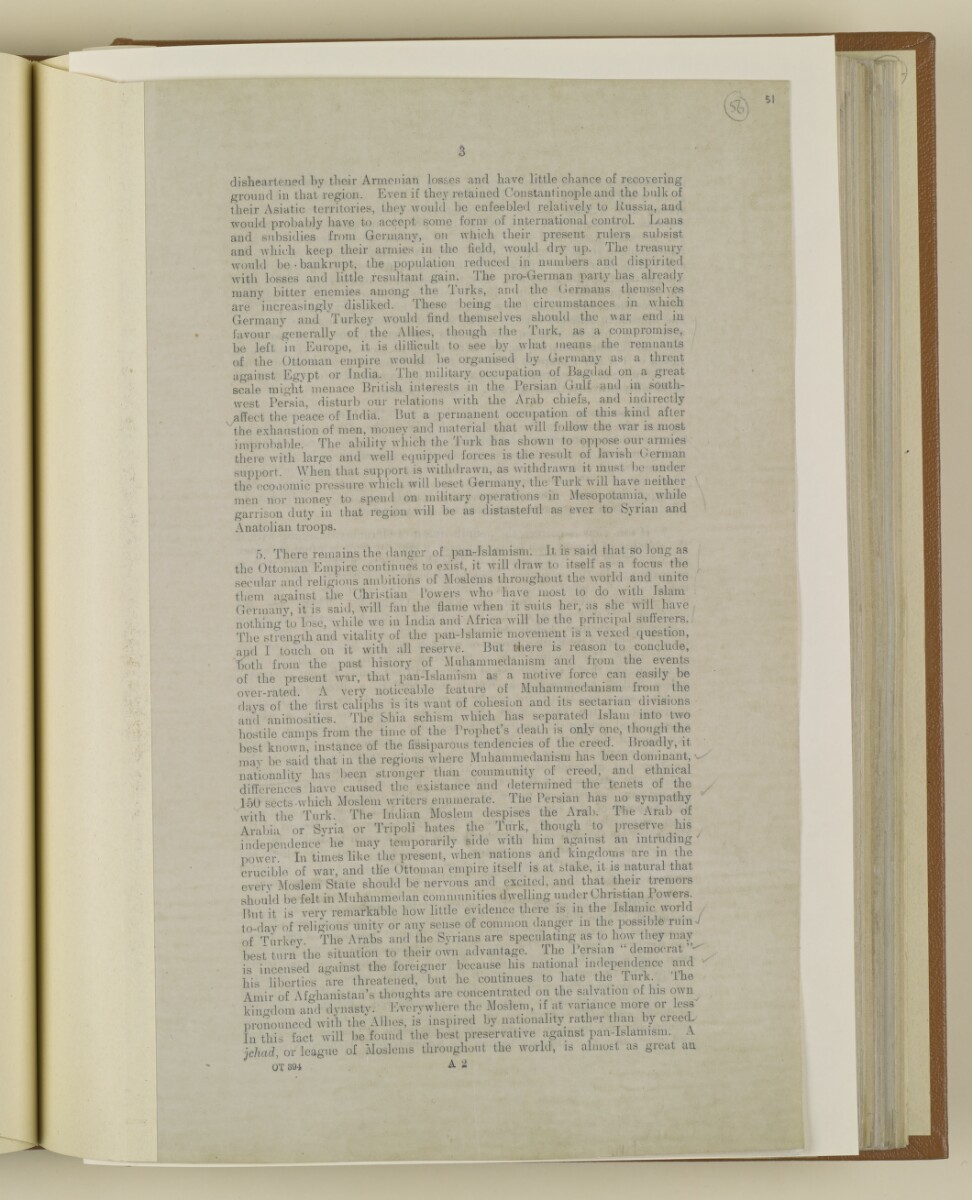
'THE WAR WITH TURKEY. Note by the Under Secretary, India Office.' [56r] (3/6)
The record is made up of 1 file (3 folios). It was created in 13 Jun 1916. It was written in English. The original is part of the British Library: India Office The department of the British Government to which the Government of India reported between 1858 and 1947. The successor to the Court of Directors. Records and Private Papers Documents collected in a private capacity. .
Transcription
This transcription is created automatically. It may contain errors.
disheartened by their Armenian losses and have little chance of recovering
ground in that region. Even if they retained Constantinople and the bulk of
their Asiatic territories, they would be enfeebled relatively to Uussia, and
would probably have to accept some form of international control. Loans
and subsidies from Germany, on which their present rulers subsist
and which keep their armies in the field, would dry up. The treasury
would be-bankrupt, the population reduced in numbers and dispirited
with losses and little resultant gain. The pro-German party has already
many bitter enemies among the Turks, and the Germans themselves
are increasingly disliked. These being the circumstances in which
Germany and Turkey would find themselves should the ^ar end in
favour generally of the Allies, though tlie Turk, as a compromise,
be left in Europe, it is difficult to see by what means the remnants
of the Ottoman empire would be organised by Germany as a threat
against Egypt or India. The military occupation of Bagdad on a great
scale might menace British interests in the
Persian Gulf
The historical term used to describe the body of water between the Arabian Peninsula and Iran.
and in south
west Persia, disturb our relations with the Arab chiefs, and indirectly
affect the peace of India. But a permanent occupation of this kind aftei
the exhaustion of men, monev and material that will follow the war is most
improbable. The ability which the Turk has shown to oppose our armies
therewith large and well equipped forces is the result of lavish German
support. When that support is withdrawn, as withdrawn it must be under
the economic pressure which will beset Germany, the Turk will have neither
men nor money to spend on military operations in Mesopotamia, while
garrison duty in that region will be as distasteful as ever to Syrian and
Anatolian troops.
5. There remains the danger of pan-Islam ism. It is said that so long as
the Ottoman Empire continues to exist, it will draw to itself as a focus the
secular and religious ambitions of Moslems throughout the world and unite
them against the Christian Towers who' have most to do with Islam
Germany, it is said, will fan the flame when it suits her, as she will have
nothing to lose, while we in India and Africa will be the principal sufferers.
The strength and vitality of the pan-Islamic movement is a vexed question,
and I touch on it with all reserve. But tihere is reason to conclude,
forth from the past history of Muhammedanism and from the events
of the present war, that pan-Islamism as a motive force can easily be
over-rated. A very noticeable feature of Muhammedanism from the
davs of the first caliphs is its want of cohesion and its sectarian divisions
and animosities. The fehia schism which has separated Islam into two
hostile camps from the time of the Prophet s death is only one, though the
best known, instance of the fissiparous tendencies of the creed. Broadly, it
mav be said that in the regions where Muhammedanism has been dominant, ~
nationality has been stronger than community of creed, and ethnical
differences have caused the existance and determined the tenets of the
150 sects.which Moslem writers enumerate. The Persian has no sympathy
with the Turk. The Indian Moslem despises the Arab. The Arab of
Arabia or Syria or Tripoli hates the Turk, though to preserve his
independence he mav temporarily side with him against an intruding
power. In times like the present, when nations and kingdoms are m the
crucible of war, and tlie Ottoman empire itself is at stake, it is natural that
every Moslem State should be nervous and excited, and that their tremors
should be felt in Muhammedan communities dwelling under Christian Powers
But it is very remarkable how little evidence there is in the Islamic world
to-dav of religious unitv or any sense of common danger in the possible ruuW
of Turkev. The Arabs and the Syrians are speculating as to how they may
best turn the situation to their own advantage. The Persian "democrat -
is incensed against the foreigner because his national independence and
his liberties are threatened, but he continues to hate the lurk Lhe
Amir of Afghanistan's thoughts are concentrated on the salvation of his own
kingdom and dynasty. Everywhere the Moslem, if at variance more or less
pronounced with the Allies, is inspired by nationality rather than by creed
In this fact will be found the best preservative against pan-lslamism. A
ichad or league of Moslems throughout the world, is almost as great an
OT 394
A 2
About this item
- Content
Note written by Sir Thomas William Holderness, Under Secretary of State, India Office The department of the British Government to which the Government of India reported between 1858 and 1947. The successor to the Court of Directors. , in response to Sir Arthur Hirtzel's memorandum on the war with Turkey (IOR/L/PS/18/B233).
The note describes the recommendations of the Inter-Department Committee on Asiatic Turkey, which Sir Thomas Holderness was a member of, and which were based on the assumption by the Committee at the time of its convening that an allied occupation of Constantinople was only weeks away, that Russia would be in possession of the city and surrounding areas and that peace with the Turks would be possible.
The committee's responsibility, in light of the assumptions, was as follows:
- To propose a scheme for Asiatic Turkey that would satisfy Russian, French, Italian and Greek interests in the region and which would suit the needs and requirements of Great Britain; possibilities included the complete partition of the region; the removal of the Ottoman Empire; and decentralisation of Turkey without the need for military intervention.
The note goes on to consider potential concerns over German power and influence in Turkey; the dangers of any settlement with Turkey that would not include the ending of the Ottoman Empire; the risks from Germany gaining control of the Balkan States; the danger of pan-Islamism; the possibilities of British interests in the East being achieved if Germany is defeated and Turkey collapses as a military power; and the Mesopotamian Campaign and its development as a serious military operation.
- Extent and format
- 1 file (3 folios)
- Physical characteristics
Foliation: The foliation for this description commences at folio 55 and terminates at folio 57, as it is part of a larger physical volume; these numbers are written in pencil, are circled, and are located in the top right corner of the recto The front of a sheet of paper or leaf, often abbreviated to 'r'. side of each folio. An additional foliation sequence is also present in parallel between folios 6-153; these numbers are also written in pencil, but are not circled, and can be found in the same position as the main sequence.
- Written in
- English in Latin script View the complete information for this record
Use and share this item
- Share this item
'THE WAR WITH TURKEY. Note by the Under Secretary, India Office.' [56r] (3/6), British Library: India Office Records and Private Papers, IOR/L/PS/18/B234, in Qatar Digital Library <https://www.qdl.qa/archive/81055/vdc_100023571222.0x000004> [accessed 19 July 2026]
https://www.qdl.qa/en/archive/81055/vdc_100023571222.0x000004
Copy and paste the code below into your web page where you would like to embed the image.
<meta charset="utf-8"><a href="https://www.qdl.qa/en/archive/81055/vdc_100023571222.0x000004">'THE WAR WITH TURKEY. Note by the Under Secretary, India Office.' [‎56r] (3/6)</a> <a href="https://www.qdl.qa/en/archive/81055/vdc_100023571222.0x000004"> <img src="https://iiif.qdl.qa/iiif/images/81055/vdc_100000000833.0x00025c/IOR_L_PS_18_B234_0003.jp2/full/!280,240/0/default.jpg" alt="" /> </a>
This record has a IIIF manifest available as follows. If you have a compatible viewer you can drag the icon to load it.https://www.qdl.qa/en/iiif/81055/vdc_100000000833.0x00025c/manifestOpen in Universal viewerOpen in Mirador viewerMore options for embedding images
Copyright: How to use this content
- Reference
- IOR/L/PS/18/B234
- Title
- 'THE WAR WITH TURKEY. Note by the Under Secretary, India Office.'
- Pages
- 55r:57v
- Author
- East India Company, the Board of Control, the India Office, or other British Government Department
- Usage terms
- Open Government Licence