
!['Turkish Arabia: Being an Account of an Official Tour in Babylonia, Assyria, and Mesopotamia, 1886-87' [‎31r] (59/72)](https://iiif.qdl.qa/iiif/images/81055/vdc_100000001452.0x0002df/Mss Eur F112_384_0068.jp2/full/!1200,1200/0/default.jpg "'Turkish Arabia: Being an Account of an Official Tour in Babylonia, Assyria, and Mesopotamia, 1886-87' [‎31r] (59/72)")
'Turkish Arabia: Being an Account of an Official Tour in Babylonia, Assyria, and Mesopotamia, 1886-87' [31r] (59/72)
The record is made up of 1 volume (35 folios). It was created in 1888. It was written in English and Persian. The original is part of the British Library: India Office The department of the British Government to which the Government of India reported between 1858 and 1947. The successor to the Court of Directors. Records and Private Papers Documents collected in a private capacity. .
Transcription
This transcription is created automatically. It may contain errors.
43
the
ft it
i
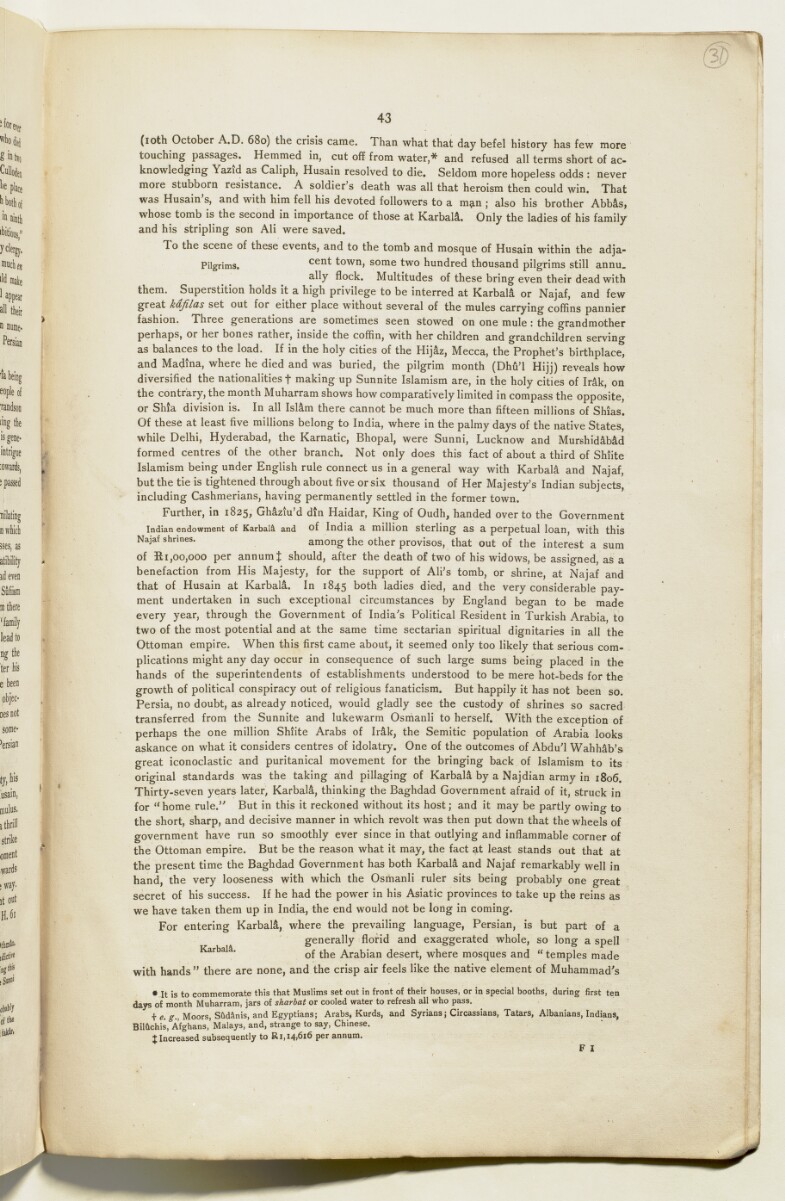
(10th October A.D. 680) the crisis came. Than what that day befel history has few more
touching passages. Hemmed in, cut off from water,* and refused all terms short of ac
knowledging Yazid as Caliph, Husain resolved to die. Seldom more hopeless odds : never
more stubborn resistance. A soldier s death was all that heroism then could win. That
was Husain s, and with him fell his devoted followers to a m9,n ; also his brother Abb4s,
whose tomb is the second in importance of those at Karbala. Only the ladies of his family
and his stripling son Ali were saved.
T o the scene of these events, and to the tomb and mosque of Husain within the adja-
Pilgrims. cent town, some two hundred thousand pilgrims still annu.
ally flock. Multitudes of these bring even their dead with
them. Superstition holds it a high privilege to be interred at Karbal^ or Najaf, and few
great kufilcis set out for either place without several of the mules carrying coffins pannier
fashion. Three generations are sometimes seen stowed on one mule \ the grandmother
perhaps, or her bones rather, inside the coffin, with her children and grandchildren serving
as balances to the load. If in the holy cities of the Hijaz, Mecca, the Prophet's birthplace,
and Madina, where he died and was buried, the pilgrim month (Dhu'l Hijj) reveals how
diversified the nationalities f making up Sunnite Islamism are, in the holy cities of Irak, on
the contrary, the month Muharram shows how comparatively limited in compass the opposite,
or Shia division is. In all Islam there cannot be much more than fifteen millions of Shias.
Of these at least five millions belong to India, where in the palmy days of the native States,
while Delhi, Hyderabad, the Karnatic, Bhopal, were Sunni, Lucknow and Murshidab^d
formed centres of the other branch. Not only does this fact of about a third of Shiite
Islamism being under English rule connect us in a general way with Karbala and Najaf,
but the tie is tightened through about five or six thousand of Her Majesty's Indian subjects,
including Cashmerians, having permanently settled in the former town.
Further, in 1825, Gh&zm'd din Haidar, King of Oudh, handed over to the Government
Indian endowment of Karbal& and of India a million sterling as a perpetual loan, with this
Najaf shrines. among the other provisos, that out of the interest a sum
of Ei,00,000 per annum J should, after the death o£ two of his widows, be assigned, as a
benefaction from His Majesty, for the support of Ali's tomb, or shrine, at Najaf and
that of Husain at Karbald. In 1845 both ladies died, and the very considerable pay
ment undertaken in such exceptional circumstances by England began to be made
every year, through the Government of India's
Political Resident
A senior ranking political representative (equivalent to a Consul General) from the diplomatic corps of the Government of India or one of its subordinate provincial governments, in charge of a Political Residency.
in
Turkish Arabia
A term used by the British officials to describe the territory roughly corresponding to, but not coextensive with, modern-day Iraq under the control of the Ottoman Empire.
, to
two of the most potential and at the same time sectarian spiritual dignitaries in all the
Ottoman empire. When this first came about, it seemed only too likely that serious com
plications might any day occur in consequence of such large sums being placed in the
hands of the superintendents of establishments understood to be mere hot-beds for the
growth of political conspiracy out of religious fanaticism. But happily it has not been so.
Persia, no doubt, as already noticed, would gladly see the custody of shrines so sacred
transferred from the Sunnite and lukewarm Osmanli to herself. With the exception of
perhaps the one million Shiite Arabs of Irak, the Semitic population of Arabia looks
askance on what it considers centres of idolatry. One of the outcomes of Abdu'l Wahhab's
great iconoclastic and puritanical movement for the bringing back of Islamism to its
original standards was the taking and pillaging of Karbala by a Najdian army in 1806.
Thirty -seven years later, Karbala, thinking the Baghdad Government afraid of it, struck in
for " home rule." But in this it reckoned without its host; and it may be partly owing to
the short, sharp, and decisive manner in which revolt was then put down that the wheels of
government have run so smoothly ever since in that outlying and inflammable corner of
the Ottoman empire. But be the reason what it may, the fact at least stands out that at
the present time the Baghdad Government has both Karbala and Najaf remarkably well in
hand, the very looseness with which the Osmanli ruler sits being probably one great
secret of his success. If he had the power in his Asiatic provinces to take up the reins as
we have taken them up in India, the end would not be long in coming.
For entering Karbald, where the prevailing language, Persian, is but part of a
generally florid and exaggerated whole, so long a spell
Karbaia ' of the Arabian desert, where mosques and " temples made
with hands " there are none, and the crisp air feels like the native element of Muhammad's
• It is to commemorate this that Muslims set out in front of their houses, or in special booths, during first ten
days of month Muharram, jars of sharbat or cooled water to refresh all who pass.
•i-Moors, Sudanis, and Egyptians; Arahs^ Kurds, and Syrians; Circassians, Tatars, Albanians, Indians,
Biluchis, Afghans, Malays, and, strange to say, Chinese.
J Increased subsequently to R 1,14,616 per annum.
F I
About this item
- Content
This volume is a printed account of the official winter tour of 1886-87 in Babylonia, Assyria and Mesopotamia (modern-day Iraq) undertaken by Colonel William Tweedie, Bengal Staff Corps, Political Resident A senior ranking political representative (equivalent to a Consul General) from the diplomatic corps of the Government of India or one of its subordinate provincial governments, in charge of a Political Residency. in Turkish Arabia A term used by the British officials to describe the territory roughly corresponding to, but not coextensive with, modern-day Iraq under the control of the Ottoman Empire. (Iraq) and His Majesty's Consul-General at Baghdad. The purpose of the tour was to visit the Vice-Consulate of Mosul in Upper Mesopotamia and the Consulate at Bussorah [Basra], as well as Indian subjects residing in Karbala and Najaf, the two centres of Shiah pilgrimage. In addition, the author identifies it as an opportunity to see the inhabitants and features of Turkish Arabia A term used by the British officials to describe the territory roughly corresponding to, but not coextensive with, modern-day Iraq under the control of the Ottoman Empire. more generally (folio 7). The report was published by the British Residency An office of the East India Company and, later, of the British Raj, established in the provinces and regions considered part of, or under the influence of, British India. Baghdad on 24 May 1887, and printed by the Superintendent of Government Printing, Calcutta, India in 1888. This copy was presented by the author to George Curzon (see inscription on folio 2v).
The volume contains a table of contents (folio 5), list of maps and illustations (folio 6), and note on Arabic and Persian transliteration and names (folio 6v). The volume includes the following sections: 'Section I.- Marching in Turkish Arabia A term used by the British officials to describe the territory roughly corresponding to, but not coextensive with, modern-day Iraq under the control of the Ottoman Empire. '; 'Section II.- Transport'; 'Section III.- Equipment'; 'Section IV.- From Tigris to Euphrates'; 'Section V.- Across Al Jazîrah [al-Jazīrah]'; 'Section VI.- Localised Bedouins east of Tigris'; 'Section VII.- Through Al Hawîja [al-Ḥawījah] to Kirkûk'; 'Section VIII.- Kirkûk to Sulimânîa [Sulaymānīyah]'; 'Section IX.- Sulimânîa to Mosul'; 'Section X.- Mosul to Sinjâr Hills', including details about the Yazîdîs [Yazidis]; 'Section XI.- Sinjâr to Der on the Euphrates'; 'Section XII.- Right bank of Euphrates, from Der to Rumâdi [al-Ramādī]'; 'Section XIII.- Southern Shâmîya'; 'Section XIV.- Karbalâ and Najaf'; and 'Section XV.- Baghdad to Bussorah and back, by steamer', including details on Arab coast of the Persian Gulf The historical term used to describe the body of water between the Arabian Peninsula and Iran. and Muhamarah.
Illustrations include: 'Resident's Camp, Turkish Arabia A term used by the British officials to describe the territory roughly corresponding to, but not coextensive with, modern-day Iraq under the control of the Ottoman Empire. , 1886' (folio 7v); 'Mule gear equally for draught and pack' (folio 8); 'Arab pâlân [ pālān , pack-saddle]' and 'Persian pâlân' (folio 9); 'Arab Camel-rider: and Saddle' and 'Horseshoe of Arabs, Persians, Turkomans, Afghans, and others' (folio 9v); 'Picqueting chain and peg (forefront)' and 'Arab and Persian paiwand' (folio 10); 'Arab rashma [ rashmah ]: including (1) rashma proper, or (iron) nose-band: (2) idhâr [ ‘idhār ] , or headstall: and (3) rasn [ rasan ] (lit. rope) or rein' (folio 10v); and 'Flying camp: Sinjâr to Karbala (all three tents Baghdad-made)' (folio 24).
Maps include: 'Map Accompanying Account by Resident, Turkish Arabia A term used by the British officials to describe the territory roughly corresponding to, but not coextensive with, modern-day Iraq under the control of the Ottoman Empire. , of his Winter-Tour, 1886-87' (folio 4v); 'Sketch of Map of Route from Hît to Tikrît crossing lower portion of Al-Jazîra' (folio 14v); 'Mosul Pashâlik, 1887' and 'Plan of Mosul Town (After Capt. F. Jones), 1852' (folio 18v); and 'Straightest route (across Syrian desert) for camel riders only, between Baghdad and Mediterranean, as followed by late (Consular) dromedary post' (folio 27).
- Extent and format
- 1 volume (35 folios)
- Arrangement
This volume contains a page of contents (folio 5) which references page numbers.
- Physical characteristics
Condition: Folio 34 includes annotation (likely by Curzon) and a section of text has been cut out and removed.
Foliation: The foliation sequence commences at the front cover, and terminates at the inside back cover; these numbers are written in pencil, are circled, and are located in the top right corner of the recto The front of a sheet of paper or leaf, often abbreviated to 'r'. side of each folio. Pagination: The volume also contains an original printed pagination sequence.
- Written in
- English and Persian in Latin and Arabic script View the complete information for this record
Use and share this item
- Share this item
'Turkish Arabia: Being an Account of an Official Tour in Babylonia, Assyria, and Mesopotamia, 1886-87' [31r] (59/72), British Library: India Office Records and Private Papers, Mss Eur F112/384, in Qatar Digital Library <https://www.qdl.qa/archive/81055/vdc_100023643185.0x00003d> [accessed 19 August 2026]
https://www.qdl.qa/en/archive/81055/vdc_100023643185.0x00003d
Copy and paste the code below into your web page where you would like to embed the image.
<meta charset="utf-8"><a href="https://www.qdl.qa/en/archive/81055/vdc_100023643185.0x00003d">'Turkish Arabia: Being an Account of an Official Tour in Babylonia, Assyria, and Mesopotamia, 1886-87' [‎31r] (59/72)</a> <a href="https://www.qdl.qa/en/archive/81055/vdc_100023643185.0x00003d"> <img src="https://iiif.qdl.qa/iiif/images/81055/vdc_100000001452.0x0002df/Mss Eur F112_384_0068.jp2/full/!280,240/0/default.jpg" alt="" /> </a>
This record has a IIIF manifest available as follows. If you have a compatible viewer you can drag the icon to load it.https://www.qdl.qa/en/iiif/81055/vdc_100000001452.0x0002df/manifestOpen in Universal viewerOpen in Mirador viewerMore options for embedding images
Copyright: How to use this content
- Reference
- Mss Eur F112/384
- Title
- 'Turkish Arabia: Being an Account of an Official Tour in Babylonia, Assyria, and Mesopotamia, 1886-87'
- Pages
- front, front-i, 2r:29r, 30v:35v, i-r:i-v, back-i, back
- Author
- East India Company, the Board of Control, the India Office, or other British Government Department
- Usage terms
- Open Government Licence