
!['Some years travels into divers parts of Africa, and Asia the great. Describing more particularly the empires of Persia and Industan: interwoven with such remarkable occurrences as hapned in those parts during these later times. As also, many other rich and famous kingdoms in the oriental India, with the isles adjacent. Severally relating their religion, language, customs and habit: as also proper observations concerning them.' [‎57] (78/448)](https://iiif.qdl.qa/iiif/images/81055/vdc_100023517877.0x000001/215.e.12._0078.jp2/full/!1200,1200/0/default.jpg "'Some years travels into divers parts of Africa, and Asia the great. Describing more particularly the empires of Persia and Industan: interwoven with such remarkable occurrences as hapned in those parts during these later times. As also, many other rich and famous kingdoms in the oriental India, with the isles adjacent. Severally relating their religion, language, customs and habit: as also proper observations concerning them.' [‎57] (78/448)")
'Some years travels into divers parts of Africa, and Asia the great. Describing more particularly the empires of Persia and Industan: interwoven with such remarkable occurrences as hapned in those parts during these later times. As also, many other rich and famous kingdoms in the oriental India, with the isles adjacent. Severally relating their religion, language, customs and habit: as also proper observations concerning them.' [57] (78/448)
The record is made up of 1 volume (399 pages). It was created in 1677. It was written in English. The original is part of the British Library: Printed Collections.
Transcription
This transcription is created automatically. It may contain errors.
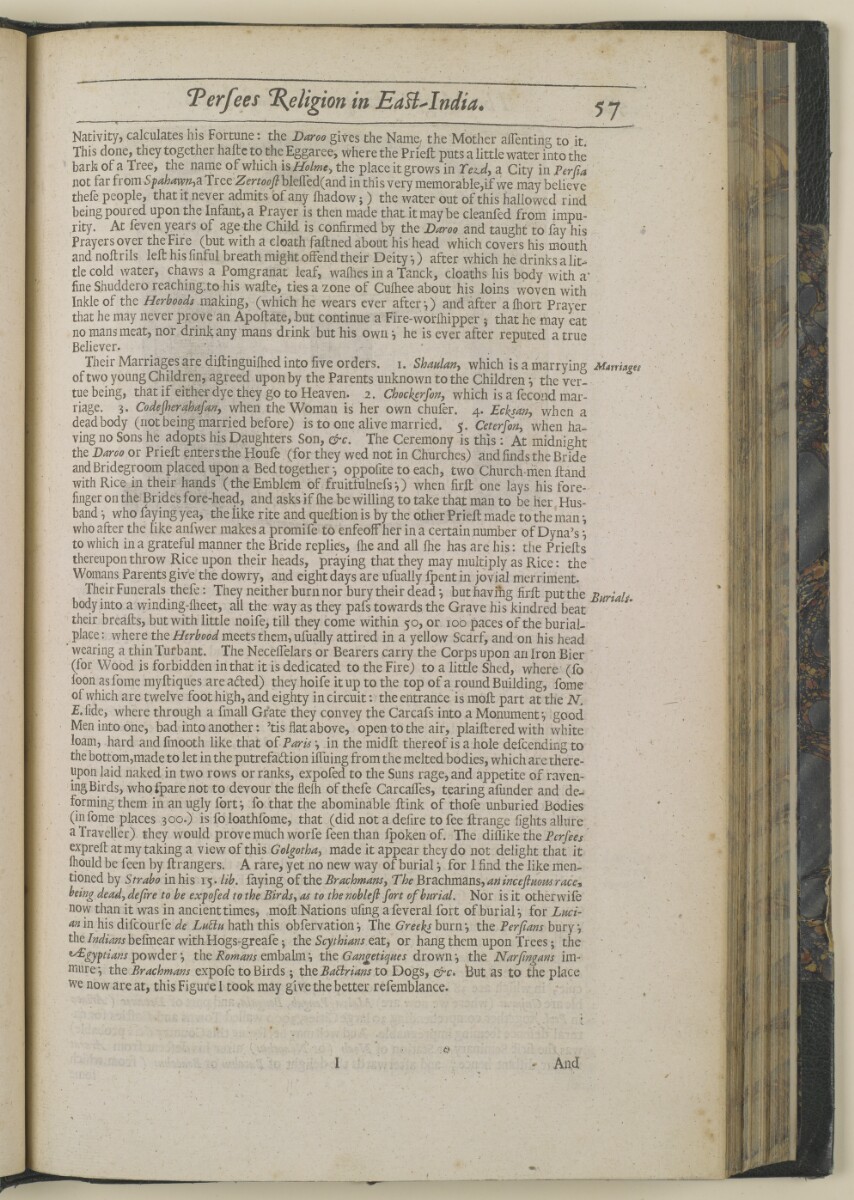
T* erfees Religion in Easl-India. 5 j
Nativity, calculates his Fortune: the Daroo gives the Name, the Mother aflenting to it
This done, they together hafte to the Eggaree, where the Pneft puts a little water into the
bark of a Tree, the name of which Holme the place it grows in TW, a City in VerCia
not far fromSpaham^ TreeZertoofi blefred(and in this very memorable,if we may believe
thefe people, that it never admits of any ftiadow; ) the water out of this hallowed rind
being poured upon the Infant, a Prayer is then made that it may be cleanfed from impu
rity. At feven years of age the Child is confirmed by the Daroo and taught to fay his
Prayers over the Fire (but with a cloath faftned about his head which covers his mouth
and noftrils left his finful breath might offend their Deity v) after which he drinks a lit
tle cold water, chaws a Pomgranat leaf, walhes in a Tanck, cloaths his body with a"
fine Shuddero reaching,to his wafte, ties a zone of Cuihee about his loins woven with
Inkle of the Herboods making, (which he wears ever after*,) andafter afhort Prayer
that he may never prove an Apoftate, but continue a Fire-worihipper 5 that he may eat
no mans meat, nor drink any mans drink but his own *, he is ever after reputed a true
Believer.
Their Marriages are diflinguifhed into five orders. 1. Shaulan, which is a marrying Mmiaget
of two young Children, agreed upon by the Parents unknown to the Children *, the ver-
tue being, that if either dye they go to Heaven. 2. Chockerfon, which is a fecond mar
riage. 3. Codejherahafan, when the Woman is her own chufer. 4. Eeksan, when a
dead body (not being married before) is to one alive married. 5. Ceterfon, when ha
ving no Sons he adopts his Daughters Son, &c. The Ceremony is this; At midnight
the Daroo or Prieft enters the Houfe (for they wed not in Churches) and finds the Bride
and Bridegroom placed upon a Bed together *, oppofite to each, two Church men ftand
with Rice in their hands (the Emblem of fruitfulnefs0 when firft one lays his fore
finger on the Brides fore-head, and asks if ihe be willing to take that man to be her Hus
band who faying yea, the like rite and queftion is by the other Prieft made to the man *,
who after the like anfwer makes a promife to enfeoff her in a certain number of Dyna's
to which in a grateful manner the Bride replies, fhe and all fhe has are his: the Priefts
thereupon throw Rice upon their heads, praying that they may multiply as Rice: the
Womans Parents give the dowry, and eight days are ufually fpent in jovial merriment.
Their Funerals thefe: They neither burn nor bury their dead ^ but having firft put the BuriaU.
body into a winding-fheet, all the way as they pafs towards the Grave his kindred beat
their breafts, but with little noife, till they come within 50, or 100 paces of the burial-
place: where the Herbood meets them, ufually attired in a yellow Scarf, and on his head
wearing a thin Turbant. The Neceffelars or Bearers carry the Corps upon an Iron Bier
(for Wood is forbidden in that it is dedicated to the Fire) to a little Shed, where (fo
foon asfome myftiques areaded) they hoife it up to the top of a round Building, fome
of which are twelve foot high, and eighty in circuit: the entrance is molt part at the N.
E'fide, where through a fmall Grate they convey the Carcafs into a Monument', good
Men into one, bad into another: 'tis flat above, open to the air, plaiftered with white
loam, hard and finooth like that of Paris ^ in the midft thereof is a hole defcending to
the bottom,made to let in the putrefadion iffuing from the melted bodies, which are there
upon laid naked in two rows or ranks, expofed to the Suns rage, and appetite of raven
ing Birds, whofparenot to devour the flefh of thefe Carcaffes, tearing afunder and de
forming them in an ugly fort:, fo that the abominable ftink of thofe unburied Bodies
(infome places 300.) is fo loathfome, that (did not a defire to fee ftrange lights allure
a Traveller) they would prove much worfe feen than Ipoken of. The diflike the
expreft at my taking a view of this Golgotha, made it appear they dp not delight that it
fhould be feen by ftrangers. A rare, yet no new way of burial •, for 1 find the like men
tioned by Strabo in his 15. lib. faying of the Brachmam, The Brachmans, an inceftmm race*
being dead-, defire to be expofed to the Birds, as to the noblefi fort of burial. Nor is it other wife
now than it was in ancient times, moft Nations ufing a feveral fort of burial^ for Luci-
an in his difcourfe de LhUu hath this obfervation ^ The Greeks burn*, the Terfians bury j
the Indians befmear with Hogs-greafe •, the Scythians eat, or hang them upon Trees; the
Egyptians powder *, the Romans embalm, the Gangetiques drown *, the Narfingans im
pure*, the Brachmans expofe to Birds; the BaBrians to Dogs, &c. But as to the place
we now are at, this Figure 1 took may give the better refemblance.
■ * .
I r And
About this item
- Content
Some years travels into divers parts of Africa, and Asia the great. Describing more particularly the empires of Persia and Industan: interwoven with such remarkable occurrences as hapned in those parts during these later times. As also, many other rich and famous kingdoms in the oriental India, with the isles adjacent. Severally relating their religion, language, customs and habit: as also proper observations concerning them.
Publication Details: London : printed by R. Everingham, for R. Scot, T. Basset, J. Wright, and R. Chiswell, 1677.
Edition: In this fourth impression are added (by the author now living) as well many additions throughout the whole work, as also several sculptures, never before printed.
Notes: Numerous engraved illustrations, including maps, views of cities and animals, printed within the text. Engraved plate entitled "Rvines of Persæpolis" is signed "W. Hollar fecit 1663". Misprinted page number: 711 instead of 117. Bibliography note: Includes bibliographical references and index.
Physical Description: [6], 399, [21] p., [4] leaves of plates (1 folded) : ill., maps ; 32 cm. (fol.)
- Extent and format
- 1 volume (399 pages)
- Physical characteristics
Dimensions: 320mm x 210mm
- Written in
- English in Latin script View the complete information for this record
Use and share this item
- Share this item
'Some years travels into divers parts of Africa, and Asia the great. Describing more particularly the empires of Persia and Industan: interwoven with such remarkable occurrences as hapned in those parts during these later times. As also, many other rich and famous kingdoms in the oriental India, with the isles adjacent. Severally relating their religion, language, customs and habit: as also proper observations concerning them.' [57] (78/448), British Library: Printed Collections, 215.e.12., in Qatar Digital Library <https://www.qdl.qa/archive/81055/vdc_100023696099.0x00004f> [accessed 24 June 2026]
https://www.qdl.qa/en/archive/81055/vdc_100023696099.0x00004f
Copy and paste the code below into your web page where you would like to embed the image.
<meta charset="utf-8"><a href="https://www.qdl.qa/en/archive/81055/vdc_100023696099.0x00004f">'Some years travels into divers parts of Africa, and Asia the great. Describing more particularly the empires of Persia and Industan: interwoven with such remarkable occurrences as hapned in those parts during these later times. As also, many other rich and famous kingdoms in the oriental India, with the isles adjacent. Severally relating their religion, language, customs and habit: as also proper observations concerning them.' [‎57] (78/448)</a> <a href="https://www.qdl.qa/en/archive/81055/vdc_100023696099.0x00004f"> <img src="https://iiif.qdl.qa/iiif/images/81055/vdc_100023517877.0x000001/215.e.12._0078.jp2/full/!280,240/0/default.jpg" alt="" /> </a>
This record has a IIIF manifest available as follows. If you have a compatible viewer you can drag the icon to load it.https://www.qdl.qa/en/iiif/81055/vdc_100023517877.0x000001/manifestOpen in Universal viewerOpen in Mirador viewerMore options for embedding images
Copyright: How to use this content
- Reference
- 215.e.12.
- Title
- 'Some years travels into divers parts of Africa, and Asia the great. Describing more particularly the empires of Persia and Industan: interwoven with such remarkable occurrences as hapned in those parts during these later times. As also, many other rich and famous kingdoms in the oriental India, with the isles adjacent. Severally relating their religion, language, customs and habit: as also proper observations concerning them.'
- Pages
- front, back, spine, edge, head, tail, front-i, i-r:iii-v, 1:8, 1:242, 242a:242b, 243:418, iv-r:vi-v, back-i
- Author
- Herbert, Thomas
- Usage terms
- Public Domain