
!['The Expedition for the survey of the rivers Euphrates and Tigris, carried on by order of the British government, in the years 1835, 1836, and 1837; preceded by geographical and historical notices of the regions situated between the rivers Nile and Indus. In four volumes. With fourteen maps and charts, and embellished with ninety-seven plates, besides numerous wood-cuts. Volume the first.' [‎144] (199/905)](https://iiif.qdl.qa/iiif/images/81055/vdc_100023550132.0x000001/IOL_1947_C_142_0200.jp2/full/!1200,1200/0/default.jpg "'The Expedition for the survey of the rivers Euphrates and Tigris, carried on by order of the British government, in the years 1835, 1836, and 1837; preceded by geographical and historical notices of the regions situated between the rivers Nile and Indus. In four volumes. With fourteen maps and charts, and embellished with ninety-seven plates, besides numerous wood-cuts. Volume the first.' [‎144] (199/905)")
'The Expedition for the survey of the rivers Euphrates and Tigris, carried on by order of the British government, in the years 1835, 1836, and 1837; preceded by geographical and historical notices of the regions situated between the rivers Nile and Indus. In four volumes. With fourteen maps and charts, and embellished with ninety-seven plates, besides numerous wood-cuts. Volume the first.' [144] (199/905)
The record is made up of 1 volume (799 pages). It was created in 1850. It was written in English. The original is part of the British Library: Printed Collections.
Transcription
This transcription is created automatically. It may contain errors.
144
ARMENIAN DISTRICTS.
[CHAP. VII.
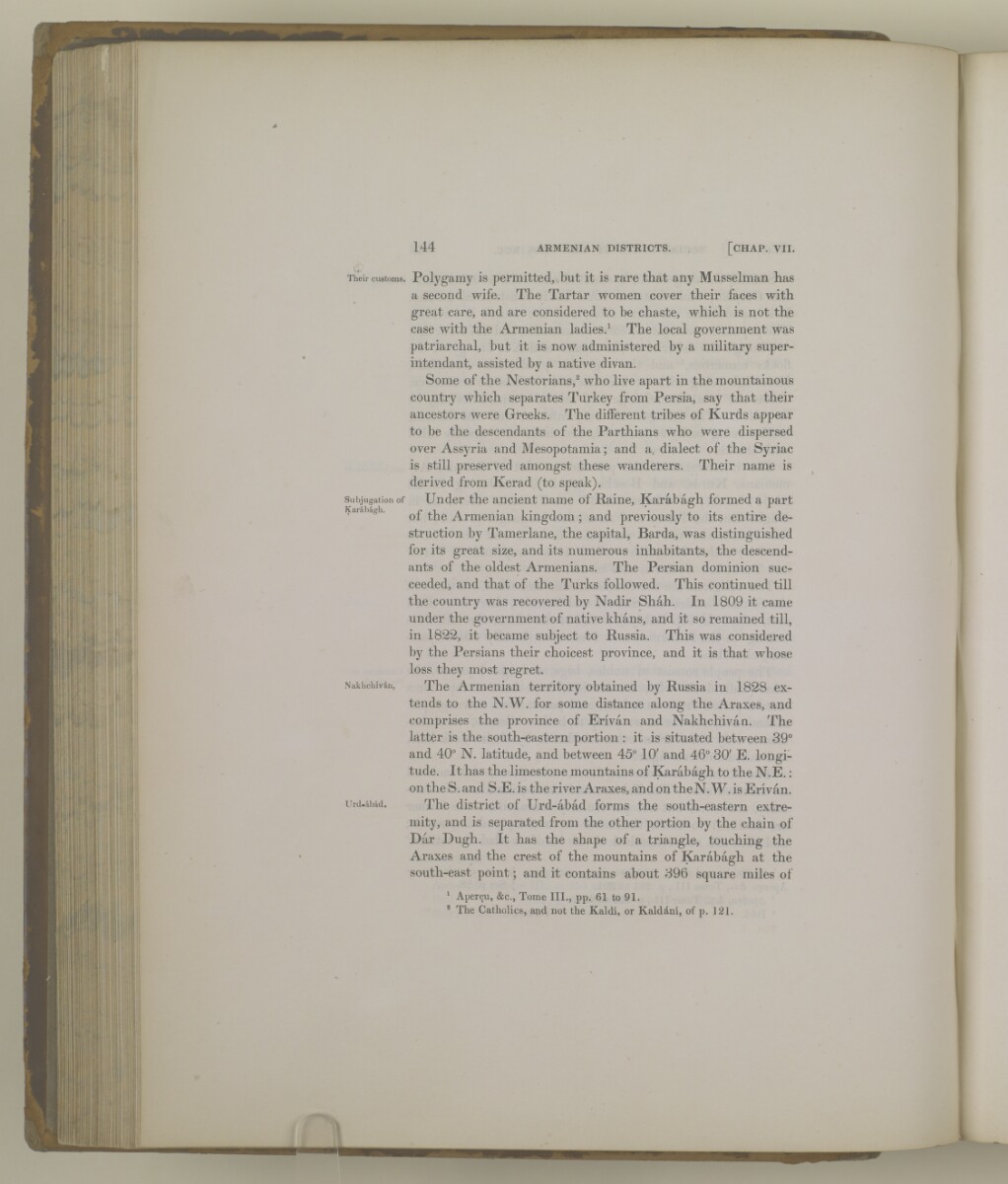
Their customs. Polygamy is permitted,, but it is rare that any Musselman has
a second wife. The Tartar women cover their faces with
great care, and are considered to be chaste, which is not the
case with the Armenian ladies. 1 The local government was
patriarchal, but it is now administered by a military super-
intendant, assisted by a native divan.
Some of the Nestorians, 2 who live apart in the mountainous
country which separates Turkey from Persia, say that their
ancestors were Greeks. The different tribes of Kurds appear
to be the descendants of the Parthians who were dispersed
over Assyria and Mesopotamia; and a f dialect of the Syriac
is still preserved amongst these wanderers. Their name is
derived from Kerad (to speak).
Subjugation of Under the ancient name of Raine, Karabagh formed a part
Karabagh. ^ Armenian kingdom; and previously to its entire de
struction by Tamerlane, the capital, Barda, was distinguished
for its great size, and its numerous inhabitants, the descend
ants of the oldest Armenians. The Persian dominion suc
ceeded, and that of the Turks followed. This continued till
the country was recovered by Nadir Shah. In 1809 it came
under the government of native khans, and it so remained till,
in 1822, it became subject to Russia. This was considered
by the Persians their choicest province, and it is that whose
loss they most regret.
NakhchivS.ri, The Armenian territory obtained by Russia in 1828 ex
tends to the N.W. for some distance along the Araxes, and
comprises the province of Erivan and Nakhchivan. The
latter is the south-eastern portion: it is situated between 39°
and 40° N. latitude, and between 45° 10' and 46° 30' E. longi
tude. It has the limestone mountains of Karabagh to the N.E.:
on the S. and S.E. is the river Araxes, and on the N.W. is Erivan.
Urd-ibad. The district of Urd-abad forms the south-eastern extre
mity, and is separated from the other portion by the chain of
Dar Dugh. It has the shape of a triangle, touching the
Araxes and the crest of the mountains of Karabagh at the
south-east point; and it contains about 396 square miles of
1 Aper^u, &c., Tome III., pp. 61 to 91.
' The Catholics, and not the Kaldi, or Kalddni, of p. 121.
About this item
- Content
The Expedition for the survey of the rivers Euphrates and Tigris, carried on by order of the British government, in the years 1835, 1836, and 1837; preceded by geographical and historical notices of the regions situated between the rivers Nile and Indus. In four volumes. With fourteen maps and charts, and embellished with ninety-seven plates, besides numerous wood-cuts. Volume the first.
Publication Details: London : Longman, Brown, Green and Longmans, 1850 Printed by W. Clowes and sons, Stamford Street.
Notes: Printer's name from colophon Section at the end of a manuscript text. . Only two volumes of text and an atlas containing the maps were published.
Bibliography note: Includes bibliographical references and index.
Physical Description: xxvii, [3], 799, [1] p., [29] leaves of plates (1 folded), (the plates are numbered: 1, 3-9, 11-26, 28, 33, 37, 39, 42-43). Vol. 1, p. 705-706 and p. 707-708 are fold-out leaves.
- Extent and format
- 1 volume (799 pages)
- Physical characteristics
Dimensions: 320mm x 240mm
- Written in
- English in Latin script View the complete information for this record
Use and share this item
- Share this item
'The Expedition for the survey of the rivers Euphrates and Tigris, carried on by order of the British government, in the years 1835, 1836, and 1837; preceded by geographical and historical notices of the regions situated between the rivers Nile and Indus. In four volumes. With fourteen maps and charts, and embellished with ninety-seven plates, besides numerous wood-cuts. Volume the first.' [144] (199/905), British Library: Printed Collections, IOL.1947.c.142, in Qatar Digital Library <https://www.qdl.qa/archive/81055/vdc_100023939721.0x0000c8> [accessed 29 June 2026]
https://www.qdl.qa/en/archive/81055/vdc_100023939721.0x0000c8
Copy and paste the code below into your web page where you would like to embed the image.
<meta charset="utf-8"><a href="https://www.qdl.qa/en/archive/81055/vdc_100023939721.0x0000c8">'The Expedition for the survey of the rivers Euphrates and Tigris, carried on by order of the British government, in the years 1835, 1836, and 1837; preceded by geographical and historical notices of the regions situated between the rivers Nile and Indus. In four volumes. With fourteen maps and charts, and embellished with ninety-seven plates, besides numerous wood-cuts. Volume the first.' [‎144] (199/905)</a> <a href="https://www.qdl.qa/en/archive/81055/vdc_100023939721.0x0000c8"> <img src="https://iiif.qdl.qa/iiif/images/81055/vdc_100023550132.0x000001/IOL_1947_C_142_0200.jp2/full/!280,240/0/default.jpg" alt="" /> </a>
This record has a IIIF manifest available as follows. If you have a compatible viewer you can drag the icon to load it.https://www.qdl.qa/en/iiif/81055/vdc_100023550132.0x000001/manifestOpen in Universal viewerOpen in Mirador viewerMore options for embedding images
Copyright: How to use this content
- Reference
- IOL.1947.c.142
- Title
- 'The Expedition for the survey of the rivers Euphrates and Tigris, carried on by order of the British government, in the years 1835, 1836, and 1837; preceded by geographical and historical notices of the regions situated between the rivers Nile and Indus. In four volumes. With fourteen maps and charts, and embellished with ninety-seven plates, besides numerous wood-cuts. Volume the first.'
- Pages
- front, back, spine, head, edge, tail, front-i, i-r:ii-v, 1:30, 1:8, 8a, 8a, 9:34, 34a:34b, 35:48, 48a:48b, 49:92, 92a:92b, 93:114, 114a:114b, 115:116, 116a:116b, 117:138, 138a:138b, 139:189, 188:198, 198a:198b, 199:208, 208a:208b, 209:212, 212a:212b, 213:230, 230a:230b, 231:266, 266a:266b, 267:310, 310a:310b, 311:324, 324a:324b, 325:336, 336a:336b, 337:350, 350a:350b, 351:368, 368a:368b, 369:392, 392a:392b, 393:406, 406a:406b, 407:426, 426a:426b, 427:432, 432a:432b, 433:470, 470a:470b, 471:490, 490a:490b, 491:526, 526a:526b, 527:596, 596a:596b, 597:616, 616a:616b, 617:622, 622a:622b, 623:636, 636a:636b, 637:704, 704a, 705, 705, 707:802, iii-r:iii-v, back-i
- Author
- Chesney, Francis Rawdon
- Usage terms
- Public Domain