
!['History of the Indian Navy. (1613-1863).' [‎307] (326/622)](https://iiif.qdl.qa/iiif/images/81055/vdc_100023550043.0x000001/IOL.1947.a.1844 vol.2_0326.jp2/full/!1200,1200/0/default.jpg "'History of the Indian Navy. (1613-1863).' [‎307] (326/622)")
'History of the Indian Navy. (1613-1863).' [307] (326/622)
The record is made up of 1 volume (575 pages). It was created in 1877. It was written in English. The original is part of the British Library: Printed Collections.
Transcription
This transcription is created automatically. It may contain errors.
HISTORY OF THE INDIAN NAVY.
307
Jd
fci
adln,
\}\\
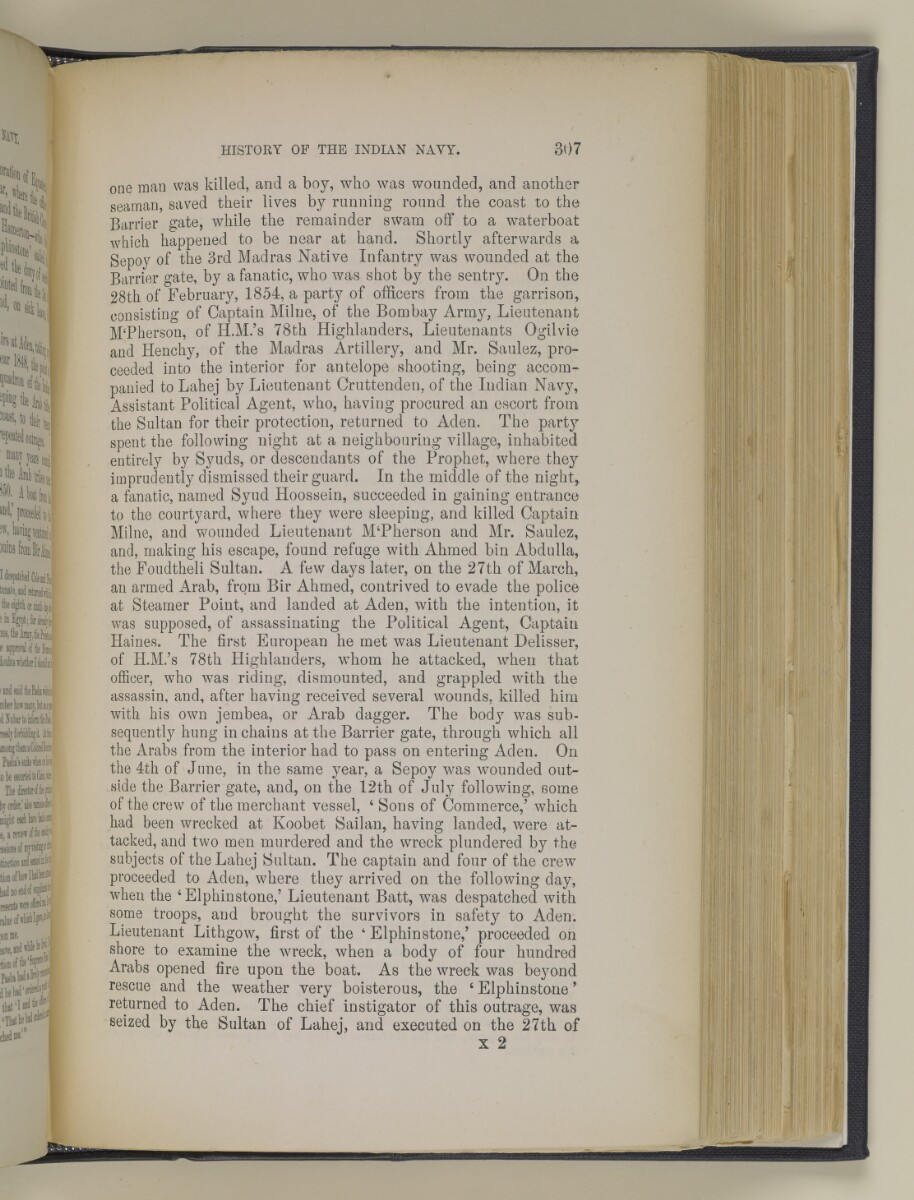
one man was killed, and a boy, who was wounded, and another
seaman, saved their lives by running round the coast to the
Barrier gate, while the remainder swam off to a waterboat
which happened to be near at hand. Shortly afterwards a
Sepoy
Term used in English to refer to an Indian infantryman. Carries some derogatory connotations as sometimes used as a means of othering and emphasising race, colour, origins, or rank.
of the 3rd Madras Native Infantry was wounded at the
Barrier gate, by a fanatic, who was shot by the sentry. On the
28th of February, 1854, a party of officers from the garrison,
consisting of Captain Milne, of the Bombay Army, Lieutenant
M'Pherson, of H.M.'s 78th Highlanders, Lieutenants Ogilvie
and Henchy, of the Madras Artillery, and Mr. Saulez, pro
ceeded into the interior for antelope shooting, being accom
panied to Lahej by Lieutenant Cruttenden, of the Indian Navy,
Assistant
Political Agent
A mid-ranking political representative (equivalent to a Consul) from the diplomatic corps of the Government of India or one of its subordinate provincial governments, in charge of a Political Agency.
, who, having procured an escort from
the Sultan for their protection, returned to Aden. The party
spent the following night at a neighbouring village, inhabited
entirely by Syuds, or descendants of the Prophet, where they
imprudently dismissed their guard. In the middle of the night,,
a fanatic, named Syud Hoossein, succeeded in gaining entrance
to the courtyard, where they were sleeping, and killed Captain
Milne, and wounded Lieutenant M'Pherson and Mr. Saulez,
and, making his escape, found refuge with Ahmed bin Abdulla,
the Foudtheli Sultan. A few days later, on the 27th of March,
an armed Arab, from Bir Ahmed, contrived to evade the police
at Steamer Point, and landed at Aden, with the intention, it
was supposed, of assassinating the
Political Agent
A mid-ranking political representative (equivalent to a Consul) from the diplomatic corps of the Government of India or one of its subordinate provincial governments, in charge of a Political Agency.
, Captain
Haines. The first European he met was Lieutenant Delisser,
of H.M.'s 78th Highlanders, whom he attacked, when that
officer, who was riding, dismounted, and grappled with the
assassin, and, after having received several wounds, killed him
with his own jembea, or Arab dagger. The body was sub
sequently hung in chains at the Barrier gate, through which all
the Arabs from the interior had to pass on entering Aden. On
the 4th of June, in the same year, a
Sepoy
Term used in English to refer to an Indian infantryman. Carries some derogatory connotations as sometimes used as a means of othering and emphasising race, colour, origins, or rank.
was wounded out
side the Barrier gate, and, on the 12th of July following, some
of the crew of the merchant vessel, 6 Sons of Commerce,' which
had been wrecked at Koobet Sailan, having landed, were at
tacked, and two men murdered and the wreck plundered by the
subjects of the Lahej Sultan. The captain and four of the crew
proceeded to Aden, where they arrived on the following day,
when the c Elphinstone,' Lieutenant Batt, was despatched with
some troops, and brought the survivors in safety to Aden.
Lieutenant Lithgow, first of the 4 Elphinstone,' proceeded on
shore to examine the wreck, when a body of four hundred
Arabs opened fire upon the boat. As the wreck was beyond
rescue and the weather very boisterous, the ' Elphinstone'
returned to Aden. The chief instigator of this outrage, was
seized by the Sultan of Lahej, and executed on the 27th of
x 2
iiil
N -i
11
mm ' i
About this item
- Content
History of the Indian Navy. (1613-1863).
Author: Charles Rathbone Low.
Publication Details: London: Richard Bentley and Son, New Burlington Street.
Physical Description: initial Roman numeral pagination (i-vi); octavo.
- Extent and format
- 1 volume (575 pages)
- Arrangement
This volume contains a table of contents giving chapter headings and page references. Each chapter heading is followed by a detailed breakdown of the contents of that chapter.
- Physical characteristics
Dimensions: 229mm x 140mm
- Written in
- English in Latin script View the complete information for this record
Use and share this item
- Share this item
'History of the Indian Navy. (1613-1863).' [307] (326/622), British Library: Printed Collections, IOL.1947.a.1844 vol. 2, in Qatar Digital Library <https://www.qdl.qa/archive/81055/vdc_100023958180.0x00007f> [accessed 3 August 2026]
https://www.qdl.qa/en/archive/81055/vdc_100023958180.0x00007f
Copy and paste the code below into your web page where you would like to embed the image.
<meta charset="utf-8"><a href="https://www.qdl.qa/en/archive/81055/vdc_100023958180.0x00007f">'History of the Indian Navy. (1613-1863).' [‎307] (326/622)</a> <a href="https://www.qdl.qa/en/archive/81055/vdc_100023958180.0x00007f"> <img src="https://iiif.qdl.qa/iiif/images/81055/vdc_100023550043.0x000001/IOL.1947.a.1844 vol.2_0326.jp2/full/!280,240/0/default.jpg" alt="" /> </a>
This record has a IIIF manifest available as follows. If you have a compatible viewer you can drag the icon to load it.https://www.qdl.qa/en/iiif/81055/vdc_100023550043.0x000001/manifestOpen in Universal viewerOpen in Mirador viewerMore options for embedding images
Copyright: How to use this content
- Reference
- IOL.1947.a.1844 vol. 2
- Title
- 'History of the Indian Navy. (1613-1863).'
- Pages
- front, back, spine, edge, head, tail, front-i, i-r:iii-v, 1:6, 1:596, iv-r:vi-v, back-i
- Author
- Low. Charles Rathbone
- Usage terms
- Public Domain