
!['Collections of travels through Turky into Persia, and the East Indies. Giving an account of the present state of those countries, as also a full relation of the five years wars, between Aureng-Zebe and his brothers in their father's life time, about the succession. And a voyage made by the Great Mogul (Aureng-Zebe) with his Army from Dehli to Lahor, from Lahor to Bember, and from thence to the Kingdom of Kachemire, by the Mogols, call'd, the Paradise of the Indies. Together with a relation of the Kingdom of Japan and Tunkin, and of their particular manners and trade. To which is added a new description of the Grand Seignior's Seraglio, and also of all the Kingdoms that encompass the Euxine and Caspian Seas, being the travels of Monsieur TavernierBernier, and other great men.' [‎2] (673/1024)](https://iiif.qdl.qa/iiif/images/81055/vdc_100023560208.0x000001/567.i.19._0673.jp2/full/!1200,1200/0/default.jpg "'Collections of travels through Turky into Persia, and the East Indies. Giving an account of the present state of those countries, as also a full relation of the five years wars, between Aureng-Zebe and his brothers in their father's life time, about the succession. And a voyage made by the Great Mogul (Aureng-Zebe) with his Army from Dehli to Lahor, from Lahor to Bember, and from thence to the Kingdom of Kachemire, by the Mogols, call'd, the Paradise of the Indies. Together with a relation of the Kingdom of Japan and Tunkin, and of their particular manners and trade. To which is added a new description of the Grand Seignior's Seraglio, and also of all the Kingdoms that encompass the Euxine and Caspian Seas, being the travels of Monsieur TavernierBernier, and other great men.' [‎2] (673/1024)")
'Collections of travels through Turky into Persia, and the East Indies. Giving an account of the present state of those countries, as also a full relation of the five years wars, between Aureng-Zebe and his brothers in their father's life time, about the succession. And a voyage made by the Great Mogul (Aureng-Zebe) with his Army from Dehli to Lahor, from Lahor to Bember, and from thence to the Kingdom of Kachemire, by the Mogols, call'd, the Paradise of the Indies. Together with a relation of the Kingdom of Japan and Tunkin, and of their particular manners and trade. To which is added a new description of the Grand Seignior's Seraglio, and also of all the Kingdoms that encompass the Euxine and Caspian Seas, being the travels of Monsieur TavernierBernier, and other great men.' [2] (673/1024)
The record is made up of 1 volume (898 pages). It was created in 1684. It was written in English. The original is part of the British Library: Printed Collections.
Transcription
This transcription is created automatically. It may contain errors.
2
The Hiflory of the Late Revolution
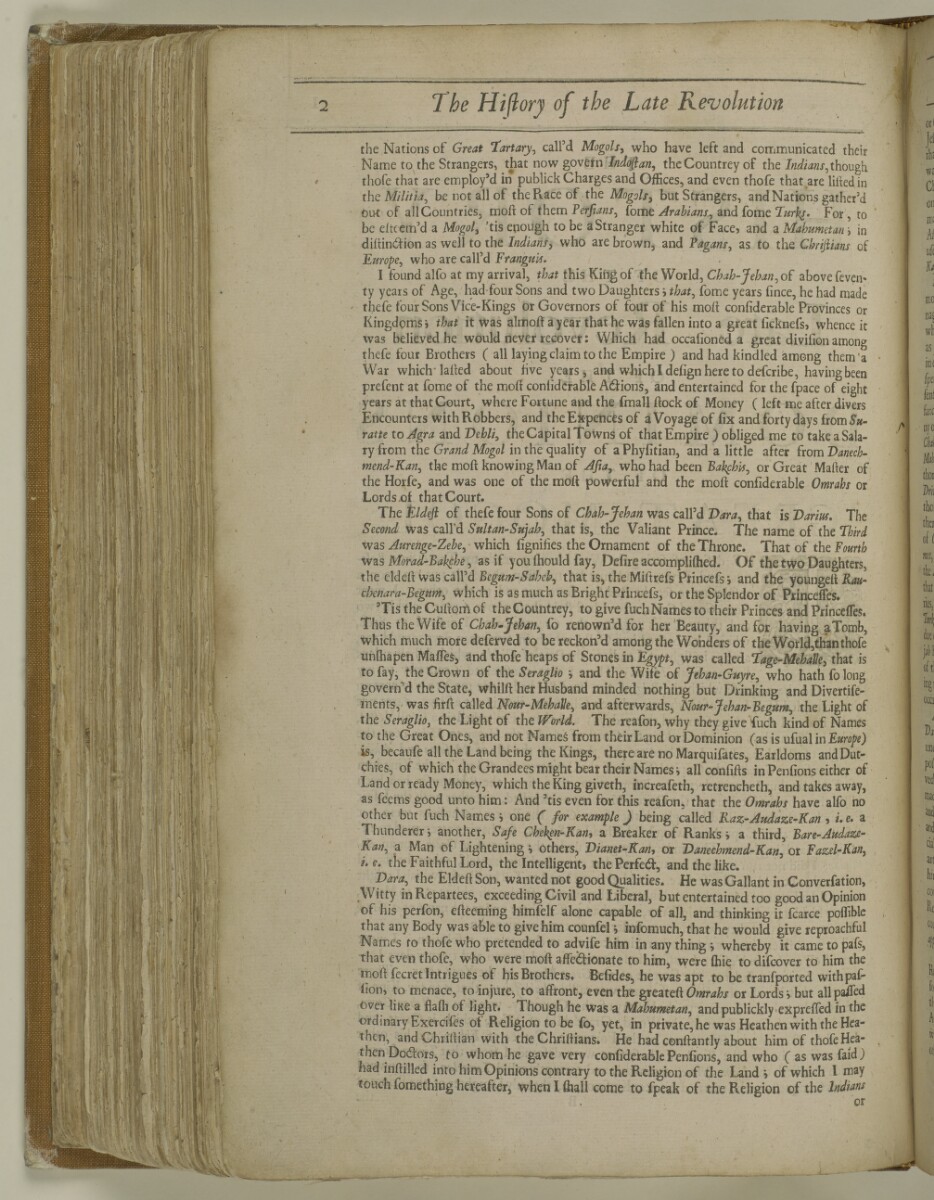
the Nations of Great Tartary^ call’d Mogols, who have left and communicated their
Name to the Strangers, that now govern 'Indoftan, the Countrey of the Indians, though
thofe that are employ’d in publick Charges and Offices, and even thofe that are lifted in
the Militia, be not all of the Pvace of the Mogols, but Strangers, and Nations gather’d
out of all Countries, moft of them Perfians, fome Arabians, and fome For, to
be dteem’d a Mogol, ’tis enough to be a Stranger white of Face, and a Mahumetan i in
diitindion as well to the Indians, who are brown, and Pagans, as to the Cbrijlians of
Europe, who are call’d Franguis.
I found alfo at my arrival, that this King of the World, Chah-Jehan, of above fevem
ty years of Age, had four Sons and two Daughters i that, fome years fince, he had made
thefe four Sons Vice-Kings or Governors of four of his molt confiderable Provinces or
Kingdoms i that it was almoft a year that he was fallen into a great ficknefs, whence it
was believed he would never recover: Which had occafioned a great divifion among
thefe four Brothers ( all laying claim to the Empire ) and had kindled among them a
War which'lalted about live years, and whichldefignhereto defcribe, having been
prefent at fome of the moft conlidcrable Actions, and entertained for the fpace of eight
years at that Court, where Fortune and the fmall ftock of Money ( left me after divers
Encounters with Robbers, and the Expences of a Voyage of fix and forty days from
ratte to Agra and Dehli, the Capital Towns of that Empire ) obliged me to take a Sala
ry from the Grand Mogol in the quality of a Phyfitian, and a little after from Danecb-
mend-Kan, the moft knowing Man of Afia, who had been Bal^hh, or Great Mafter of
the Horfe, and was one of the moft powerful and the moft confiderable Omrahs or
Lords.of that Court.
The Eldeji of thefe four Sons of Chah-Jehan was call’d Vara, that is Varius, The
Second was call’d Sultan-Sujah, that is, the Valiant Prince. The name of the Third
was Aurenge-Zebe, which figniftes the Ornament of the Throne. That of the Forf
was Morad-Bakche, as if you fhould fay. Defire accomplifhed. Of the two Daughters,
the eldeft was call’d
Begum
Courteous or formal title for (usually Muslim) women of elite status, especially of Turko-Mongol lineage.
-Saheb, that is, the Miftrefs Princefsi and the youngeft Rau-
chenara-Begnm, which is as much as Bright Princefs, or the Splendor of Princeffes.
’Tis theGuftom of theCountrey, to give fuchNames to their Princes and Princefles.
Thus the Wife of Chah-Jehan, fo renown’d for her Beauty, and for having aTomb,
which much more deferved to be reckon’d among the Wonders of the World,than thofe
unlhapen Maffes, and thofe heaps of Stones in Egypt, was called Tage-MehaUe, that is
to fay, the Crown of the Seraglio > and the Wife of Jehan-Guyre, who hath fblong
govern’d the State, whilft her Husband minded nothing but Drinking and Divertife-
ments, was firft called Nour-Mehalle, and afterwards, Nour-Jehan-
Begum
Courteous or formal title for (usually Muslim) women of elite status, especially of Turko-Mongol lineage.
, the Light of
the Seraglio, the Light of the World. The reafon, why they give fuch kind of Names
to the Great Ones, and not Names from their Land or Dominion (as is ufual in Europe)
is, becaufe all the Land being the Kings, there are no Marquifates, Earldoms and Dut
ches, of which the Grandees might bear their Names i all confifts in Penfions either of
Land or ready Money, which the King giveth, increafeth, retrencheth, and takes away,
as feems good unto him: And ’tis even for this reafon, that the Omrahs have alfo no
other but fuch Names j one ( for example ) being called Raz-Audaze-Kan , i. e. a
Thunderer j another, Safe Chetyn-Kan, a Breaker of Ranks i a third, Bare-Audaze-
Kan, a Man of Lightening i others, Vianet-Kan, or Vanechmend-Kan, or Fazel-Kan,
i. e. the Faithful Lord, the Intelligent, the Perfedf, and the like.
Vara, the Eldeft Son, wanted not good Qualities. He was Gallant in Converfation,
Witty in Repartees, exceeding Civil and Liberal, but entertained too good an Opinion
of his perfon, efteeming himfelf alone capable of all, and thinking it fcarce poffibie
that any Body was able to give him counfel j infbmuch, that he would give reproachful
Names to thofe who pretended to advife him in any thing i whereby it came to pafs,
that even thofe, who were moft affe&ionate to him, were (hie to difcover to him the
moft fecret Intrigues of his Brothers. Befides, he was apt to be tranfported withpaf-
lion, to menace, to injure, to affront, even the gveateft Omrahs or Lords i but allpaifed
twer liKe a flafli of light. Though he was a Mahumetan, andpublickly exprefted in the
ordinary Exercifes of Religion to be fo, yet, in private, he was Heathen with the Hea
then, and Chriftian with the Chriftians. He had conftantly about him of thofe Hea
then Docftors, to whom he gave very confiderable Penfions, and who ( as was faid)
had inftilled into him Opinions contrary to the Religion of the Land i of which 1 may
touch fomething hereafter, when I (hall come to fpeak of the Religion of the Indians
About this item
- Content
Collections of travels through Turky into Persia, and the East Indies. Giving an account of the present state of those countries, as also a full relation of the five years wars, between Aureng-Zebe and his brothers in their father's life time, about the succession. And a voyage made by the Great Mogul (Aureng-Zebe) with his Army from Dehli to Lahor, from Lahor to Bember, and from thence to the Kingdom of Kachemire, by the Mogols, call'd, the Paradise of the Indies. Together with a relation of the Kingdom of Japan and Tunkin, and of their particular manners and trade. To which is added a new description of the Grand Seignior's Seraglio, and also of all the Kingdoms that encompass the Euxine and Caspian Seas, being the travels of Monsieur TavernierBernier, and other great men.
Author: John-Baptist Tavernier
Publication details: Printed for Moses Pitt at the Angel in St Paul's Churchyard, MDCLXXXIV [1864].
Physical description: Pagination. Vol. 1: [18], 184, 195-264, [2]; [2], 214; [6], 94, [6], 101-113, [1] p., [23] leaves of plates (1 folded). Vol. 2: [8], 154; [12], 14, [2], 15-46, 47-87, [3]; 66 p., [10] leaves of plates (2 folded).
Misprinted page numbers. Vol. 1, part I: 176 instead of 169; 169 instead of 176; 201 instead of 209; 202 instead of 210. Vol. 1, part II: 56 instead of 58; 61 instead of 63; 178 instead of 187. Vol. 1, part III: 13 instead of 30; 49 instead of 48. Vol. 2, part II: 93 instead of 39.
- Extent and format
- 1 volume (898 pages)
- Arrangement
The volume contains a table of contents giving chapter headings and page references which covers all four books within the volume. There is also a list of illustrations giving titles anf page references. There is an alphabetic index at the end of Books I and II and a separate alphabetic index of place names which accompanies the map at the beginning of book IV.
- Physical characteristics
Dimensions: 306 x 200mm
- Written in
- English in Latin script View the complete information for this record
Use and share this item
- Share this item
'Collections of travels through Turky into Persia, and the East Indies. Giving an account of the present state of those countries, as also a full relation of the five years wars, between Aureng-Zebe and his brothers in their father's life time, about the succession. And a voyage made by the Great Mogul (Aureng-Zebe) with his Army from Dehli to Lahor, from Lahor to Bember, and from thence to the Kingdom of Kachemire, by the Mogols, call'd, the Paradise of the Indies. Together with a relation of the Kingdom of Japan and Tunkin, and of their particular manners and trade. To which is added a new description of the Grand Seignior's Seraglio, and also of all the Kingdoms that encompass the Euxine and Caspian Seas, being the travels of Monsieur TavernierBernier, and other great men.' [2] (673/1024), British Library: Printed Collections, 567.i.19., in Qatar Digital Library <https://www.qdl.qa/archive/81055/vdc_100026187080.0x00004a> [accessed 27 June 2026]
https://www.qdl.qa/en/archive/81055/vdc_100026187080.0x00004a
Copy and paste the code below into your web page where you would like to embed the image.
<meta charset="utf-8"><a href="https://www.qdl.qa/en/archive/81055/vdc_100026187080.0x00004a">'Collections of travels through Turky into Persia, and the East Indies. Giving an account of the present state of those countries, as also a full relation of the five years wars, between Aureng-Zebe and his brothers in their father's life time, about the succession. And a voyage made by the Great Mogul (Aureng-Zebe) with his Army from Dehli to Lahor, from Lahor to Bember, and from thence to the Kingdom of Kachemire, by the Mogols, call'd, the Paradise of the Indies. Together with a relation of the Kingdom of Japan and Tunkin, and of their particular manners and trade. To which is added a new description of the Grand Seignior's Seraglio, and also of all the Kingdoms that encompass the Euxine and Caspian Seas, being the travels of Monsieur TavernierBernier, and other great men.' [‎2] (673/1024)</a> <a href="https://www.qdl.qa/en/archive/81055/vdc_100026187080.0x00004a"> <img src="https://iiif.qdl.qa/iiif/images/81055/vdc_100023560208.0x000001/567.i.19._0673.jp2/full/!280,240/0/default.jpg" alt="" /> </a>
This record has a IIIF manifest available as follows. If you have a compatible viewer you can drag the icon to load it.https://www.qdl.qa/en/iiif/81055/vdc_100023560208.0x000001/manifestOpen in Universal viewerOpen in Mirador viewerMore options for embedding images
Copyright: How to use this content
- Reference
- 567.i.19.
- Title
- 'Collections of travels through Turky into Persia, and the East Indies. Giving an account of the present state of those countries, as also a full relation of the five years wars, between Aureng-Zebe and his brothers in their father's life time, about the succession. And a voyage made by the Great Mogul (Aureng-Zebe) with his Army from Dehli to Lahor, from Lahor to Bember, and from thence to the Kingdom of Kachemire, by the Mogols, call'd, the Paradise of the Indies. Together with a relation of the Kingdom of Japan and Tunkin, and of their particular manners and trade. To which is added a new description of the Grand Seignior's Seraglio, and also of all the Kingdoms that encompass the Euxine and Caspian Seas, being the travels of Monsieur TavernierBernier, and other great men.'
- Pages
- front, back, spine, edge, head, tail, front-i, i-r:ii-v, 1:18, 1:12, 12a:12b, 13:14, 14a:14b, 15:50, 50a:50b, 51:56, 56a:56b, 57:86, 86a:86b, 87:128, 128a:128b, 129:178, 178a:178b, 179:184, 195:256, 256a:256b, 257:258, 258a:258b, 259:264, iii-r:iv-v, 1:2, 2a:2b, 3:4, 4a:4b, 5:6, 6a:6b, 7:8, 8a:8b, 9:10, 10a:10b, 11:12, 12a:12b, 13:14, 14a:14b, 15:148, 148a:148d, 149:150, 150a:150b, 151:152, 152a:152b, 153:166, 166a:166b, 167:214, 1:6, 1:114, 1:8, 1:154, 1:18, 1:14, 14a:14f, 15:16, 16a:16b, 17:22, 22a:22b, 23:46, 46a:46h, 47:52, 52a:52b, 53:92, 1:66, v-r:v-v, back-i
- Author
- Tavernier, Jean-Baptiste, 1605-1689--Travel
- Usage terms
- Public Domain
- Reference
- 567.i.19.
- Title
- 'Collections of travels through Turky into Persia, and the East Indies. Giving an account of the present state of those countries, as also a full relation of the five years wars, between Aureng-Zebe and his brothers in their father's life time, about the succession. And a voyage made by the Great Mogul (Aureng-Zebe) with his Army from Dehli to Lahor, from Lahor to Bember, and from thence to the Kingdom of Kachemire, by the Mogols, call'd, the Paradise of the Indies. Together with a relation of the Kingdom of Japan and Tunkin, and of their particular manners and trade. To which is added a new description of the Grand Seignior's Seraglio, and also of all the Kingdoms that encompass the Euxine and Caspian Seas, being the travels of Monsieur TavernierBernier, and other great men.'
- Pages
- front, back, spine, edge, head, tail, front-i, i-r:ii-v, 1:18, 1:12, 12a:12b, 13:14, 14a:14b, 15:50, 50a:50b, 51:56, 56a:56b, 57:86, 86a:86b, 87:128, 128a:128b, 129:178, 178a:178b, 179:184, 195:256, 256a:256b, 257:258, 258a:258b, 259:264, iii-r:iv-v, 1:2, 2a:2b, 3:4, 4a:4b, 5:6, 6a:6b, 7:8, 8a:8b, 9:10, 10a:10b, 11:12, 12a:12b, 13:14, 14a:14b, 15:148, 148a:148d, 149:150, 150a:150b, 151:152, 152a:152b, 153:166, 166a:166b, 167:214, 1:6, 1:114, 1:8, 1:154, 1:18, 1:14, 14a:14f, 15:16, 16a:16b, 17:22, 22a:22b, 23:46, 46a:46h, 47:52, 52a:52b, 53:92, 1:66, v-r:v-v, back-i
- Author
- Tavernier, Jean-Baptiste, 1605-1689--Travel
- Usage terms
- Public Domain
- Reference
- 567.i.19.
- Title
- 'Collections of travels through Turky into Persia, and the East Indies. Giving an account of the present state of those countries, as also a full relation of the five years wars, between Aureng-Zebe and his brothers in their father's life time, about the succession. And a voyage made by the Great Mogul (Aureng-Zebe) with his Army from Dehli to Lahor, from Lahor to Bember, and from thence to the Kingdom of Kachemire, by the Mogols, call'd, the Paradise of the Indies. Together with a relation of the Kingdom of Japan and Tunkin, and of their particular manners and trade. To which is added a new description of the Grand Seignior's Seraglio, and also of all the Kingdoms that encompass the Euxine and Caspian Seas, being the travels of Monsieur TavernierBernier, and other great men.'
- Pages
- front, back, spine, edge, head, tail, front-i, i-r:ii-v, 1:18, 1:12, 12a:12b, 13:14, 14a:14b, 15:50, 50a:50b, 51:56, 56a:56b, 57:86, 86a:86b, 87:128, 128a:128b, 129:178, 178a:178b, 179:184, 195:256, 256a:256b, 257:258, 258a:258b, 259:264, iii-r:iv-v, 1:2, 2a:2b, 3:4, 4a:4b, 5:6, 6a:6b, 7:8, 8a:8b, 9:10, 10a:10b, 11:12, 12a:12b, 13:14, 14a:14b, 15:148, 148a:148d, 149:150, 150a:150b, 151:152, 152a:152b, 153:166, 166a:166b, 167:214, 1:6, 1:114, 1:8, 1:154, 1:18, 1:14, 14a:14f, 15:16, 16a:16b, 17:22, 22a:22b, 23:46, 46a:46h, 47:52, 52a:52b, 53:92, 1:66, v-r:v-v, back-i
- Author
- Tavernier, Jean-Baptiste, 1605-1689--Travel
- Usage terms
- Public Domain
- Reference
- 567.i.19.
- Title
- 'Collections of travels through Turky into Persia, and the East Indies. Giving an account of the present state of those countries, as also a full relation of the five years wars, between Aureng-Zebe and his brothers in their father's life time, about the succession. And a voyage made by the Great Mogul (Aureng-Zebe) with his Army from Dehli to Lahor, from Lahor to Bember, and from thence to the Kingdom of Kachemire, by the Mogols, call'd, the Paradise of the Indies. Together with a relation of the Kingdom of Japan and Tunkin, and of their particular manners and trade. To which is added a new description of the Grand Seignior's Seraglio, and also of all the Kingdoms that encompass the Euxine and Caspian Seas, being the travels of Monsieur TavernierBernier, and other great men.'
- Pages
- front, back, spine, edge, head, tail, front-i, i-r:ii-v, 1:18, 1:12, 12a:12b, 13:14, 14a:14b, 15:50, 50a:50b, 51:56, 56a:56b, 57:86, 86a:86b, 87:128, 128a:128b, 129:178, 178a:178b, 179:184, 195:256, 256a:256b, 257:258, 258a:258b, 259:264, iii-r:iv-v, 1:2, 2a:2b, 3:4, 4a:4b, 5:6, 6a:6b, 7:8, 8a:8b, 9:10, 10a:10b, 11:12, 12a:12b, 13:14, 14a:14b, 15:148, 148a:148d, 149:150, 150a:150b, 151:152, 152a:152b, 153:166, 166a:166b, 167:214, 1:6, 1:114, 1:8, 1:154, 1:18, 1:14, 14a:14f, 15:16, 16a:16b, 17:22, 22a:22b, 23:46, 46a:46h, 47:52, 52a:52b, 53:92, 1:66, v-r:v-v, back-i
- Author
- Tavernier, Jean-Baptiste, 1605-1689--Travel
- Usage terms
- Public Domain
- Reference
- 567.i.19.
- Title
- 'Collections of travels through Turky into Persia, and the East Indies. Giving an account of the present state of those countries, as also a full relation of the five years wars, between Aureng-Zebe and his brothers in their father's life time, about the succession. And a voyage made by the Great Mogul (Aureng-Zebe) with his Army from Dehli to Lahor, from Lahor to Bember, and from thence to the Kingdom of Kachemire, by the Mogols, call'd, the Paradise of the Indies. Together with a relation of the Kingdom of Japan and Tunkin, and of their particular manners and trade. To which is added a new description of the Grand Seignior's Seraglio, and also of all the Kingdoms that encompass the Euxine and Caspian Seas, being the travels of Monsieur TavernierBernier, and other great men.'
- Pages
- front, back, spine, edge, head, tail, front-i, i-r:ii-v, 1:18, 1:12, 12a:12b, 13:14, 14a:14b, 15:50, 50a:50b, 51:56, 56a:56b, 57:86, 86a:86b, 87:128, 128a:128b, 129:178, 178a:178b, 179:184, 195:256, 256a:256b, 257:258, 258a:258b, 259:264, iii-r:iv-v, 1:2, 2a:2b, 3:4, 4a:4b, 5:6, 6a:6b, 7:8, 8a:8b, 9:10, 10a:10b, 11:12, 12a:12b, 13:14, 14a:14b, 15:148, 148a:148d, 149:150, 150a:150b, 151:152, 152a:152b, 153:166, 166a:166b, 167:214, 1:6, 1:114, 1:8, 1:154, 1:18, 1:14, 14a:14f, 15:16, 16a:16b, 17:22, 22a:22b, 23:46, 46a:46h, 47:52, 52a:52b, 53:92, 1:66, v-r:v-v, back-i
- Author
- Tavernier, Jean-Baptiste, 1605-1689--Travel
- Usage terms
- Public Domain
- Reference
- 567.i.19.
- Title
- 'Collections of travels through Turky into Persia, and the East Indies. Giving an account of the present state of those countries, as also a full relation of the five years wars, between Aureng-Zebe and his brothers in their father's life time, about the succession. And a voyage made by the Great Mogul (Aureng-Zebe) with his Army from Dehli to Lahor, from Lahor to Bember, and from thence to the Kingdom of Kachemire, by the Mogols, call'd, the Paradise of the Indies. Together with a relation of the Kingdom of Japan and Tunkin, and of their particular manners and trade. To which is added a new description of the Grand Seignior's Seraglio, and also of all the Kingdoms that encompass the Euxine and Caspian Seas, being the travels of Monsieur TavernierBernier, and other great men.'
- Pages
- front, back, spine, edge, head, tail, front-i, i-r:ii-v, 1:18, 1:12, 12a:12b, 13:14, 14a:14b, 15:50, 50a:50b, 51:56, 56a:56b, 57:86, 86a:86b, 87:128, 128a:128b, 129:178, 178a:178b, 179:184, 195:256, 256a:256b, 257:258, 258a:258b, 259:264, iii-r:iv-v, 1:2, 2a:2b, 3:4, 4a:4b, 5:6, 6a:6b, 7:8, 8a:8b, 9:10, 10a:10b, 11:12, 12a:12b, 13:14, 14a:14b, 15:148, 148a:148d, 149:150, 150a:150b, 151:152, 152a:152b, 153:166, 166a:166b, 167:214, 1:6, 1:114, 1:8, 1:154, 1:18, 1:14, 14a:14f, 15:16, 16a:16b, 17:22, 22a:22b, 23:46, 46a:46h, 47:52, 52a:52b, 53:92, 1:66, v-r:v-v, back-i
- Author
- Tavernier, Jean-Baptiste, 1605-1689--Travel
- Usage terms
- Public Domain
- Reference
- 567.i.19.
- Title
- 'Collections of travels through Turky into Persia, and the East Indies. Giving an account of the present state of those countries, as also a full relation of the five years wars, between Aureng-Zebe and his brothers in their father's life time, about the succession. And a voyage made by the Great Mogul (Aureng-Zebe) with his Army from Dehli to Lahor, from Lahor to Bember, and from thence to the Kingdom of Kachemire, by the Mogols, call'd, the Paradise of the Indies. Together with a relation of the Kingdom of Japan and Tunkin, and of their particular manners and trade. To which is added a new description of the Grand Seignior's Seraglio, and also of all the Kingdoms that encompass the Euxine and Caspian Seas, being the travels of Monsieur TavernierBernier, and other great men.'
- Pages
- front, back, spine, edge, head, tail, front-i, i-r:ii-v, 1:18, 1:12, 12a:12b, 13:14, 14a:14b, 15:50, 50a:50b, 51:56, 56a:56b, 57:86, 86a:86b, 87:128, 128a:128b, 129:178, 178a:178b, 179:184, 195:256, 256a:256b, 257:258, 258a:258b, 259:264, iii-r:iv-v, 1:2, 2a:2b, 3:4, 4a:4b, 5:6, 6a:6b, 7:8, 8a:8b, 9:10, 10a:10b, 11:12, 12a:12b, 13:14, 14a:14b, 15:148, 148a:148d, 149:150, 150a:150b, 151:152, 152a:152b, 153:166, 166a:166b, 167:214, 1:6, 1:114, 1:8, 1:154, 1:18, 1:14, 14a:14f, 15:16, 16a:16b, 17:22, 22a:22b, 23:46, 46a:46h, 47:52, 52a:52b, 53:92, 1:66, v-r:v-v, back-i
- Author
- Tavernier, Jean-Baptiste, 1605-1689--Travel
- Usage terms
- Public Domain
- Reference
- 567.i.19.
- Title
- 'Collections of travels through Turky into Persia, and the East Indies. Giving an account of the present state of those countries, as also a full relation of the five years wars, between Aureng-Zebe and his brothers in their father's life time, about the succession. And a voyage made by the Great Mogul (Aureng-Zebe) with his Army from Dehli to Lahor, from Lahor to Bember, and from thence to the Kingdom of Kachemire, by the Mogols, call'd, the Paradise of the Indies. Together with a relation of the Kingdom of Japan and Tunkin, and of their particular manners and trade. To which is added a new description of the Grand Seignior's Seraglio, and also of all the Kingdoms that encompass the Euxine and Caspian Seas, being the travels of Monsieur TavernierBernier, and other great men.'
- Pages
- front, back, spine, edge, head, tail, front-i, i-r:ii-v, 1:18, 1:12, 12a:12b, 13:14, 14a:14b, 15:50, 50a:50b, 51:56, 56a:56b, 57:86, 86a:86b, 87:128, 128a:128b, 129:178, 178a:178b, 179:184, 195:256, 256a:256b, 257:258, 258a:258b, 259:264, iii-r:iv-v, 1:2, 2a:2b, 3:4, 4a:4b, 5:6, 6a:6b, 7:8, 8a:8b, 9:10, 10a:10b, 11:12, 12a:12b, 13:14, 14a:14b, 15:148, 148a:148d, 149:150, 150a:150b, 151:152, 152a:152b, 153:166, 166a:166b, 167:214, 1:6, 1:114, 1:8, 1:154, 1:18, 1:14, 14a:14f, 15:16, 16a:16b, 17:22, 22a:22b, 23:46, 46a:46h, 47:52, 52a:52b, 53:92, 1:66, v-r:v-v, back-i
- Author
- Tavernier, Jean-Baptiste, 1605-1689--Travel
- Usage terms
- Public Domain
- Reference
- 567.i.19.
- Title
- 'Collections of travels through Turky into Persia, and the East Indies. Giving an account of the present state of those countries, as also a full relation of the five years wars, between Aureng-Zebe and his brothers in their father's life time, about the succession. And a voyage made by the Great Mogul (Aureng-Zebe) with his Army from Dehli to Lahor, from Lahor to Bember, and from thence to the Kingdom of Kachemire, by the Mogols, call'd, the Paradise of the Indies. Together with a relation of the Kingdom of Japan and Tunkin, and of their particular manners and trade. To which is added a new description of the Grand Seignior's Seraglio, and also of all the Kingdoms that encompass the Euxine and Caspian Seas, being the travels of Monsieur TavernierBernier, and other great men.'
- Pages
- front, back, spine, edge, head, tail, front-i, i-r:ii-v, 1:18, 1:12, 12a:12b, 13:14, 14a:14b, 15:50, 50a:50b, 51:56, 56a:56b, 57:86, 86a:86b, 87:128, 128a:128b, 129:178, 178a:178b, 179:184, 195:256, 256a:256b, 257:258, 258a:258b, 259:264, iii-r:iv-v, 1:2, 2a:2b, 3:4, 4a:4b, 5:6, 6a:6b, 7:8, 8a:8b, 9:10, 10a:10b, 11:12, 12a:12b, 13:14, 14a:14b, 15:148, 148a:148d, 149:150, 150a:150b, 151:152, 152a:152b, 153:166, 166a:166b, 167:214, 1:6, 1:114, 1:8, 1:154, 1:18, 1:14, 14a:14f, 15:16, 16a:16b, 17:22, 22a:22b, 23:46, 46a:46h, 47:52, 52a:52b, 53:92, 1:66, v-r:v-v, back-i
- Author
- Tavernier, Jean-Baptiste, 1605-1689--Travel
- Usage terms
- Public Domain
- Reference
- 567.i.19.
- Title
- 'Collections of travels through Turky into Persia, and the East Indies. Giving an account of the present state of those countries, as also a full relation of the five years wars, between Aureng-Zebe and his brothers in their father's life time, about the succession. And a voyage made by the Great Mogul (Aureng-Zebe) with his Army from Dehli to Lahor, from Lahor to Bember, and from thence to the Kingdom of Kachemire, by the Mogols, call'd, the Paradise of the Indies. Together with a relation of the Kingdom of Japan and Tunkin, and of their particular manners and trade. To which is added a new description of the Grand Seignior's Seraglio, and also of all the Kingdoms that encompass the Euxine and Caspian Seas, being the travels of Monsieur TavernierBernier, and other great men.'
- Pages
- front, back, spine, edge, head, tail, front-i, i-r:ii-v, 1:18, 1:12, 12a:12b, 13:14, 14a:14b, 15:50, 50a:50b, 51:56, 56a:56b, 57:86, 86a:86b, 87:128, 128a:128b, 129:178, 178a:178b, 179:184, 195:256, 256a:256b, 257:258, 258a:258b, 259:264, iii-r:iv-v, 1:2, 2a:2b, 3:4, 4a:4b, 5:6, 6a:6b, 7:8, 8a:8b, 9:10, 10a:10b, 11:12, 12a:12b, 13:14, 14a:14b, 15:148, 148a:148d, 149:150, 150a:150b, 151:152, 152a:152b, 153:166, 166a:166b, 167:214, 1:6, 1:114, 1:8, 1:154, 1:18, 1:14, 14a:14f, 15:16, 16a:16b, 17:22, 22a:22b, 23:46, 46a:46h, 47:52, 52a:52b, 53:92, 1:66, v-r:v-v, back-i
- Author
- Tavernier, Jean-Baptiste, 1605-1689--Travel
- Usage terms
- Public Domain