
!['GAZETTEER OF PERSIA. VOLUME II' [‎14v] (33/706)](https://iiif.qdl.qa/iiif/images/81055/vdc_100025472757.0x000001/IOR_L_MIL_17_15_3_1_0033.jp2/full/!1200,1200/0/default.jpg "'GAZETTEER OF PERSIA. VOLUME II' [‎14v] (33/706)")
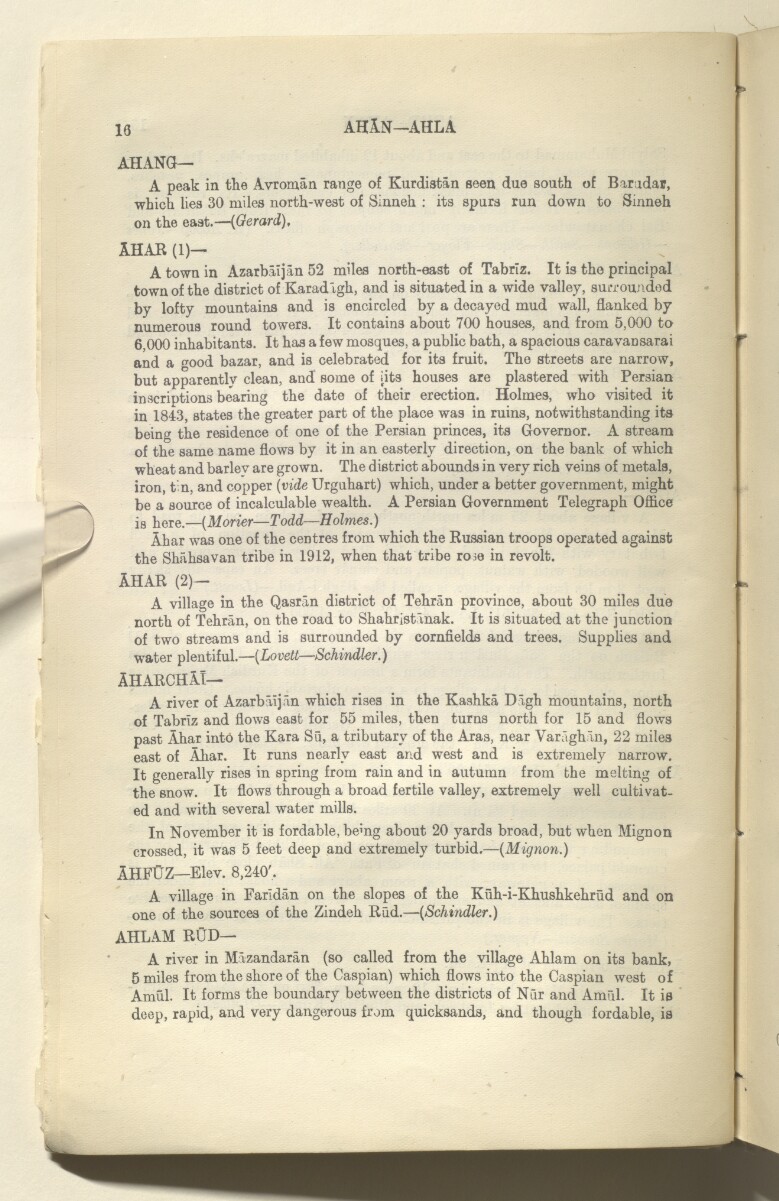
'GAZETTEER OF PERSIA. VOLUME II' [14v] (33/706)
The record is made up of 1 volume (349 folios). It was created in 1914. It was written in English. The original is part of the British Library: India Office The department of the British Government to which the Government of India reported between 1858 and 1947. The successor to the Court of Directors. Records and Private Papers Documents collected in a private capacity. .
Transcription
This transcription is created automatically. It may contain errors.
16
AHlN—AHLA
AHANG—
A peak in the Avroman range of Kurdistan seen due south of Bandar,
•which lies 30 miles north-west of Sinneh : its spurs run down to Sinneh
on the east.— [Gerard),
AHAR (1)—
A town in Azarbaijan 52 miles north-east of Tabriz. It is the principal
town of the district of Karadigh, and is situated in a wide valley, surrounded
by lofty mountains and is encircled by a decayed mud wall, flanked by
numerous round towers. It contains about 700 houses, and from 5,000 to
6,000 inhabitants. It has a few mosques, a public bath, a spacious caravansarai
and a good bazar, and is celebrated for its fruit. The streets are narrow,
but apparently clean, and’ some of iits houses are plastered with Persian
inscriptions bearing the date of their erection. Holmes, who visited it
in 1843, states the greater part of the place was in ruins, notwithstanding its
being the residence of one of the Persian princes, its Governor. A stream
of the same name flows by it in an easterly direction, on the bank of which
wheat and barlev are grown. The district abounds in very rich veins of metals,
iron, t’n, and copper [vide Urguhart) which, under a better government, might
be a source of incalculable wealth. A Persian Government Telegraph Office
is here.— (Morier — Todd — Holmes.)
Ahar was one of the centres from which the Russian troops operated against
the Shahsavan tribe in 1912, when that tribe ro^e in revolt.
Ahar (2)—
A village in the Qasran district of Tehran province, about 30 miles due
north of Tehran, on the road to Shahrist inak. It is situated at the junction
of two streams and is surrounded by cornfields and trees. Supplies and
water plentiful.— [Lovett—Schindler.)
AharchAI—
A river of Azarbaijan which rises in the Kashka Dagh mountains, north
of Tabriz and flows east for 55 miles, then turns north for 15 and flows
past Ahar into the Kara Sii, a tributary of the Aras, near Varaghan, 22 miles
east of Ahar. It runs nearly east and west and is extremely narrow.
It generally rises in spring from rain and in autumn from the melting of
the snow. It flows through a broad fertile valley, extremely well cultivat
ed and with several water mills.
In November it is fordable, bemg about 20 yards broad, but when Mignon
crossed, it was 5 feet deep and extremely turbid.— [Mignon.)
AHFUZ-Elev. 8,240'.
A village in Faridan on the slopes of the Kuh-i-Khushkehrud and on
one of the sources of the Zindeh Rud.— [Schindler.)
AHLAM RUD—
A river in Mazandaran (so called from the village Ahlam on its bank,
5 miles from the shore of the Caspian) which flows into the Caspian west of
Amul. It forms the boundary between the districts of Nar and Amfil. It is
deep, rapid, and very dangerous from quicksands, and though fordable, is
About this item
- Content
The item is Volume II of the four-volume Gazetteer of Persia (1914 edition).
The volume comprises the north-western portion of Persia, bounded on the west by the Turco-Persian frontier; on the north by the Russo-Persian frontier and Caspian Sea; on the east by a line joining Barfarush, Damghan, and Yazd; and on the south by a line joining Yazd, Isfahan, and Khanikin.
The gazetteer includes entries on human settlements (towns, villages, provinces, and districts); communications (roads, bridges, halting places, caravan camping places, springs, and cisterns); tribes and religious sects; and physical features (rivers, streams, valleys, mountains and passes). Entries include information on history, geography, climate, population, ethnography, resources, trade, and agriculture.
Information sources are provided at the end of each gazetteer entry, in the form of an author or source’s surname, italicised and bracketed.
A Note (folio 4) makes reference to a map at the end of the volume; this is not present, but an identical map may be found in IOR/L/MIL/17/15/4/1 (folio 636) and IOR/L/MIL/17/15/4/2 (folio 491).
Printed at the Government of India Monotype Press, Simla, 1914.
- Extent and format
- 1 volume (349 folios)
- Arrangement
The volume contains a list of authorities (folio 6) and a glossary (folios 343-349).
- Physical characteristics
Foliation: the foliation sequence for this description commences at the front cover with 1, and terminates at inside back cover with 351; these numbers are written in pencil, are circled, and are located in the top right corner of the recto The front of a sheet of paper or leaf, often abbreviated to 'r'. side of each folio. Pagination: the volume also contains an original printed pagination sequence.
- Written in
- English in Latin script View the complete information for this record
Use and share this item
- Share this item
'GAZETTEER OF PERSIA. VOLUME II' [14v] (33/706), British Library: India Office Records and Private Papers, IOR/L/MIL/17/15/3/1, in Qatar Digital Library <https://www.qdl.qa/archive/81055/vdc_100034644542.0x000022> [accessed 23 June 2026]
https://www.qdl.qa/en/archive/81055/vdc_100034644542.0x000022
Copy and paste the code below into your web page where you would like to embed the image.
<meta charset="utf-8"><a href="https://www.qdl.qa/en/archive/81055/vdc_100034644542.0x000022">'GAZETTEER OF PERSIA. VOLUME II' [‎14v] (33/706)</a> <a href="https://www.qdl.qa/en/archive/81055/vdc_100034644542.0x000022"> <img src="https://iiif.qdl.qa/iiif/images/81055/vdc_100025472757.0x000001/IOR_L_MIL_17_15_3_1_0033.jp2/full/!280,240/0/default.jpg" alt="" /> </a>
This record has a IIIF manifest available as follows. If you have a compatible viewer you can drag the icon to load it.https://www.qdl.qa/en/iiif/81055/vdc_100025472757.0x000001/manifestOpen in Universal viewerOpen in Mirador viewerMore options for embedding images
Copyright: How to use this content
- Reference
- IOR/L/MIL/17/15/3/1
- Title
- 'GAZETTEER OF PERSIA. VOLUME II'
- Pages
- front, back, spine, edge, head, tail, front-i, 2r:350v, back-i
- Author
- East India Company, the Board of Control, the India Office, or other British Government Department
- Usage terms
- Open Government Licence