
!['GAZETTEER OF PERSIA. VOLUME II' [‎251v] (507/706)](https://iiif.qdl.qa/iiif/images/81055/vdc_100025472757.0x000001/IOR_L_MIL_17_15_3_1_0507.jp2/full/!1200,1200/0/default.jpg "'GAZETTEER OF PERSIA. VOLUME II' [‎251v] (507/706)")
'GAZETTEER OF PERSIA. VOLUME II' [251v] (507/706)
The record is made up of 1 volume (349 folios). It was created in 1914. It was written in English. The original is part of the British Library: India Office The department of the British Government to which the Government of India reported between 1858 and 1947. The successor to the Court of Directors. Records and Private Papers Documents collected in a private capacity. .
Transcription
This transcription is created automatically. It may contain errors.
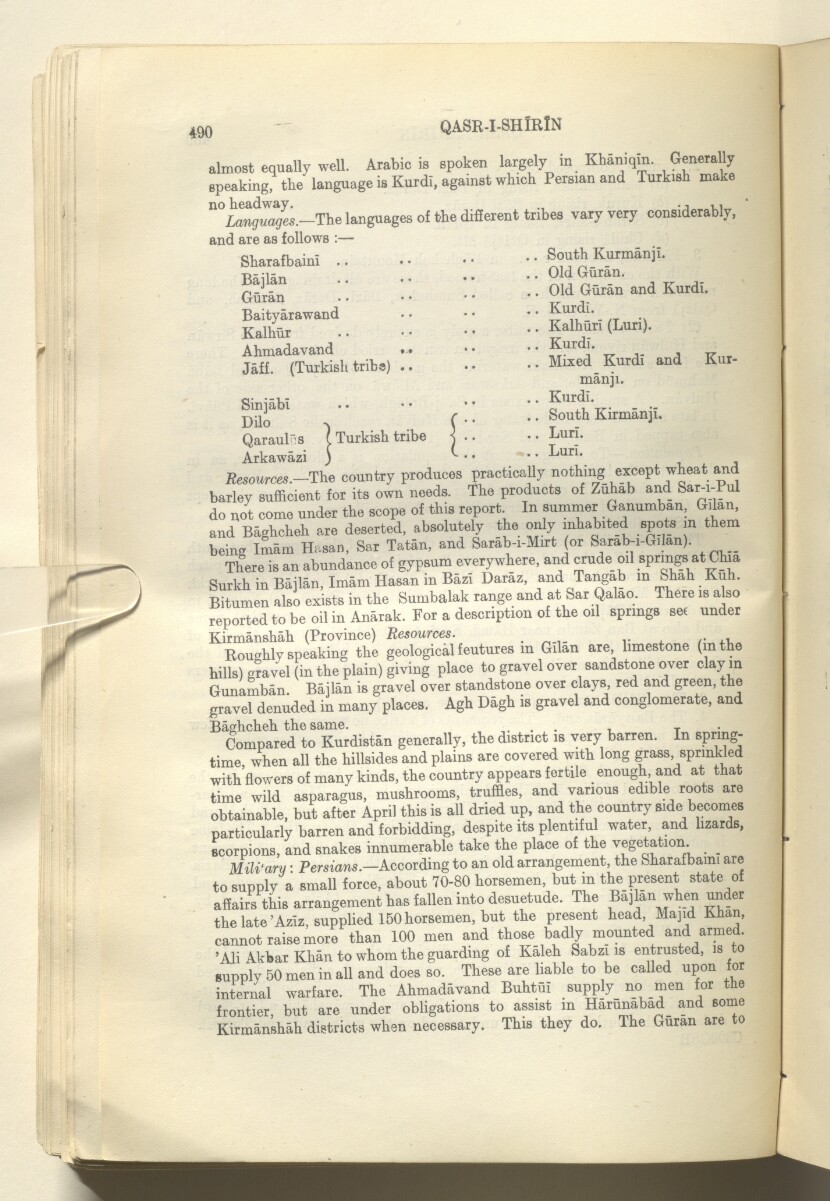
490
QASR-I-SHlRlN
almost equally well. Arabic is spoken largely in Khaniqin Generally
speaking, the language is Kurdi, against which Persian and Turkish make
Languages .—languages of the different tribes vary very considerably,
and are as follows :—
Sharafbaini ..
Bajlan
Guran
Baityarawand
Kalhur
Ahmadavand
Jaff. (Turkish tribe)
Sinmbl
Dilo
Qarauliis
Arkawazi
Resources.
| Turkish tribe
South Kurmanji.
Old Guran.
Old Guran and Kurdi.
Kurdi.
Kalhurl (Luri).
Kurdi.
Mixed Kurdi and Kur
manji.
Kurdi.
South Kirmanji.
Luri.
Luri.
-The country produces practically nothing except wheat and
barley sufficient for its own needs. The products of Zuhab and_ Sar-i-Pul
do not come under the scope of this report. In summer Ganumban, Gilan,
and Baahcheh are deserted, absolutely the only inhabited spots m them
being Imam Hasan, Sar Tatan, and Sarab-i-Mirt (or Sarab-i-G.lan).
There is an abundance of gypsum everywhere, and crude oil springs at Chia
Surkh in Bajlan, Imam Hasan in Bazi Daraz, and Tangab in Shah Kuh.
Bitumen also exists in the Sumbalak range and at Sar Qalao. There is also
reported to be oil in Aniirak. For a description of the oil springs set under
Kirmanshah (Province) Resources. . ,
Roughly speaking the geological feutures m Gilan are, limestone (m the
hills) gravel (in the plain) giving place to gravel over sandstone over clay m
Gunamban. Bajlan is gravel over standstone over clays, red and green, the
gravel denuded in many places. Agh Dagh is gravel and conglomerate, and
Compared to Kurdistan generally, the district is very barren. In s P ri ^g-
time, when all the hillsides and plains are covered with long grass, sprinkled
with flowers of many kinds, the country appears fertile enough, and at that
time wild asparagus, mushrooms, truffles, and various edible roots are
obtainable, but after April this is all dried up, and the country side becomes
particularly barren and forbidding, despite its plentiful water, and lizards,
scorpions, and snakes innumerable take the place of the vegetation. _
Mili'ary • Persians.—According to an old arrangement, the Sharafbaini are
to supply a small force, about 70-80 horsemen, but in the present state of
affairs this arrangement has fallen into desuetude. The Bajlan when under
the late’Aziz, supplied 150 horsemen, but the present head, Majid Khan,
cannot raise more than 100 men and those badly mounted and armed
’Ali Akbar Khan to whom the guarding of Kaleh Sabzi is entrusted, is to
supply 50 men in all and does so. These are liable to be called upon for
internal warfare. The Ahmadavand Buhtui supply no men for the
frontier, but are under obligations to assist in Harunabad and some
Kirmanshah districts when necessary. This they do. The Guran are
About this item
- Content
The item is Volume II of the four-volume Gazetteer of Persia (1914 edition).
The volume comprises the north-western portion of Persia, bounded on the west by the Turco-Persian frontier; on the north by the Russo-Persian frontier and Caspian Sea; on the east by a line joining Barfarush, Damghan, and Yazd; and on the south by a line joining Yazd, Isfahan, and Khanikin.
The gazetteer includes entries on human settlements (towns, villages, provinces, and districts); communications (roads, bridges, halting places, caravan camping places, springs, and cisterns); tribes and religious sects; and physical features (rivers, streams, valleys, mountains and passes). Entries include information on history, geography, climate, population, ethnography, resources, trade, and agriculture.
Information sources are provided at the end of each gazetteer entry, in the form of an author or source’s surname, italicised and bracketed.
A Note (folio 4) makes reference to a map at the end of the volume; this is not present, but an identical map may be found in IOR/L/MIL/17/15/4/1 (folio 636) and IOR/L/MIL/17/15/4/2 (folio 491).
Printed at the Government of India Monotype Press, Simla, 1914.
- Extent and format
- 1 volume (349 folios)
- Arrangement
The volume contains a list of authorities (folio 6) and a glossary (folios 343-349).
- Physical characteristics
Foliation: the foliation sequence for this description commences at the front cover with 1, and terminates at inside back cover with 351; these numbers are written in pencil, are circled, and are located in the top right corner of the recto The front of a sheet of paper or leaf, often abbreviated to 'r'. side of each folio. Pagination: the volume also contains an original printed pagination sequence.
- Written in
- English in Latin script View the complete information for this record
Use and share this item
- Share this item
'GAZETTEER OF PERSIA. VOLUME II' [251v] (507/706), British Library: India Office Records and Private Papers, IOR/L/MIL/17/15/3/1, in Qatar Digital Library <https://www.qdl.qa/archive/81055/vdc_100034644545.0x00006c> [accessed 14 June 2026]
https://www.qdl.qa/en/archive/81055/vdc_100034644545.0x00006c
Copy and paste the code below into your web page where you would like to embed the image.
<meta charset="utf-8"><a href="https://www.qdl.qa/en/archive/81055/vdc_100034644545.0x00006c">'GAZETTEER OF PERSIA. VOLUME II' [‎251v] (507/706)</a> <a href="https://www.qdl.qa/en/archive/81055/vdc_100034644545.0x00006c"> <img src="https://iiif.qdl.qa/iiif/images/81055/vdc_100025472757.0x000001/IOR_L_MIL_17_15_3_1_0507.jp2/full/!280,240/0/default.jpg" alt="" /> </a>
This record has a IIIF manifest available as follows. If you have a compatible viewer you can drag the icon to load it.https://www.qdl.qa/en/iiif/81055/vdc_100025472757.0x000001/manifestOpen in Universal viewerOpen in Mirador viewerMore options for embedding images
Copyright: How to use this content
- Reference
- IOR/L/MIL/17/15/3/1
- Title
- 'GAZETTEER OF PERSIA. VOLUME II'
- Pages
- front, back, spine, edge, head, tail, front-i, 2r:350v, back-i
- Author
- East India Company, the Board of Control, the India Office, or other British Government Department
- Usage terms
- Open Government Licence