
!['GAZETTEER OF PERSIA. VOLUME II' [‎284r] (572/706)](https://iiif.qdl.qa/iiif/images/81055/vdc_100025472757.0x000001/IOR_L_MIL_17_15_3_1_0572.jp2/full/!1200,1200/0/default.jpg "'GAZETTEER OF PERSIA. VOLUME II' [‎284r] (572/706)")
'GAZETTEER OF PERSIA. VOLUME II' [284r] (572/706)
The record is made up of 1 volume (349 folios). It was created in 1914. It was written in English. The original is part of the British Library: India Office The department of the British Government to which the Government of India reported between 1858 and 1947. The successor to the Court of Directors. Records and Private Papers Documents collected in a private capacity. .
Transcription
This transcription is created automatically. It may contain errors.
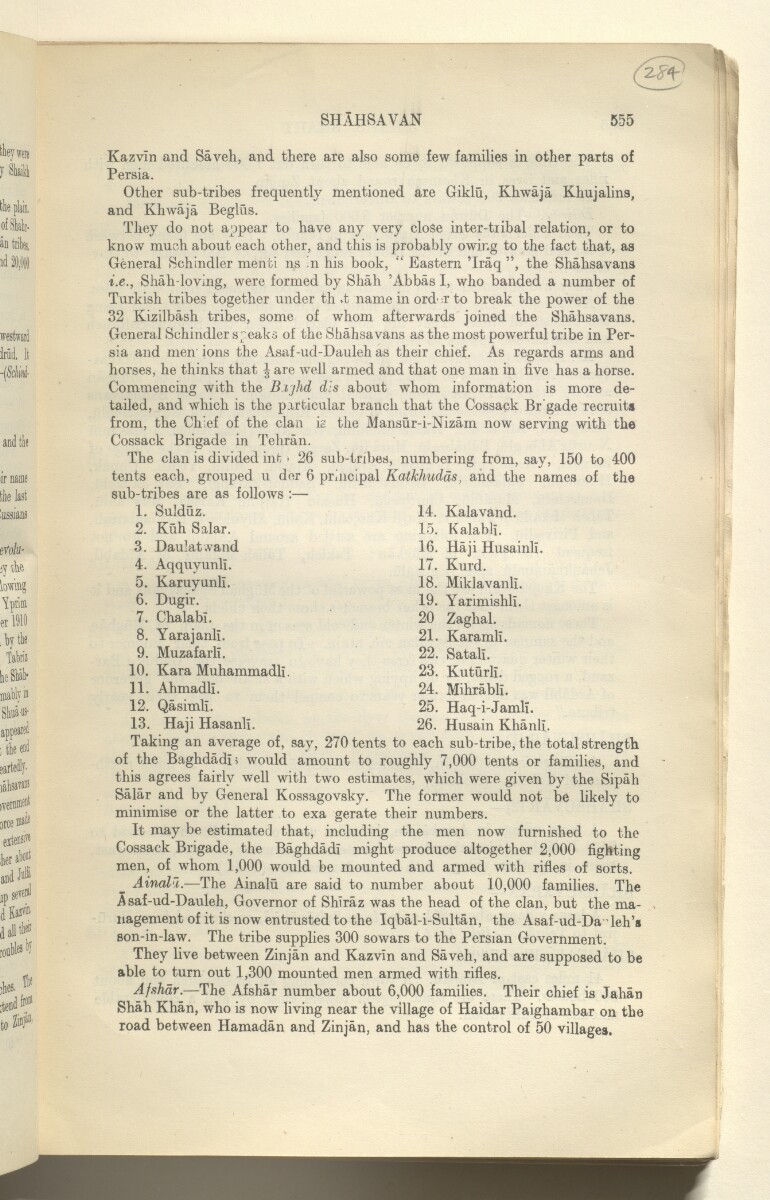
SHAHS A VAN
555
Kazvln and Saveh, and there are also some few families in other parts of
Persia.
Other sub-tribes frequently mentioned are Giklu, Khwaja Khujalins,
and Khwaja Begins.
They do not appear to have any very close inter-tiibal relation, or to
kno w much about each other, and this is probably owing to the fact that, as
General Schindler menti ns in his book, “ Eastern ’Iraq ”, the Shahsavans
i.e., Shah-loving, were formed by Shah ’Abbas I, who banded a number of
Turkish tribes together under th .t name in ord x to break the power of the
32 Kizilbash tribes, some of whom afterwards joined the Shahsavans.
General Schindler speaks of the Shahsavans as the most powerful tribe in Per
sia and men ions the Asaf-ud-Dauleh as their chief. As regards arms and
horses, he thinks that | are well armed and that one man in five has a horse.
Commencing with the Bijhd dls about whom information is more de
tailed, and which is the particular branch that the Cossack Br'gade recruits
from, the Chief of the clan is the Mansur-i-Nizam now serving with the
Cossack Brigade in Tehran.
The clan is divided inf » 26 sub-tribes, numbering from, say, 150 to 400
tents each, grouped u der 6 principal Katkhudds, and the names of the
sub-tribes are as follows :—
1. Sulduz. 14. Kalavand.
2. Kuh Salar. 15. Kalabli.
3. Daulatwand 16. Haji Husainli.
4. Aqquyunll. 17. Kurd.
5. Karuyunli. 18. Miklavanli.
6. Dugir. 19. Yarimishli.
7. Chalabi. 20 Zaghal.
8. Yarajanli. 21. Karamli.
9. Muzafarli. 22. Satall.
10. Kara Muhammadll. 23. Kuturll.
11. Ahmadli. 24. Mihrabli.
12. Qasimli. 25. Haq-i-Jamli.
13. Haji Hasanli. 26. Husain Khanli.
Taking an average of, say, 270 tents to each sub-tribe, the total strength
of the Baghdadi i would amount to roughly 7,000 tents or families, and
this agrees fairly well with two estimates, which were given by the Sipah
Salar and by General Kossagovsky. The former would not be likely to
minimise or the latter to exa gerate their numbers.
It may be estimated that, including the men now furnished to the
Cossack Brigade, the Baghdadi might produce altogether 2,000 fighting
men, of whom 1,000 would be mounted and armed with rifles of sorts.
Ainalu. —The Ainalu are said to number about 10,000 families. The
Asaf-ud-Dauleh, Governor of Shiraz was the head of the clan, but the ma
nagement of it is now entrusted to the Iqbal-i-Sultan, the Asaf-ud-Da Teh’s
son-in-law. The tribe supplies 300 sowars to the Persian Government.
They live between Zinjan and Kazvin and Saveh, and are supposed to be
able to turn out 1,300 mounted men armed with rifles.
Afshar .—The Afshar number about 6,000 families. Their chief is Jahan
Shah Khan, who is now living near the village of Haidar Paighambar on the
road between Hamadan and Zinjan, and has the control of 50 villages.
About this item
- Content
The item is Volume II of the four-volume Gazetteer of Persia (1914 edition).
The volume comprises the north-western portion of Persia, bounded on the west by the Turco-Persian frontier; on the north by the Russo-Persian frontier and Caspian Sea; on the east by a line joining Barfarush, Damghan, and Yazd; and on the south by a line joining Yazd, Isfahan, and Khanikin.
The gazetteer includes entries on human settlements (towns, villages, provinces, and districts); communications (roads, bridges, halting places, caravan camping places, springs, and cisterns); tribes and religious sects; and physical features (rivers, streams, valleys, mountains and passes). Entries include information on history, geography, climate, population, ethnography, resources, trade, and agriculture.
Information sources are provided at the end of each gazetteer entry, in the form of an author or source’s surname, italicised and bracketed.
A Note (folio 4) makes reference to a map at the end of the volume; this is not present, but an identical map may be found in IOR/L/MIL/17/15/4/1 (folio 636) and IOR/L/MIL/17/15/4/2 (folio 491).
Printed at the Government of India Monotype Press, Simla, 1914.
- Extent and format
- 1 volume (349 folios)
- Arrangement
The volume contains a list of authorities (folio 6) and a glossary (folios 343-349).
- Physical characteristics
Foliation: the foliation sequence for this description commences at the front cover with 1, and terminates at inside back cover with 351; these numbers are written in pencil, are circled, and are located in the top right corner of the recto The front of a sheet of paper or leaf, often abbreviated to 'r'. side of each folio. Pagination: the volume also contains an original printed pagination sequence.
- Written in
- English in Latin script View the complete information for this record
Use and share this item
- Share this item
'GAZETTEER OF PERSIA. VOLUME II' [284r] (572/706), British Library: India Office Records and Private Papers, IOR/L/MIL/17/15/3/1, in Qatar Digital Library <https://www.qdl.qa/archive/81055/vdc_100034644545.0x0000ad> [accessed 22 August 2026]
https://www.qdl.qa/en/archive/81055/vdc_100034644545.0x0000ad
Copy and paste the code below into your web page where you would like to embed the image.
<meta charset="utf-8"><a href="https://www.qdl.qa/en/archive/81055/vdc_100034644545.0x0000ad">'GAZETTEER OF PERSIA. VOLUME II' [‎284r] (572/706)</a> <a href="https://www.qdl.qa/en/archive/81055/vdc_100034644545.0x0000ad"> <img src="https://iiif.qdl.qa/iiif/images/81055/vdc_100025472757.0x000001/IOR_L_MIL_17_15_3_1_0572.jp2/full/!280,240/0/default.jpg" alt="" /> </a>
This record has a IIIF manifest available as follows. If you have a compatible viewer you can drag the icon to load it.https://www.qdl.qa/en/iiif/81055/vdc_100025472757.0x000001/manifestOpen in Universal viewerOpen in Mirador viewerMore options for embedding images
Copyright: How to use this content
- Reference
- IOR/L/MIL/17/15/3/1
- Title
- 'GAZETTEER OF PERSIA. VOLUME II'
- Pages
- front, back, spine, edge, head, tail, front-i, 2r:350v, back-i
- Author
- East India Company, the Board of Control, the India Office, or other British Government Department
- Usage terms
- Open Government Licence