
!['THIM DAYS IS GONE' [‎36r] (71/248)](https://iiif.qdl.qa/iiif/images/81055/vdc_100000000880.0x0002ed/Mss Eur F226_28_0071.jp2/full/!1200,1200/0/default.jpg "'THIM DAYS IS GONE' [‎36r] (71/248)")
'THIM DAYS IS GONE' [36r] (71/248)
The record is made up of 1 file (124 folios). It was created in c 1980. It was written in English. The original is part of the British Library: India Office The department of the British Government to which the Government of India reported between 1858 and 1947. The successor to the Court of Directors. Records and Private Papers Documents collected in a private capacity. .
Transcription
This transcription is created automatically. It may contain errors.
37
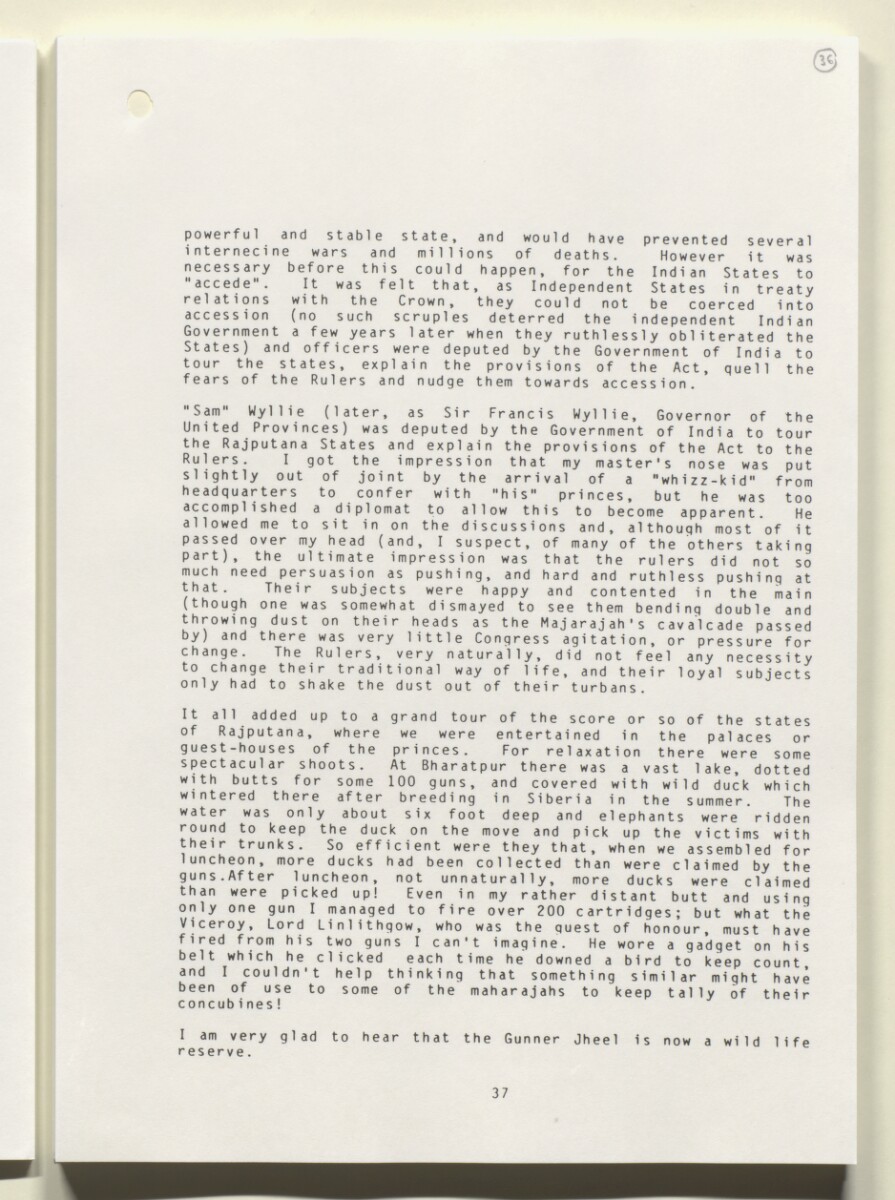
powerful and stable state, and would have prevented several
internecine wars and millions of deaths. However it was
necessary before this could happen, for the Indian States to
"accede". It was felt that, as Independent States in treaty
relations with the Crown, they could not be coerced into
accession (no such scruples deterred the independent Indian
Government a few years later when they ruthlessly obliterated the
States) and officers were deputed by the Government of India to
tour the states, explain the provisions of the Act, quell the
fears of the Rulers and nudge them towards accession.
"Sam" Wyllie (later, as Sir Francis Wyllie, Governor of the
United Provinces) was deputed by the Government of India to tour
the Rajputana States and explain the provisions of the Act to the
Rulers. I got the impression that my master's nose was put
slightly out of joint by the arrival of a "whizz-kid" from
headquarters to confer with "his" princes, but he was too
accomplished a diplomat to allow this to become apparent. He
allowed me to sit in on the discussions and, although most of it
passed over my head (and, I suspect, of many of the others taking
part), the ultimate impression was that the rulers did not so
much need persuasion as pushing, and hard and ruthless pushing at
that. Their subjects were happy and contented in the main
(though one was somewhat dismayed to see them bending double and
throwing dust on their heads as the Majarajah’s cavalcade passed
by) and there was very little Congress agitation, or pressure for
change. The Rulers, very naturally, did not feel any necessity
to change their traditional way of life, and their loyal subjects
only had to shake the dust out of their turbans.
It all added up to a grand tour of the score or so of the states
of Rajputana, where we were entertained in the palaces or
guest-houses of the princes. For relaxation there were some
spectacular shoots. At Bharatpur there was a vast lake, dotted
with butts for some 100 guns, and covered with wild duck which
wintered there after breeding in Siberia in the summer. The
water was only about six foot deep and elephants were ridden
round to keep the duck on the move and pick up the victims with
their trunks. So efficient were they that, when we assembled for
luncheon, more ducks had been collected than were claimed by the
guns.After luncheon, not unnaturally, more ducks were claimed
than were picked up! Even in my rather distant butt and using
only one gun I managed to fire over 200 cartridges; but what the
Viceroy, Lord Linlithgow, who was the quest of honour, must have
fired from his two guns I can't imagine. He wore a gadget on his
belt which he clicked each time he downed a bird to keep count
and I couldn't help thinking that something similar might have
been of use to some of the maharajahs to keep tally of their
concubines!
I am very glad to hear that the Gunner Jheel is now a wild life
reserve.
About this item
- Content
A memoir written by Major Maurice Patrick O'Connor Tandy recounting his career in the Royal Artillery, Rajputana, Sialkot, Persia, North West Frontier Province, Afghanistan, the Persian Gulf The historical term used to describe the body of water between the Arabian Peninsula and Iran. , and Kuwait.
Typescript with manuscript corrections.
- Extent and format
- 1 file (124 folios)
- Physical characteristics
Foliation: the foliation sequence commences at the first folio with 1 and terminates at the last folio with 124; these numbers are written in pencil, are circled, and are located in the top right corner of the recto The front of a sheet of paper or leaf, often abbreviated to 'r'. side of each folio. Pagination: the file also contains an original printed pagination sequence.
- Written in
- English in Latin script View the complete information for this record
Use and share this item
- Share this item
'THIM DAYS IS GONE' [36r] (71/248), British Library: India Office Records and Private Papers, Mss Eur F226/28, in Qatar Digital Library <https://www.qdl.qa/archive/81055/vdc_100037450601.0x000048> [accessed 9 August 2026]
https://www.qdl.qa/en/archive/81055/vdc_100037450601.0x000048
Copy and paste the code below into your web page where you would like to embed the image.
<meta charset="utf-8"><a href="https://www.qdl.qa/en/archive/81055/vdc_100037450601.0x000048">'THIM DAYS IS GONE' [‎36r] (71/248)</a> <a href="https://www.qdl.qa/en/archive/81055/vdc_100037450601.0x000048"> <img src="https://iiif.qdl.qa/iiif/images/81055/vdc_100000000880.0x0002ed/Mss Eur F226_28_0071.jp2/full/!280,240/0/default.jpg" alt="" /> </a>
This record has a IIIF manifest available as follows. If you have a compatible viewer you can drag the icon to load it.https://www.qdl.qa/en/iiif/81055/vdc_100000000880.0x0002ed/manifestOpen in Universal viewerOpen in Mirador viewerMore options for embedding images
Copyright: How to use this content
- Reference
- Mss Eur F226/28
- Title
- 'THIM DAYS IS GONE'
- Pages
- 1r:124v
- Author
- Tandy, Maurice Patrick O'Connor
- Copyright
- ©Major M P O C Tandy
- Usage terms
- Creative Commons Non-Commercial Licence