
![Coll 6/21(2) 'Saudi Arabia: Relations with H.M.G.: Saudi Legation in London and British Minister in Jeddah. Prolongation of Treaty of Jedda.' [‎174v] (348/761)](https://iiif.qdl.qa/iiif/images/81055/vdc_100000000555.0x000272/IOR_L_PS_12_2088_0351.jp2/full/!1200,1200/0/default.jpg "Coll 6/21(2) 'Saudi Arabia: Relations with H.M.G.: Saudi Legation in London and British Minister in Jeddah. Prolongation of Treaty of Jedda.' [‎174v] (348/761)")
Coll 6/21(2) 'Saudi Arabia: Relations with H.M.G.: Saudi Legation in London and British Minister in Jeddah. Prolongation of Treaty of Jedda.' [174v] (348/761)
The record is made up of 1 file (379 folios). It was created in 14 Jan 1935-12 Apr 1947. It was written in English and Arabic. The original is part of the British Library: India Office The department of the British Government to which the Government of India reported between 1858 and 1947. The successor to the Court of Directors. Records and Private Papers Documents collected in a private capacity. .
Transcription
This transcription is created automatically. It may contain errors.
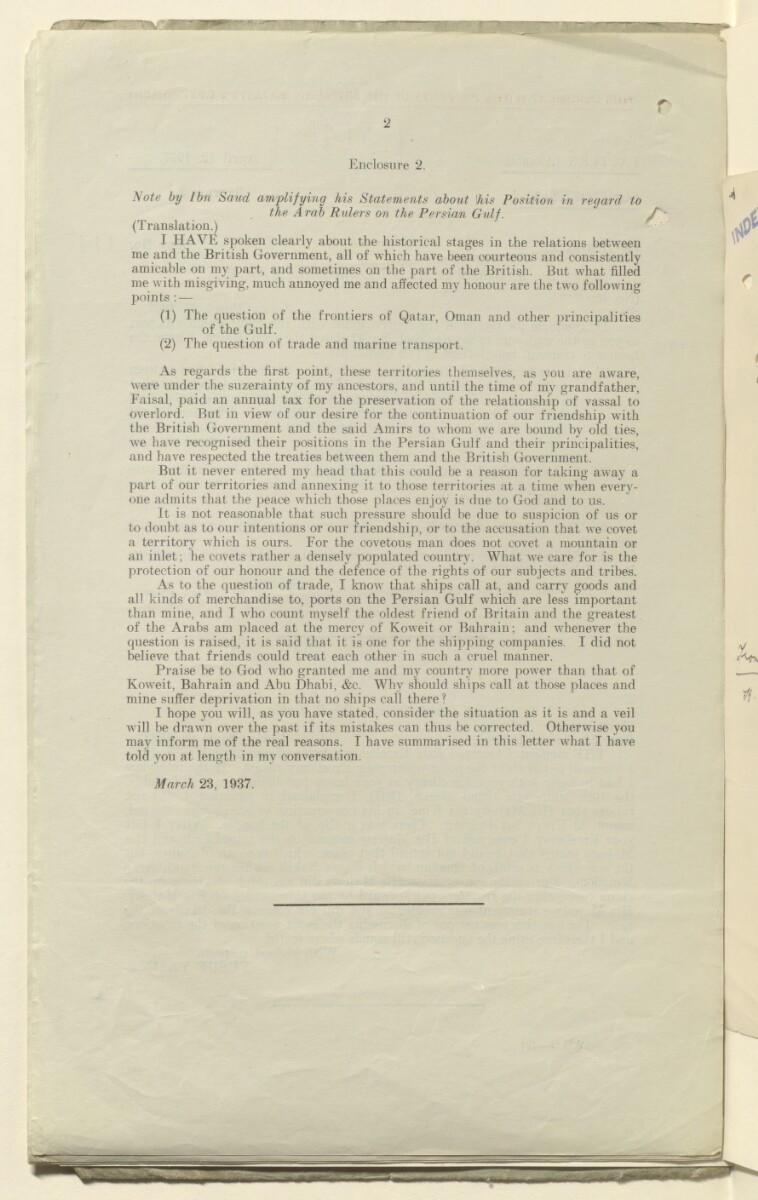
Enclosure 2.
]\!ote by Ibn Saud am'plifying his Statements about \his Position in regard to
the Arab Rulers on the Persian Gidf.
(Translation.)
I HAVE spoken clearly about the historical stages in the relations between
me and the British Government, all of which have been courteous and consistently
amicable on my part, and sometimes on the part of the British. But what filled
me with misgiving, much annoyed me and affected my honour are the two following
points : —
(1) The question of the frontiers of Qatar, Oman and other principalities
of the Gulf.
(2) The question of trade and marine transport.
As regards the first point, these territories themselves, as you are aware,
were under the suzerainty of my ancestors, and until the time of my grandfather,
Faisal, paid an annual tax for the preservation of the relationship of vassal to
overlord. But in view of our desire for the continuation of our friendship with
the British Government and the said Amirs to whom we are bound by old ties,
we have recognised their positions in the
Persian Gulf
The historical term used to describe the body of water between the Arabian Peninsula and Iran.
and their principalities,
and have respected the treaties between them and the British Government.
But it never entered my head that this could be a reason for taking away a
part of our territories and annexing it to those territories at a time when every
one admits that the peace which those places enjoy is due to God and to us.
It is not reasonable that such pressure should be due to suspicion of us or
to doubt as to our intentions or our friendship, or to the accusation that we covet
a territory which is ours. For the covetous man does not covet a mountain or
an inlet; he covets rather a densely populated country. What we care for is the
protection of our honour and the defence of the rights of our subjects and tribes.
As to the question of trade, I know that ships call at, and carry goods and
all kinds of merchandise to, ports on the
Persian Gulf
The historical term used to describe the body of water between the Arabian Peninsula and Iran.
which are less important
than mine, and I who count myself the oldest friend of Britain and the greatest
of the Arabs am placed at the mercy of Koweit or Bahrain; and whenever the
question is raised, it is said that it is one for the shipping companies. I did not
believe that friends could treat each other in such a cruel manner.
Praise be to God who granted me and my country more power than that of
Koweit, Bahrain and Abu Dhabi, &c. Why should ships call at those places and
mine suffer deprivation in that no ships call there ?
I hope you will, as you have stated, consider the situation as it is and a veil
will be drawn over the past if its mistakes can thus be corrected. Otherwise you
may inform me of the real reasons. I have summarised in this letter what I have
told you at length in my conversation.
March 23, 1937.
About this item
- Content
This file, like the previous volume (IOR/L/PS/12/2087), concerns relations between the British Government and the Government of Saudi Arabia.
The file largely consists of copies of Foreign Office correspondence, mainly between His Majesty's Minister at Jedda (Sir Andrew Ryan, Sir Reader William Bullard, Hugh Stonehewer Bird, and Stanley R Jordan successively) and officials of the Foreign Office. Other prominent correspondents include the following: the Secretary of State for Foreign Affairs; His Majesty's Chargé d’Affaires to Jedda (Albert Spencer Calvert, succeeded by Alan Charles Trott); His Majesty's Ambassador in Baghdad (Sir Kinahan Cornwallis); Ibn Saud [‘Abd al-‘Azīz bin ‘Abd al-Raḥmān bin Fayṣal Āl Sa‘ūd]; Amir Faisal [Fayṣal bin ‘Abd al-‘Azīz Āl Sa‘ūd], Minister of Foreign Affairs for Saudi Arabia; officials of the Colonial Office and the War Office.
The correspondence documents the progression of negotiations for a general settlement between the two governments, which would result in the initial prolongation of the validity of the Treaty of Jedda (the treaty signed between Britain and Ibn Saud in 1927, which initially expired in September 1934) for a period of seven years from 1936 (and for another seven years from 1943).
In addition to discussing matters relating to the proposed general settlement (e.g. the eastern and south-eastern boundaries of Saudi Arabia, slavery regulations, arms traffic, and Saudi debts), the correspondence also documents various visits and meetings, including the following:
- The visit of Amir Saud [Āl Sa‘ūd, Sa‘ūd bin ‘Abd al-‘Azīz, heir apparent of Ibn Saud] to Britain (17 June-1 July 1935), accompanied by Fuad Bey Hamza, Deputy Minister for Foreign Affairs for Saudi Arabia.
- Further meetings at the Foreign Office between Fuad Bey Hamza, Hafiz Wahba (Saudi Minister in London), Sir Andrew Ryan, George William Rendel (Head of the Foreign Office's Eastern Department), and other Foreign Office officials, in July 1935, following on from meetings in September 1934.
- Sir Andrew Ryan's meetings with Ibn Saud in Riyadh in December 1935 and in Jedda in February 1936.
- Four interviews held between Ibn Saud, Sir Reader William Bullard and George William Rendel, in Jedda, during March 1937.
Also discussed are matters relating to the Second World War, including:
- An exchange of letters between Ibn Saud and the British Prime Minister, Neville Chamberlain, in early 1939, which principally relate to Ibn Saud's concerns regarding his country's security in the event of the beginning of general hostilities.
- German radio broadcasts in Jedda during the first few weeks of the Second World War and their possible effect on the Jedda population.
- The possibility of Iraq and Saudi Arabia formally joining the Allies in the Second World War.
In addition to correspondence the file includes the following: a copy of a programme for Amir Saud's visit to Britain (ff 339-348); exchanges of notes (in English and Arabic) between the Saudi Ministry of Foreign Affairs and the British Legation at Jedda, confirming the prolongation of the Treaty of Jedda, dated 1936 and 1943 respectively (ff 189-192 and ff 4-5); a sketch map showing air routes over Saudi Arabia and Iraq (f 31v).
Although the material in this file falls inside the date range of 1935-1943, the final document in the file does include an additional date stamp which is marked '12 April 1947'.
The file includes two dividers which give a list of correspondence references contained in the file by year. These are placed at the back of the correspondence.
- Extent and format
- 1 file (379 folios)
- Arrangement
The papers are arranged in approximate chronological order from the rear to the front of the file.
- Physical characteristics
Foliation: the foliation sequence commences at the inside front cover with 1, and terminates at the last folio with 380; these numbers are written in pencil, are circled, and are located in the top right corner of the recto The front of a sheet of paper or leaf, often abbreviated to 'r'. side of each folio. A previous foliation sequence, which is also circled, has been superseded and therefore crossed out.
- Written in
- English and Arabic in Latin and Arabic script View the complete information for this record
Use and share this item
- Share this item
Coll 6/21(2) 'Saudi Arabia: Relations with H.M.G.: Saudi Legation in London and British Minister in Jeddah. Prolongation of Treaty of Jedda.' [174v] (348/761), British Library: India Office Records and Private Papers, IOR/L/PS/12/2088, in Qatar Digital Library <https://www.qdl.qa/archive/81055/vdc_100048209024.0x000097> [accessed 16 June 2026]
https://www.qdl.qa/en/archive/81055/vdc_100048209024.0x000097
Copy and paste the code below into your web page where you would like to embed the image.
<meta charset="utf-8"><a href="https://www.qdl.qa/en/archive/81055/vdc_100048209024.0x000097">Coll 6/21(2) 'Saudi Arabia: Relations with H.M.G.: Saudi Legation in London and British Minister in Jeddah. Prolongation of Treaty of Jedda.' [‎174v] (348/761)</a> <a href="https://www.qdl.qa/en/archive/81055/vdc_100048209024.0x000097"> <img src="https://iiif.qdl.qa/iiif/images/81055/vdc_100000000555.0x000272/IOR_L_PS_12_2088_0351.jp2/full/!280,240/0/default.jpg" alt="" /> </a>
This record has a IIIF manifest available as follows. If you have a compatible viewer you can drag the icon to load it.https://www.qdl.qa/en/iiif/81055/vdc_100000000555.0x000272/manifestOpen in Universal viewerOpen in Mirador viewerMore options for embedding images
Copyright: How to use this content
- Reference
- IOR/L/PS/12/2088
- Title
- Coll 6/21(2) 'Saudi Arabia: Relations with H.M.G.: Saudi Legation in London and British Minister in Jeddah. Prolongation of Treaty of Jedda.'
- Pages
- 174v
- Author
- Āl Sa‘ūd, ‘Abd al-‘Azīz bin ‘Abd al-Raḥmān bin Fayṣal (xx Ibn Saud)
- Usage terms
- Public Domain