
![Coll 6/67(6) 'Boundaries of South-Eastern Arabia and Qatar: Trucial Coast Oil Concessions' [‎192v] (395/402)](https://iiif.qdl.qa/iiif/images/81055/vdc_100000000555.0x0002a5/IOR_L_PS_12_2139_0395.jp2/full/!1200,1200/0/default.jpg "Coll 6/67(6) 'Boundaries of South-Eastern Arabia and Qatar: Trucial Coast Oil Concessions' [‎192v] (395/402)")
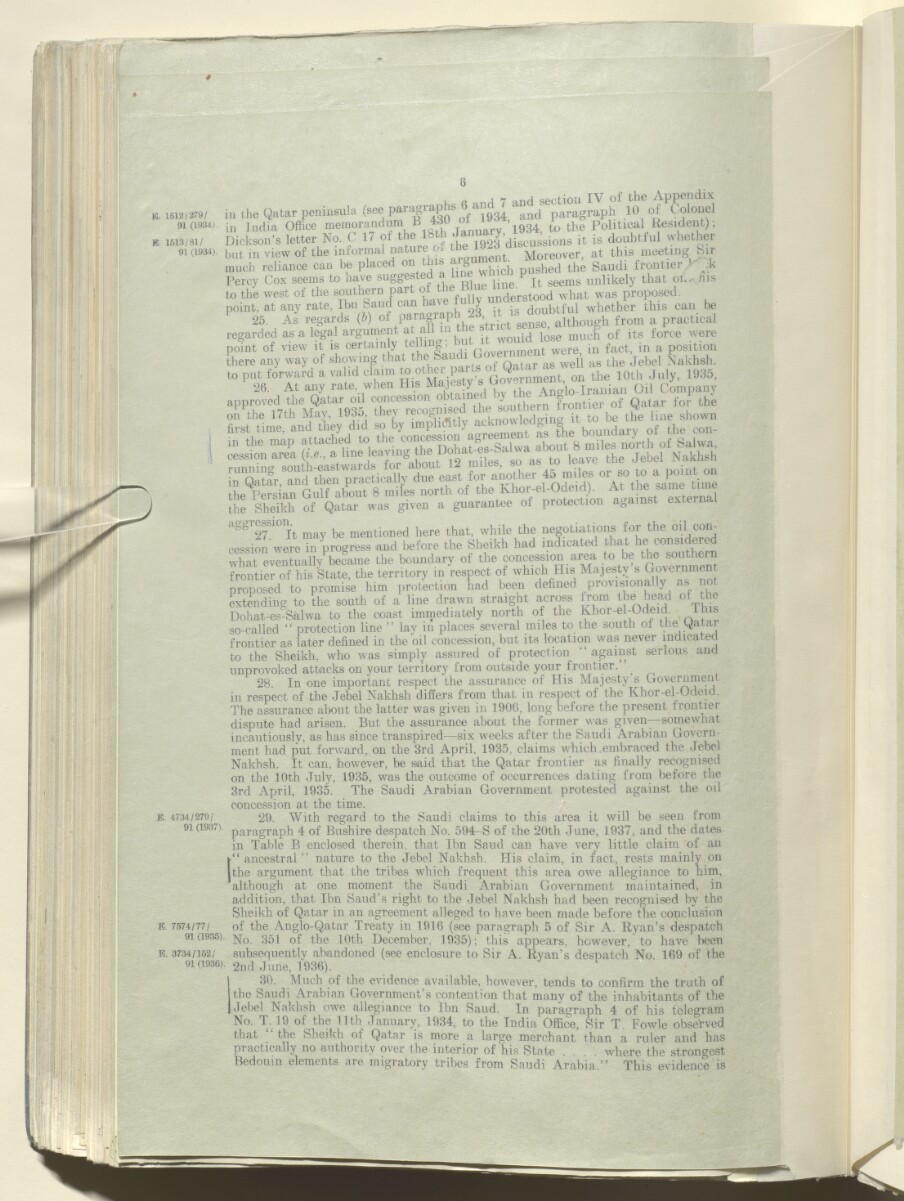
Coll 6/67(6) 'Boundaries of South-Eastern Arabia and Qatar: Trucial Coast Oil Concessions' [192v] (395/402)
The record is made up of 1 file (195 folios). It was created in 30 Jun 1940-30 Mar 1948. It was written in English. The original is part of the British Library: India Office The department of the British Government to which the Government of India reported between 1858 and 1947. The successor to the Court of Directors. Records and Private Papers Documents collected in a private capacity. .
Transcription
This transcription is created automatically. It may contain errors.
#
o
I ft ^ 7 Mnd section IV of the Appendix
e. 15X2/279/ in the Qatar peninsula (see paragraphs 6 and aad paragraph 10 of Colonel
91 (1934). j n) ji a Office memorandum ^ ■, () . u { 0 the
Political Resident
A senior ranking political representative (equivalent to a Consul General) from the diplomatic corps of the Government of India or one of its subordinate provincial governments, in charge of a Political Residency.
);
" 91 (1934). “ IndTaOfffce memorandum B 430 ol ^ Pol meal Resident);
R 1513 / 81 / Dickson’s letter No. C 17 of the 18th J “|’ discu ’ slons it is doubtful whether
91 (1934). but in view of the informal nature o, 1 ment Moreo ver, at this meeting Sir
much reliance can he placed on tl s _ g pus p e( j the Saudi frontier ;k
Percy Cox seems to have suggested a lm P unlikely that on. ins
to the west of the southern part of ^^'^stood^hat was proposed,
point, at any rate, Ibn baud can ha\ ^ ^ doubtful whether this can be
P 25. As regards (b) of although from a practical
regarded as a legal argument m a ^ . would lose much of its force were
point of view it is certainly telling. . nerlt we re, in fact, in a position
there any way of showing that the Sana q we p as the Jebel Nakhsh.
to put forward a valid clam s Gove nm^nt on the 10th July, 1935,
26. At any rate when His A Anglo-Iranian Oil Company
Xy eS recog.dsed the southern frontier of Qatar for the
ris, "S CnTrSiiVE r t. T yjss
S” is; *8""“ ““ , “ i
.^giession. mentioned here that, while the negotiations for the 01 1 con
cession were in progress and before the Sheikh had indicated that he considered
what eventually^became the boundary of the concession area to be the southern
frontier of his State, the territory in respect of which His Majesty s Government
proposed to promise him protection had been defined provisionally as no
extending to the south of a line drawn straight across i rom the head of ti e
Dohat-es-Salwa to the coast immediately north of the ixhor-el-( deid. I ms
so-called “ protection line ” lay in places several miles to the south ot tfte tyatar
frontier as later defined in the oil concession, but its location was never indicated
to the Sheikh, who was simply assured of protection ‘ ‘ against serious and
unprovoked attacks on your territory from outside your frontier.” ^
28. In one important respect the assurance of His Majesty s Government
in respect of the Jebel Nakhsh differs from that in respect of the Khor-el Odeid.
The assurance about the latter was given in 1906, long before the present frontier
dispute had arisen. But the assurance about the former was given—somewhat
incautiously, as has since transpired—six weeks after the Saudi Arabian Govern
ment had put forward, on the 3rd April, 1935, claims which embraced the Jebel
Nakhsh. It can, however, be said that the Qatar frontier as finally recognised
on the 10th July, 1935, was the outcome of occurrences dating from before the
3rd April, 1935. The Saudi Arabian Government protested against the oil
concession at the time.
E. 4734 / 279 /^ 29. With regard to the Saudi claims to this area it will be seen from
91 (1937V paragraph 4 0 f Bushire despatch No. 594—S of the 20th June, 1937, and the dates
in Table B enclosed therein, that Ibn Sand can have very little claim of an
1 “ ancestral” nature to the Jebel Nakhsh. His claim, in fact, rests mainly on
the argument that the tribes which frequent this area owe allegiance to him,
^ 1 4 - Vi -1 4 - rAVA 'rv> /'ATY'i v* h 1 H /"v n / J -1 A -v* Vv -1 -r-k ^ *
vyj. Much of the evidence available, however, tends to confirm the truth of
the Saudi Arabian Government’s contention that many of the inhabitants of the
Jebel Nakhsh owe allegiance to Ibn Sand. In paragraph 4 of his telegram
No. T. 19 of the 11th January, 1934, to the
India Office
The department of the British Government to which the Government of India reported between 1858 and 1947. The successor to the Court of Directors.
, Sir T. Fowle observed
that ^ the Sheikh of Qatar is more a large merchant than a ruler and has
practically no authority over the interior of his State .... where the strongest
Bedouin elements are migratory tribes from Saudi Arabia.” This evidence is
About this item
- Content
This volume concerns British policy regarding the south-eastern boundaries of Saudi Arabia, specifically its border with Qatar.
The correspondence and memoranda near the beginning of the volume discuss from a British perspective the origins and recent history of the boundary dispute, which is described as having been in abeyance since 1938; much of the later correspondence is concerned with whether the British should make renewed attempts to reach an agreement with Ibn Saud [‘Abd al-‘Azīz bin ‘Abd al-Raḥmān bin Fayṣal Āl Sa‘ūd] .
References are made to various existing and proposed boundary lines, the most recent of the latter is the 'Riyadh line' (the name given to the boundary proposed by the British to the Saudi Government in November 1935, referred to elsewhere as the 'final offer').
Notable correspondents include the following: the Political Resident A senior ranking political representative (equivalent to a Consul General) from the diplomatic corps of the Government of India or one of its subordinate provincial governments, in charge of a Political Residency. in the Persian Gulf The historical term used to describe the body of water between the Arabian Peninsula and Iran. (Charles Geoffrey Prior, succeeded by William Rupert Hay); the Political Agent A mid-ranking political representative (equivalent to a Consul) from the diplomatic corps of the Government of India or one of its subordinate provincial governments, in charge of a Political Agency. , Bahrain (Reginald George Alban, Edward Birkbeck Wakefield, and Cornelius James Pelly); His Majesty's Minister at Jedda (Stanley R Jordan, succeeded by Laurence Barton Grafftey-Smith); officials of the Foreign Office, the India Office The department of the British Government to which the Government of India reported between 1858 and 1947. The successor to the Court of Directors. , the Government of India's External Affairs Department, and the Ministry of Fuel and Power (Petroleum Division); representatives of the United States' State Department, Petroleum Development (Qatar) Limited, Petroleum Concessions Limited, and the Iraq Petroleum Company respectively.
Related matters of discussion include:
- Ibn Saud's claims regarding the south-eastern frontiers of Saudi Arabia, particularly those relating to Jebel Nakhsh [Khashm an Nakhsh, Qatar] and Khor-el-Odeid [Khawr al ‘Udayd, Qatar].
- Reports in 1941 of a rumour that the Shaikh of Qatar [Shaikh ‘Abdullāh bin Jāsim Āl Thānī] and Ibn Saud have reached an agreement regarding the Saudi-Qatar boundary.
- The likelihood of oil prospecting either near or within the disputed territory, and its implications for the territorial dispute.
- British concerns in 1947 regarding the possibility of the Arabian American Oil Company (Aramco) initiating drilling operations in the seabed near to the disputed territory.
- The precise location of proposed drillings by Petroleum Concessions Limited in the Qatar Peninsula.
- A reported complaint in 1947 from the Shaikh of Abu Dhabi [Shaikh Shakhbut bin Sultan Al Nahyan] that Petroleum Development (Qatar) Limited has laid buoys in his territorial waters.
- Whether the British should permit or impede a proposed survey in Qatar by Petroleum Concessions Limited, which is thought likely to provoke protests from Ibn Saud.
Also included are three maps depicting the eastern and south eastern parts of the Arabian Peninsula.
The volume includes a divider which gives a list of correspondence references contained in the volume by year. This is placed at the back of the correspondence (folio 2).
- Extent and format
- 1 file (195 folios)
- Arrangement
The papers are arranged in approximate chronological order from the rear to the front of the volume.
- Physical characteristics
Foliation: the foliation sequence commences at the first folio with 1 and terminates at the last folio with 195; these numbers are written in pencil, are circled, and are located in the top right corner of the recto The front of a sheet of paper or leaf, often abbreviated to 'r'. side of each folio. The foliation sequence does not include the front and back covers.
Pagination: the volume also contains an original printed pagination sequence.
- Written in
- English in Latin script View the complete information for this record
Use and share this item
- Share this item
Coll 6/67(6) 'Boundaries of South-Eastern Arabia and Qatar: Trucial Coast Oil Concessions' [192v] (395/402), British Library: India Office Records and Private Papers, IOR/L/PS/12/2139, in Qatar Digital Library <https://www.qdl.qa/archive/81055/vdc_100049276752.0x0000c4> [accessed 27 June 2026]
https://www.qdl.qa/en/archive/81055/vdc_100049276752.0x0000c4
Copy and paste the code below into your web page where you would like to embed the image.
<meta charset="utf-8"><a href="https://www.qdl.qa/en/archive/81055/vdc_100049276752.0x0000c4">Coll 6/67(6) 'Boundaries of South-Eastern Arabia and Qatar: Trucial Coast Oil Concessions' [‎192v] (395/402)</a> <a href="https://www.qdl.qa/en/archive/81055/vdc_100049276752.0x0000c4"> <img src="https://iiif.qdl.qa/iiif/images/81055/vdc_100000000555.0x0002a5/IOR_L_PS_12_2139_0395.jp2/full/!280,240/0/default.jpg" alt="" /> </a>
This record has a IIIF manifest available as follows. If you have a compatible viewer you can drag the icon to load it.https://www.qdl.qa/en/iiif/81055/vdc_100000000555.0x0002a5/manifestOpen in Universal viewerOpen in Mirador viewerMore options for embedding images
Copyright: How to use this content
- Reference
- IOR/L/PS/12/2139
- Title
- Coll 6/67(6) 'Boundaries of South-Eastern Arabia and Qatar: Trucial Coast Oil Concessions'
- Pages
- front, back, spine, edge, head, tail, front-i, 1r:8v, 10r:22v, 24r:42v, 44r:51v, 54r:73v, 75r:106v, 108r:147v, 150r:160v, 162r:164v, 166r:176v, 178r:190r, 191r:195v, back-i
- Author
- East India Company, the Board of Control, the India Office, or other British Government Department
- Usage terms
- Open Government Licence