
!['Military report on Tehran and adjacent Provinces of North-West Persia (including the Caspian Littoral)' [‎99v] (203/610)](https://iiif.qdl.qa/iiif/images/81055/vdc_100000000239.0x00013d/IOR_L_MIL_17_15_23_0203.jp2/full/!1200,1200/0/default.jpg "'Military report on Tehran and adjacent Provinces of North-West Persia (including the Caspian Littoral)' [‎99v] (203/610)")
'Military report on Tehran and adjacent Provinces of North-West Persia (including the Caspian Littoral)' [99v] (203/610)
The record is made up of 1 volume (301 folios). It was created in 1922. It was written in English. The original is part of the British Library: India Office The department of the British Government to which the Government of India reported between 1858 and 1947. The successor to the Court of Directors. Records and Private Papers Documents collected in a private capacity. .
Transcription
This transcription is created automatically. It may contain errors.
166
Hlburz.
5iizil,Uzua area.
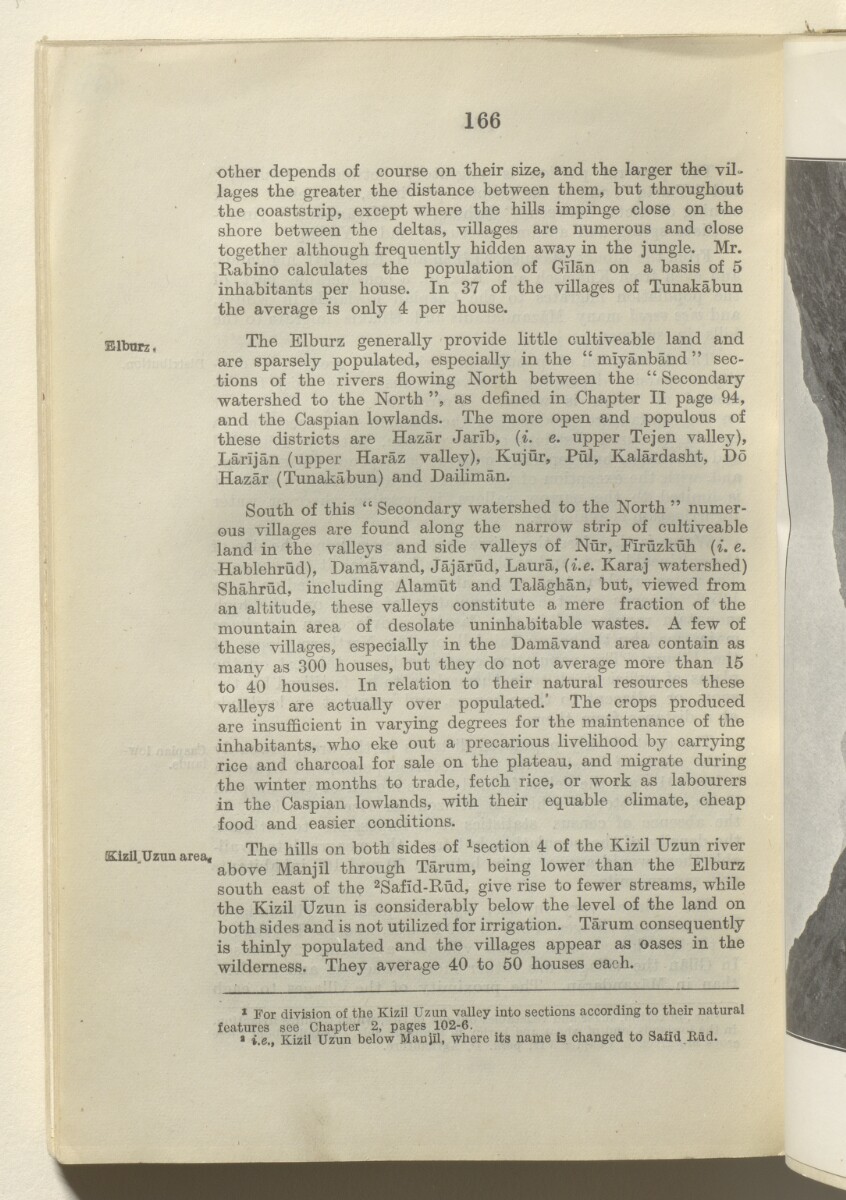
other depends of course on their size, and the larger the vil
lages the greater the distance between them, but throughout
the coaststrip, except where the hills impinge close on the
shore between the deltas, villages are numerous and close
together although frequently hidden away in the jungle. Mr.
Rabino calculates the population of Gilan on a basis of 5
inhabitants per house. In 37 of the villages of Tunakabun
the average is only 4 per house.
The Elburz generally provide little cultiveable land and
are sparsely populated, especially in the “ miyanband ” sec
tions of the rivers flowing North between the “ Secondary
watershed
The boundary between adjacent drainage basins.
to the North ”, as defined in Chapter II page 94,
and the Caspian lowlands. The more open and populous of
these districts are Hazar Jarib, (i. e. upper Tejen valley),
Larijan (upper Haraz valley), Kujur, Pul, Kalardasht, Dd
Hazar (Tunakabun) and Dailiman.
South of this “ Secondary
watershed
The boundary between adjacent drainage basins.
to the North ” numer
ous villages are found along the narrow strip of cultiveable
land in the valleys and side valleys of Nur, Firuzkuh (i. e.
Hablehrud), Damavand, Jajarud, Laura, (i.e. Karaj
watershed
The boundary between adjacent drainage basins.
)
Shahrud, including Alamut and Talaghan, but, viewed from
an altitude, these valleys constitute a mere fraction of the
mountain area of desolate uninhabitable wastes. A few of
these villages, especially in the Damavand area contain as
many as 300 houses, but they do not average more than 15
to 40 houses. In relation to their natural resources these
valleys are actually over populated.’ The. crops produced
are insufficient in varying degrees for the maintenance of the
inhabitants, who eke out a precarious livelihood by carrying
rice and charcoal for sale on the plateau, and migrate during
the winter months to trade, fetch rice, or work as labourers
in the Caspian lowlands, with their equable climate, cheap
food and easier conditions.
The hills on both sides of Section 4 of the Kizil Uzun river
above Manjil through Tarum, being lower than the Elburz
south east of the a Safid-Itud, give rise to fewer streams, while
the Kizil Uzun is considerably below the level of the land on
both sides and is not utilized for irrigation. Tarum consequently
is thinly populated and the villages appear as oases in the
wilderness. They average 40 to 50 houses each. 1
1 For division of the Kizil Uzun valley into sections according to their natural
features see Chapter 2, pages 102-6. n ^ .
a i,e., Kizil Uzun below ManjU, where its name is changed to Safid Rud.
About this item
- Content
Military report compiled by Captain LS Fortescue of the General Staff of the Mesopotamia Expeditionary Force and printed in Calcutta at the Superintendent Government Printing, India, 1922.
The volume begins with a statement defining the geographical area covered by the report. The report is divided into ten chapters, plus appendices, each concerning a different subject, as follows:
- Chapter 1: History
- Chapter 2: Geography
- Chapter 3: Climate, Water, Medical and Aviation
- Chapter 4: Ethnography
- Chapter 5: Administration (including a table of provinces with administrative details (folios 123-30)
- Chapter 6: Armed Forces of the Persian Government
- Chapter 7: Economic Resources
- Chapter 8: Tribes
- Chapter 9: Personalities
- Chapter 10: Communications
- Appendices: Glossary of terms; Weights, measures and coinage; Bibliography; Historical sketch (Chapter 1) continued from June 1920 to the end of 1921
At the back of the volume (folio 302) is a map to illustrate the report.
- Extent and format
- 1 volume (301 folios)
- Arrangement
There is a contents page (folio 5) and list of illustrations (folio 6) at the front of the volume and an index at the back (folios 270-300). All refer to the volume's original pagination. The index also includes map references of all places marked on the map.
- Physical characteristics
Foliation: the foliation sequence (used for referencing) commences at the front cover with 1, and terminates at the inside back cover with 303; these numbers are written in pencil, are circled, and are located in the top right corner of the recto The front of a sheet of paper or leaf, often abbreviated to 'r'. side of each folio.
Pagination: the file also contains an original printed pagination sequence.
- Written in
- English in Latin script View the complete information for this record
Use and share this item
- Share this item
'Military report on Tehran and adjacent Provinces of North-West Persia (including the Caspian Littoral)' [99v] (203/610), British Library: India Office Records and Private Papers, IOR/L/MIL/17/15/23, in Qatar Digital Library <https://www.qdl.qa/archive/81055/vdc_100059348671.0x000004> [accessed 7 July 2026]
https://www.qdl.qa/en/archive/81055/vdc_100059348671.0x000004
Copy and paste the code below into your web page where you would like to embed the image.
<meta charset="utf-8"><a href="https://www.qdl.qa/en/archive/81055/vdc_100059348671.0x000004">'Military report on Tehran and adjacent Provinces of North-West Persia (including the Caspian Littoral)' [‎99v] (203/610)</a> <a href="https://www.qdl.qa/en/archive/81055/vdc_100059348671.0x000004"> <img src="https://iiif.qdl.qa/iiif/images/81055/vdc_100000000239.0x00013d/IOR_L_MIL_17_15_23_0203.jp2/full/!280,240/0/default.jpg" alt="" /> </a>
This record has a IIIF manifest available as follows. If you have a compatible viewer you can drag the icon to load it.https://www.qdl.qa/en/iiif/81055/vdc_100000000239.0x00013d/manifestOpen in Universal viewerOpen in Mirador viewerMore options for embedding images
Copyright: How to use this content
- Reference
- IOR/L/MIL/17/15/23
- Title
- 'Military report on Tehran and adjacent Provinces of North-West Persia (including the Caspian Littoral)'
- Pages
- front, back, spine, edge, head, tail, front-i, 2r:301v, back-i
- Author
- East India Company, the Board of Control, the India Office, or other British Government Department
- Usage terms
- Open Government Licence