
![Papers of the War Cabinet's Eastern Committee [‎161r] (321/544)](https://iiif.qdl.qa/iiif/images/81055/vdc_100000001491.0x0002a8/Mss Eur F112_274_0321.jp2/full/!1200,1200/0/default.jpg "Papers of the War Cabinet's Eastern Committee [‎161r] (321/544)")
Papers of the War Cabinet's Eastern Committee [161r] (321/544)
The record is made up of 1 file (272 folios). It was created in 13 Mar 1918-7 Jan 1919. It was written in English. The original is part of the British Library: India Office The department of the British Government to which the Government of India reported between 1858 and 1947. The successor to the Court of Directors. Records and Private Papers Documents collected in a private capacity. .
Transcription
This transcription is created automatically. It may contain errors.
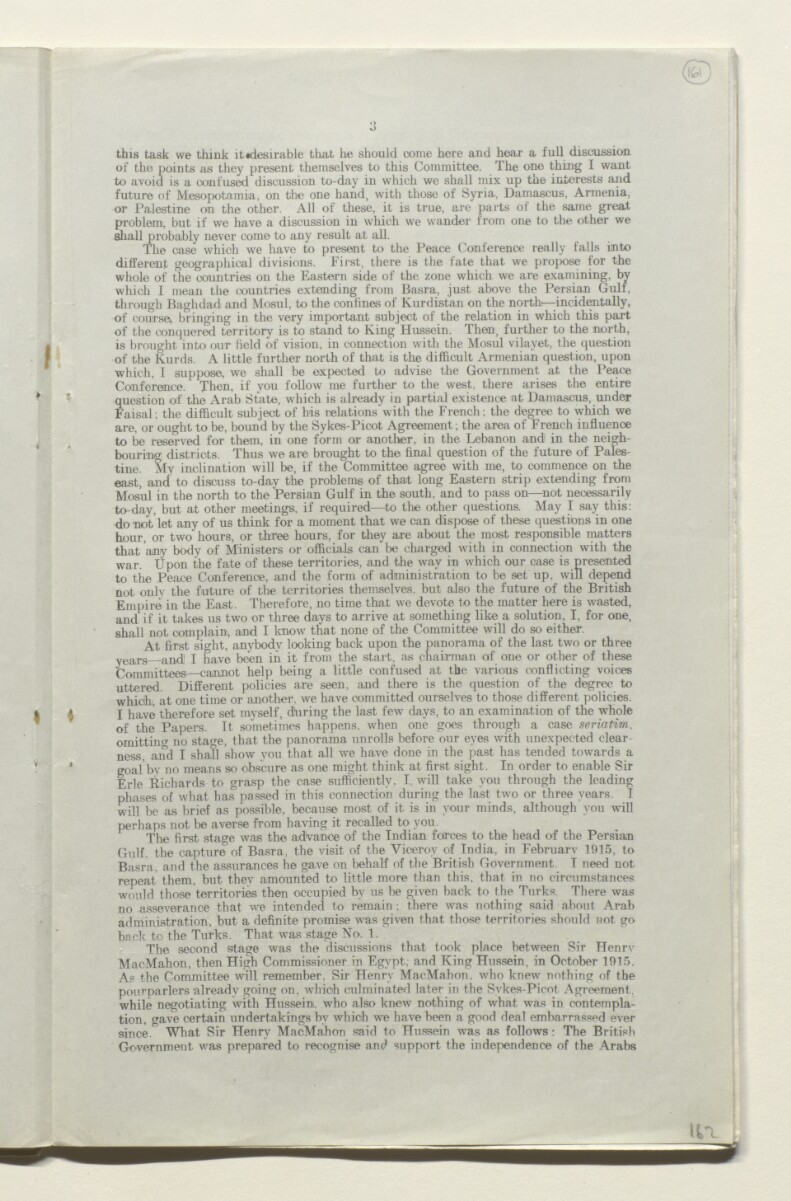
3
this task we think it«desirable that he should come here and hear a full discussion
of the points as they present themselves to this Committee. The one thing I want
to avoid is a confused discussion to-day in which we shall mix up the interests and
future of Mesopotamia, on the one hand, with those of Syria. Damascus, Armenia,
or Palestine on the other. All of these, it is true, are parts of the same great
problem, but if we have a discussion in which we wander from one to the other we
shall probably never come to any result at all.
The case which we have to present to the Peace Conference really falls into
different geographical divisions. First, there is the fate that we propose for the
whole of the countries on the Eastern side of the zone which we are examining, bv
which I mean the countries extending from Basra, just above the
Persian Gulf
The historical term used to describe the body of water between the Arabian Peninsula and Iran.
,
through Baghdad and Mosul, to the confines of Kurdistan on the northf—incidentally,
of course, bringing in the very important subject of the relation in which this part
of the conquered territory is to stand to King Hussein. Then, further to the north,
is brought into our field of vision, in connection with the Mosul vilayet, the question
of the Kurds. A little further north of that is the difficult Armenian question, upon
which, I suppose, we shall be expected to advise the Government at the Peace
Conference. Then, if you follow me further to the west, there arises the entire
question of the Arab State, which is already in partial existence at Damascus, under
Faisal; the difficult subject of his relations with the French; the degree to which we
are, or ought to be, bound by the Sykes-Picot Agreement; the area of French influence
to be reserved for them, in one form or another, in the Lebanon and in the neigh-
bouring districts. Thus we are brought to the final question of the future of Pales
tine. My inclination will be, if the Committee agree with me, to commence on the
east, and to discuss to-day the problems of that long Eastern strip extending from
Mosul in the north to the
Persian Gulf
The historical term used to describe the body of water between the Arabian Peninsula and Iran.
in the south, and to pass on—not necessarily
to-day, but at other meetings, if required—to the other questions. May I say this:
do not let any of us think for a moment that we can dispose of these questions in one
hour, or two hours, or three hours, for they are about the most responsible matters
that any body of Ministers or officials can be charged with in connection with the
war. Upon the fate of these territories, and the way in which our case is presented
to the Peace Conference, and the form of administration to be set up, will depend
not only the future of the territories themselves, but also the future of the British
Empire in the East. Therefore, no time that we devote to the matter here is wasted,
and if it takes us two or three days to arrive at something like a solution, I, for one,
shall not complain, and I know that none of the Committee will do so either.
At first sight, anybody looking back upon the panorama of the last two or three
y ears an( (i> I have been in it from the start, as chairman of one or other of these
Committees—cannot help being a little confused at the various conflicting voices
uttered. Different policies are seen, and there is the question of the degree to
which, at one time or another, we have committed ourselves to those different policies.
$ I have therefore set myself, dhring the last few days, to an examination of the whole
of the Papers. It sometimes happens, when one goes through a case seriatim,
omitting no stage, that the panorama unrolls before our eyes with unexpected clear
ness, and I shall show you that all we have done in the past has tended towards a
goal by no means so obscure as one might think at first sight. In order to enable Sir
Erie Richards to grasp the case sufficiently, I will take you through the leading
phases of what has passed in this connection during the last two or three years. I
will be as brief as possible, because most of it is in your minds, although you will
perhaps not be averse from having it recalled to yon.
The first stage was the advance of the Indian forces to the head of the Persian
Gulf, the capture of Basra, the visit of the Viceroy of India, in Februarv 1915, to
Basra, and the assurances he gave on behalf of the British Government. I need not
repeat them, but they amounted to little more than this, that in no circumstances
would those territories then occupied by us be given back to the Turks. There was
no asseverance that we intended to remain ; there was nothing said about Arab
administration, but a definite promise was given that those territories should not go
back to the Turks. That was stage No. 1.
The second stage was the discussions that took place between Sir Henrv
MacMahon, then High Commissioner in Egypt, and King Hussein, in October 1915.
As the Committee will remember. Sir Henry MacMahon, who knew nothing of the
pourparlers already going on, which culminated later in the Svkes-Picot Agreement,
while negotiating with Hussein, who also knew nothing of what was in contempla
tion, gave certain undertakings by which we have been a good deal embarrassed ever
since. What Sir Henry MacMahon said to Hussein was as follows: The British
Government was prepared to recognise and support the independence of the Arabs
I tv
About this item
- Content
This file is composed of papers produced by the War Cabinet's Eastern Committee, which was chaired by George Curzon for most of its existence. The file contains a complete set of printed minutes, beginning with the committee's first meeting on 28 March 1918, and concluding with its final meeting on 7 January 1919 (ff 6-214 and ff 227-272).
The file begins with two copies of a memorandum by Curzon, dated 13 March 1918, proposing the formation of the Eastern Committee. This is followed by a memorandum by Arthur James Balfour, Secretary of State for Foreign Affairs, approving Curzon's proposal, and a copy of a procedure for the newly created committee, outlining arrangements for committee meetings and the dissemination of information to committee members.
Also included is a set of resolutions, passed by the committee in December 1918, in order to guide British representatives at the Paris Peace conference (ff 216-225). The resolutions cover the following: the Caucasus and Armenia; Syria; Palestine; Hejaz and Arabia; Mesopotamia, Mosul, Baghdad and Basra. They are preceded by a handwritten note written by Curzon 'some years later', which remarks on how they are a 'rather remarkable forecast of the bulk of the results since obtained.'
- Extent and format
- 1 file (272 folios)
- Arrangement
The papers are arranged in approximate chronological order from the front to the rear of the file.
- Physical characteristics
Foliation: the foliation sequence (used for referencing) commences at the first folio with 1, and terminates at the last folio with 272; these numbers are written in pencil, are circled, and are located in the top right corner of the recto The front of a sheet of paper or leaf, often abbreviated to 'r'. side of each folio.
- Written in
- English in Latin script View the complete information for this record
Use and share this item
- Share this item
Papers of the War Cabinet's Eastern Committee [161r] (321/544), British Library: India Office Records and Private Papers, Mss Eur F112/274, in Qatar Digital Library <https://www.qdl.qa/archive/81055/vdc_100069672678.0x00007a> [accessed 26 August 2026]
https://www.qdl.qa/en/archive/81055/vdc_100069672678.0x00007a
Copy and paste the code below into your web page where you would like to embed the image.
<meta charset="utf-8"><a href="https://www.qdl.qa/en/archive/81055/vdc_100069672678.0x00007a">Papers of the War Cabinet's Eastern Committee [‎161r] (321/544)</a> <a href="https://www.qdl.qa/en/archive/81055/vdc_100069672678.0x00007a"> <img src="https://iiif.qdl.qa/iiif/images/81055/vdc_100000001491.0x0002a8/Mss Eur F112_274_0321.jp2/full/!280,240/0/default.jpg" alt="" /> </a>
This record has a IIIF manifest available as follows. If you have a compatible viewer you can drag the icon to load it.https://www.qdl.qa/en/iiif/81055/vdc_100000001491.0x0002a8/manifestOpen in Universal viewerOpen in Mirador viewerMore options for embedding images
Copyright: How to use this content
- Reference
- Mss Eur F112/274
- Title
- Papers of the War Cabinet's Eastern Committee
- Pages
- 1r:214v, 216r:272v
- Author
- East India Company, the Board of Control, the India Office, or other British Government Department
- Usage terms
- Open Government Licence