
![Papers of the War Cabinet's Eastern Committee [‎245r] (489/544)](https://iiif.qdl.qa/iiif/images/81055/vdc_100000001491.0x0002a8/Mss Eur F112_274_0489.jp2/full/!1200,1200/0/default.jpg "Papers of the War Cabinet's Eastern Committee [‎245r] (489/544)")
Papers of the War Cabinet's Eastern Committee [245r] (489/544)
The record is made up of 1 file (272 folios). It was created in 13 Mar 1918-7 Jan 1919. It was written in English. The original is part of the British Library: India Office The department of the British Government to which the Government of India reported between 1858 and 1947. The successor to the Court of Directors. Records and Private Papers Documents collected in a private capacity. .
Transcription
This transcription is created automatically. It may contain errors.
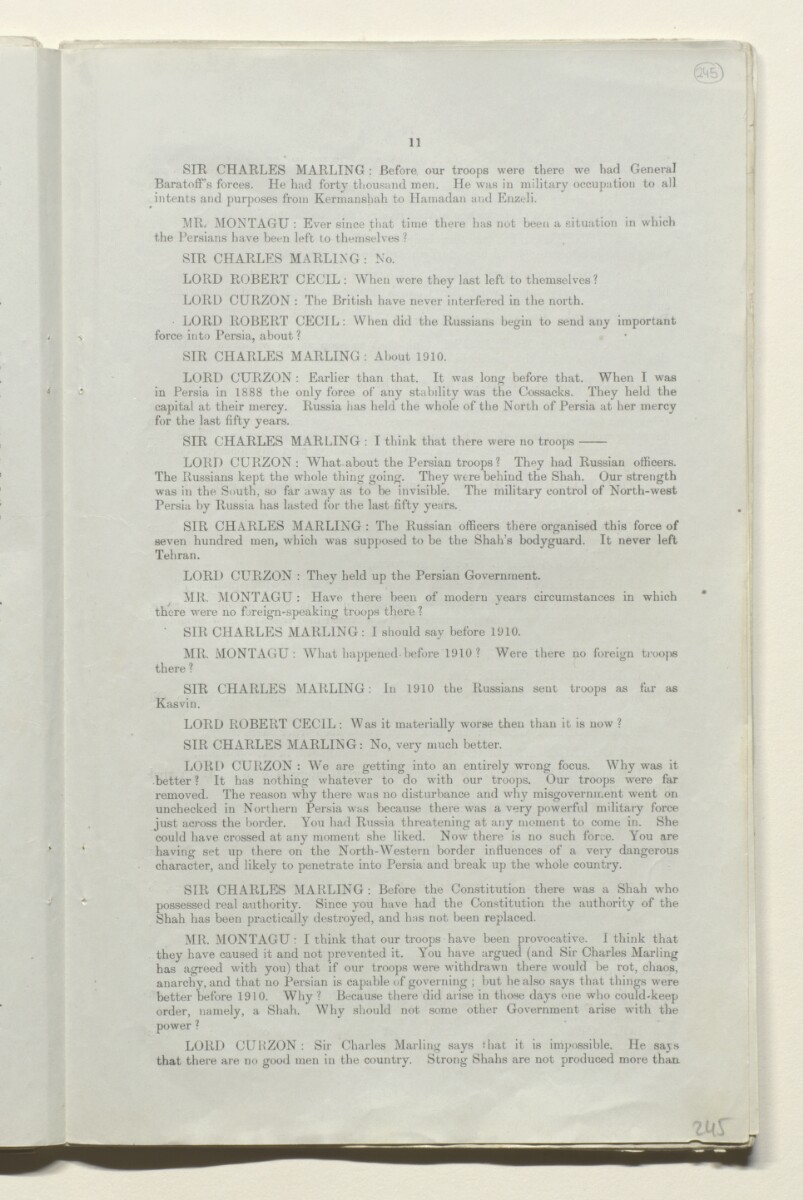
11
SIR CHARLES MARLING : Before our troops were there we had General
Baratoff’s forces. He had forty thousand men. He was in military occupation to all
intents and purposes from Kermanshah to Hamadan and Enzeli.
MR. MONTAGU : Ever since that time there has not been a situation in which
the Persians have been left to themselves ?
SIR CHARLES MARLING : No.
LORD ROBERT CECIL : When were they last left to themselves?
LORD CURZON : The British have never interfered in the north.
• LORD ROBERT CECIL: When did the Russians begin to send any important
force into Persia, about ?
SIR CHARLES MARLING: About 1910.
LORD CURZON : Earlier than that. It was long before that. When I was
in Persia in 1888 the only force of any stability was the Cossacks. They held the
capital at their mercy. Russia has held the whole of the North of Persia at her mercy
for the last fifty years.
SIR CHARLES MARLING : I think that there were no troops
LORD CURZON : What about the Persian troops? They had Russian officers.
The Russians kept the whole thing going. They were behind the Shah. Our strength
was in the South, so far away as to be invisible. The military control of North-west
Persia by Russia has lasted for the last fifty years.
SIR CHARLES MARLING : The Russian officers there organised this force of
seven hundred men, which was supposed to be the Shah’s bodyguard. It never left
Tehran.
LORD CURZON : They held up the Persian Government.
MR. MONTAGU : Have there been of modern years circumstances in which
there were no foreign-speaking troops there ?
' SIR CHARLES MARLING : I should say before 1910.
MR. MONTAGU: What happened before 1910? Were there no foreign troops
there ?
SIR CHARLES MARLING: In 1910 the Russians sent troops as far as
Kasvin.
LORD ROBERT CECIL : Was it materially worse then than it is now 7 ?
SIR CHARLES MARLING: No, very much better.
LORD CURZON : We are getting into an entirely wrong focus. Why was it
better ? It has nothing whatever to do with our troops. Our troops w 7 ere far
removed. The reason why there w r as no disturbance and why misgovernment went on
unchecked in Northern Persia was because there was a very powerful military force
just across the border. You had Russia threatening at any moment to come in. She
could have crossed at any moment she liked. Now 7 there is no such force. You are
having set up there on the North-Western border influences of a very dangerous
character, and likely to penetrate into Persia and break up the whole country.
SIR CHARLES MARLING : Before the Constitution there was a Shah who
possessed real authority. Since you have had the Constitution the authority of the
Shah has been practically destroyed, and has not been replaced.
MR. MONTAGU : I think that our troops have been provocative. I think that
they have caused it and not prevented it. You have argued (and Sir Charles Marling
has agreed wdth you) that if our troops were withdrawn there w 7 ould be rot, chaos,
anarchy, and that no Persian is capable of governing ; but he also says that things were
better before 1910. Why ? Because there did arise in those days one who could-keep
order, namely, a Shah. Why should not some other Government arise wdth the
power ?
LORD CURZON : Sir Charles Marling says that it is impossible. He says
that there are no good men in the country. Strong Shahs are not produced more than
About this item
- Content
This file is composed of papers produced by the War Cabinet's Eastern Committee, which was chaired by George Curzon for most of its existence. The file contains a complete set of printed minutes, beginning with the committee's first meeting on 28 March 1918, and concluding with its final meeting on 7 January 1919 (ff 6-214 and ff 227-272).
The file begins with two copies of a memorandum by Curzon, dated 13 March 1918, proposing the formation of the Eastern Committee. This is followed by a memorandum by Arthur James Balfour, Secretary of State for Foreign Affairs, approving Curzon's proposal, and a copy of a procedure for the newly created committee, outlining arrangements for committee meetings and the dissemination of information to committee members.
Also included is a set of resolutions, passed by the committee in December 1918, in order to guide British representatives at the Paris Peace conference (ff 216-225). The resolutions cover the following: the Caucasus and Armenia; Syria; Palestine; Hejaz and Arabia; Mesopotamia, Mosul, Baghdad and Basra. They are preceded by a handwritten note written by Curzon 'some years later', which remarks on how they are a 'rather remarkable forecast of the bulk of the results since obtained.'
- Extent and format
- 1 file (272 folios)
- Arrangement
The papers are arranged in approximate chronological order from the front to the rear of the file.
- Physical characteristics
Foliation: the foliation sequence (used for referencing) commences at the first folio with 1, and terminates at the last folio with 272; these numbers are written in pencil, are circled, and are located in the top right corner of the recto The front of a sheet of paper or leaf, often abbreviated to 'r'. side of each folio.
- Written in
- English in Latin script View the complete information for this record
Use and share this item
- Share this item
Papers of the War Cabinet's Eastern Committee [245r] (489/544), British Library: India Office Records and Private Papers, Mss Eur F112/274, in Qatar Digital Library <https://www.qdl.qa/mirador/81055/vdc_100069672679.0x00005a> [accessed 27 June 2026]
https://www.qdl.qa/en/archive/81055/vdc_100069672679.0x00005a
Copy and paste the code below into your web page where you would like to embed the image.
<meta charset="utf-8"><a href="https://www.qdl.qa/en/archive/81055/vdc_100069672679.0x00005a">Papers of the War Cabinet's Eastern Committee [‎245r] (489/544)</a> <a href="https://www.qdl.qa/en/archive/81055/vdc_100069672679.0x00005a"> <img src="https://iiif.qdl.qa/iiif/images/81055/vdc_100000001491.0x0002a8/Mss Eur F112_274_0489.jp2/full/!280,240/0/default.jpg" alt="" /> </a>
This record has a IIIF manifest available as follows. If you have a compatible viewer you can drag the icon to load it.https://www.qdl.qa/en/iiif/81055/vdc_100000001491.0x0002a8/manifestOpen in Universal viewerOpen in Mirador viewerMore options for embedding images
Copyright: How to use this content
- Reference
- Mss Eur F112/274
- Title
- Papers of the War Cabinet's Eastern Committee
- Pages
- 1r:214v, 216r:272v
- Author
- East India Company, the Board of Control, the India Office, or other British Government Department
- Usage terms
- Open Government Licence