
!['Seistan' [‎45r] (89/782)](https://iiif.qdl.qa/iiif/images/81055/vdc_100000001452.0x0003bc/Mss Eur F111_352_0101.jp2/full/!1200,1200/0/default.jpg "'Seistan' [‎45r] (89/782)")
The record is made up of 1 file (388 folios). It was created in 17 Jan 1899-4 Apr 1904. It was written in English. The original is part of the British Library: India Office The department of the British Government to which the Government of India reported between 1858 and 1947. The successor to the Court of Directors. Records and Private Papers Documents collected in a private capacity. .
Transcription
This transcription is created automatically. It may contain errors.
/
7
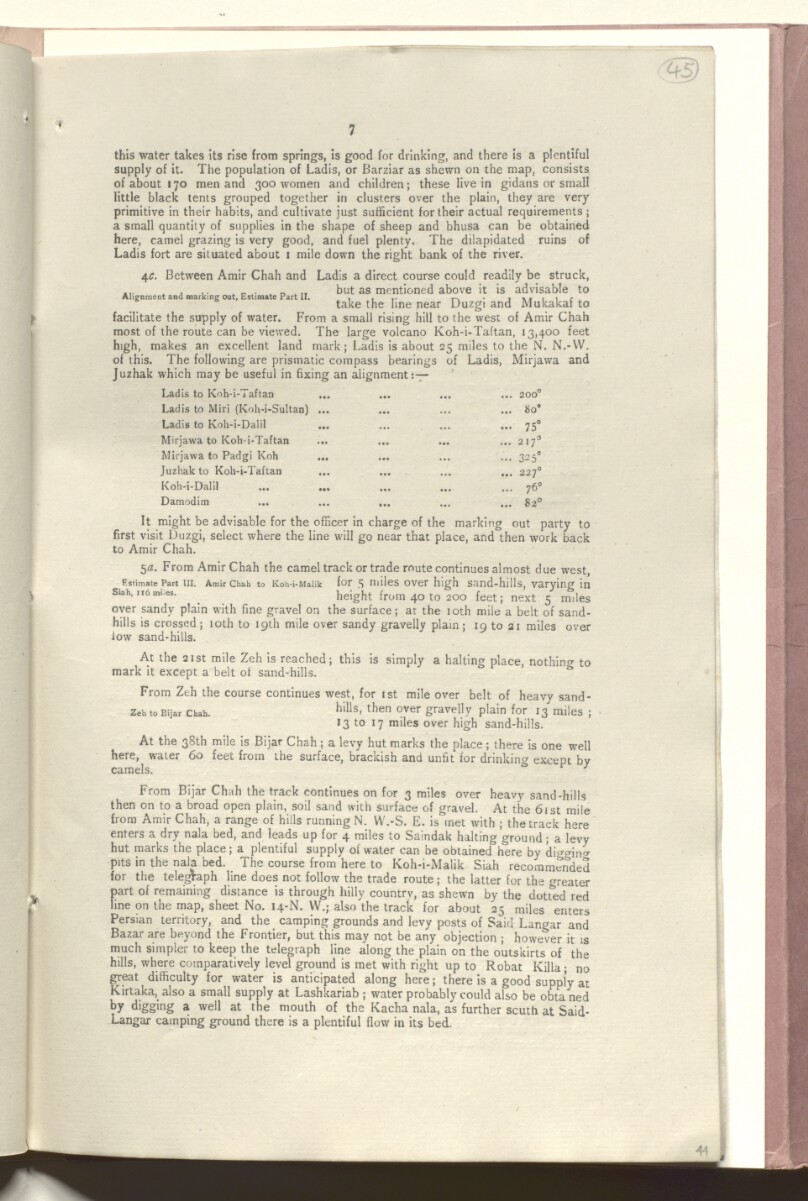
this water takes its rise from springs, is good for drinking, and there is a plentiful
supply of it. The population of Ladis, or Barziar as shewn on the map, consists
of about 170 men and 300 women and children; these live in gidans or small
little black tents grouped together in clusters over the plain, they are very
primitive in their habits, and cultivate just sufficient for their actual requirements ;
a small quantity of supplies in the shape of sheep and bhusa can be obtained
here, camel grazing is very good, and fuel plenty. The dilapidated ruins of
Ladis fort are situated about 1 mile down the right bank of the river.
4c. Between Amir Chah and Ladis a direct course could readily be struck,
... „ , .. . c. . n . but as mentioned above it is advisable to
take the line near Duzgi and Mukakat to
facilitate the supply of water. From a small rising hill to the west of Amir Chah
most of the route can be viewed. The large volcano Koh*i-Taftan, 13,400 feet
high, makes an excellent land mark; Ladis is about 25 miles to the N. N.-YV.
of this. The following are
prismatic compass
A compass fitted with a sighting vane and magnifier to achieve additional accuracy.
bearings of Ladis, Mirjawa and
Juzhak which may be useful in fixing an alignment:—
Ladis to Koh-i-Taftan ... ... ... ... 200 °
Ladis to Miri (Koh-i-Sultan) ..
Ladis to Koh-i-Dalil ,.
Mirjawa to Koh-i-Taftan
Mirjawa to Padgi Koh ,.
Juzhak to Koh-i-Taftan ..
Koh-i-Dalil ... ,,
Damodim
... 80 ®
... 75°
... 217°
... 325°
... 227 0
... 76 °
... 82°
It might be advisable for the officer in charge of the marking out party to
first visit Duzgi, select where the line will go near that place, and then work back
to Amir Chah.
$a. From Amir Chah the camel track or trade route continues almost due west,
Estimate Part in. Amir Chah to Koh-i-Maiik for 5 nules over high sand-hills, varying in
Slab, no miles. . height from 40 to 200 feet; next 5 miles
over sandy plain with fine gravel on the surface; at the 10th mile a belt of sand
hills is crossed; 10th to 19th mile over sandy gravelly plain; 10 to 21 miles over
low sand-hills.
At the 21st mile Zeh is reached; this is simply a halting place, nothino- to
mark it except a belt of sand-hills.
From Zeh the course continues west, for 1st mile over belt of heavy sand-
Zeh to Bijar Chah. hllls ’ then over gravelly plain for 13 miles ;
13 to 17 miles over high sand-hills.
At the 38th mile is Bijar Chah; a levy hut marks the place ; there is one well
here, water 60 feet from the surface, brackish and unfit for drinking except by-
camels. ^ J
From Bijar Chah the track continues on for 3 miles over heavy sand-hills
then on to a broad open plain, soil sand with surface of gravel. At the 61st mile
from Amir Chah, a range of hills running N. YV.-S. E. is met with ; the track here
enters a dry nala bed, and leads up for 4 miles to Saindak halting ground; a levy
hut marks the place; a plentiful supply of water can be obtained here by diggino-
pits in the nala bed. The course from here to Koh-i-Malik Siah recommended
for the telegraph line does not follow the trade route; the latter for the greater
part of remaining distance is through hilly countrv, as shewn by the dotted red
line on the map, sheet No. 14-N. YV. ; also the track for about 25 miles enters
Persian territory, and the camping grounds and levy posts of Said Langar and
Bazar are beyond the Frontier, but this may not be any objection ; however it is
much simpler to keep the telegraph line along the plain on the outskirts of the
hills, where comparatively level ground is met with right up to Robat Killa; no
great difficulty for water is anticipated along here; there is a good supply at
Kirtaka,. also a small supply at Lashkariab ; water probably could also be obta ned
by digging a well at the mouth of the Kacha nala, as further scuth at Said-
Langar camping ground there is a plentiful flow in its bed.
About this item
- Content
The file contains papers relating to Seistan [Sistan] and Persia [Iran].
The file includes printed copies of despatches from the Agent to the Governor-General of India and HM Consul-General for Khorasan and Seistan (Lieutenant-Colonel Henry Martindale Temple), to the Secretary to the Government of India Foreign Department, with enclosed despatches from Captain Percy Molesworth Sykes to the Secretary of State for Foreign Affairs (the Marquis of Salisbury). Skyes’s despatches regard matters including: Seistan; trade routes into South-East Persia; the boundary between Persia and Afghanistan, in relation to the River Helmund [Helmand] changing its course (in despatch No. 5, which includes four sketch maps, folios 12, 13, 14 and 15); Sykes’s journey to Birjand (in despatch No. 7, which includes a sketch map on folio 20); the ruling family of Kain, which also governed Seistan, Tabbas and Tun; Sykes’s journey from Seistan to Kerman [Kirman] (in despatch No. 11, which includes a sketch map); and the direct Kerman-Quetta caravan trade that Sykes was trying to establish.
The file also includes copies of the following papers:
- A despatch from Temple to the Secretary to the Government of India Foreign Department, enclosing a letter from Temple to Sir Henry Mortimer Durand (HM Minister, Tehran), with copies of enclosures, regarding the establishment of a Seistan and Kain consulate
- A letter from Charles Edward Pitman, Director General of Telegraphs, to the Secretary to the Government of India Public Works Department, enclosing a copy of a ‘Report on the Preliminary Survey of the Route for a Telegraph Line from Quetta to the Persian Frontier’ by H A Armstrong, Assistant Superintendent, Indian Telegraph Department, which includes six photographs of views along the route [Mss Eur F111/352, f 52; Mss Eur F111/352, f 53; Mss Eur F111/352, f 54; Mss Eur F111/352, f 55; Mss Eur F111/352, f 56; and Mss Eur F111/352, f 57], and a map showing the proposed route of the telegraph line [Mss Eur F111/352, f 59]
- Letters from Hugh Shakespear Barnes, Agent to the Governor-General in Baluchistan, to the Secretary to the Government of India Foreign Department, enclosing copies of the diary of the Political Assistant, Chagai, for the weeks ending 16 February, 28 February, and 8 March 1900
- Diary No. 3, 4, 6, 7, 8, 9, 11 and 12 of Major-General George Frederick Chenevix-Trench, HM Consul for Seistan (Diary No. 6 includes a sketch map, folio 86)
- A copy of a ‘Report on Reconnaissances Made while Attached to the Seistan Arbitration Commission’ by W A Johns, Deputy Consulting Engineer for Railways, Bombay
- A copy of the report ‘Notes on Persian Seistan’, compiled by Captain Edward Abadie Plunkett, and issued by the Government of India Intelligence Branch, Quarter-Master General’s Department
- Two copies of map signed by Plunkett titled ‘Persian Seistan-Cultivated Area’ [Mss Eur F111/352, f 270]
- A booklet entitled ‘Notes on the Leading Notables, Officials, Merchants, and Clergy of Khorasan, Seistan, Kain, and Kerman.’
- Printed copies of letters from the Government of India Foreign Department to the Secretary of State for India (Lord George Francis Hamilton), relating to the maintenance of British interests in Persia, dated 4 September 1899 and 7 November 1901 (the former with an enclosure of a minute by the Viceroy on Seistan).
- Extent and format
- 1 file (388 folios)
- Arrangement
The papers are arranged in approximate chronological order from the front to the rear of the file.
- Physical characteristics
Foliation: the foliation sequence (used for referencing) commences at the front cover with 1, and terminates at the inside back cover with 390; these numbers are written in pencil, are circled, and are located in the top right corner of the recto The front of a sheet of paper or leaf, often abbreviated to 'r'. side of each folio. The file contains one foliation anomaly, f 301A
- Written in
- English in Latin script View the complete information for this record
Use and share this item
- Share this item
'Seistan' [45r] (89/782), British Library: India Office Records and Private Papers, Mss Eur F111/352, in Qatar Digital Library <https://www.qdl.qa/archive/81055/vdc_100069721602.0x00005c> [accessed 12 July 2026]
https://www.qdl.qa/en/archive/81055/vdc_100069721602.0x00005c
Copy and paste the code below into your web page where you would like to embed the image.
<meta charset="utf-8"><a href="https://www.qdl.qa/en/archive/81055/vdc_100069721602.0x00005c">'Seistan' [‎45r] (89/782)</a> <a href="https://www.qdl.qa/en/archive/81055/vdc_100069721602.0x00005c"> <img src="https://iiif.qdl.qa/iiif/images/81055/vdc_100000001452.0x0003bc/Mss Eur F111_352_0101.jp2/full/!280,240/0/default.jpg" alt="" /> </a>
This record has a IIIF manifest available as follows. If you have a compatible viewer you can drag the icon to load it.https://www.qdl.qa/en/iiif/81055/vdc_100000001452.0x0003bc/manifestOpen in Universal viewerOpen in Mirador viewerMore options for embedding images
Copyright: How to use this content
- Reference
- Mss Eur F111/352
- Title
- 'Seistan'
- Pages
- front, front-i, 2r:51v, 58r:58v, 60r:112r, 113r:125v, 147r:218r, 218r, 219r:269v, 271r:301v, 301Ar, 301Av, 302r:388v, 389v:390r, 389r, back
- Author
- East India Company, the Board of Control, the India Office, or other British Government Department
- Usage terms
- Open Government Licence