
!['Seistan' [‎66v] (132/782)](https://iiif.qdl.qa/iiif/images/81055/vdc_100000001452.0x0003bc/Mss Eur F111_352_0146.jp2/full/!1200,1200/0/default.jpg "'Seistan' [‎66v] (132/782)")
The record is made up of 1 file (388 folios). It was created in 17 Jan 1899-4 Apr 1904. It was written in English. The original is part of the British Library: India Office The department of the British Government to which the Government of India reported between 1858 and 1947. The successor to the Court of Directors. Records and Private Papers Documents collected in a private capacity. .
Transcription
This transcription is created automatically. It may contain errors.
a
<
N
*
*
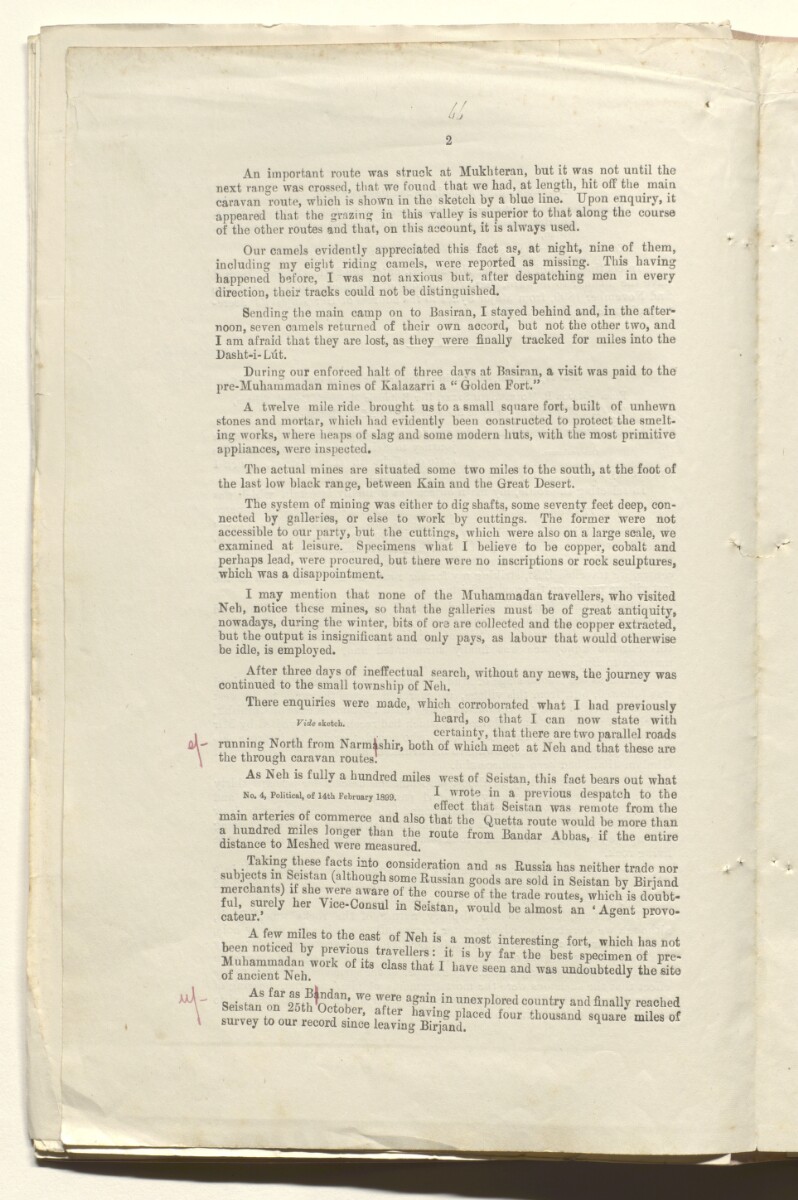
An important route was struck at Mukhteran, but it was not until the
next range was crossed, that we found that we had, at length, hit off the main
caravan route, which is shown in the sketch by a blue line. Upon enquiry, it
appeared that the grazing in this valley is superior to that along the course
of the other routes and that, on this account, it is always used.
Our camels evidently appreciated this fact as, at night, nine of them,
including my eight riding camels, were reported as missing. This having
happened before, I was not anxious but, after despatching men in every
direction, their tracks could not be distinguished.
Sending the main camp on to Basiran, I stayed behind and, in the after
noon, seven camels returned of their own accord, but not the other two, and
I am afraid that they are lost, as they were finally tracked for miles into the
Dasht-i- Lut.
During our enforced halt of three days at Basiran, a visit was paid to the
pre-Muhammadan mines of Kalazarri a “ Golden Fort. ,,
A twelve mile ride brought us to a small square fort, built of unhewn
stones and mortar, which had evidently been constructed to protect the smelt
ing works, where heaps of slag and some modern huts, with the most primitive
appliances, were inspected.
The actual mines are situated some two miles to the south, at the foot of
the last low black range, between Kain and the Great Desert.
The system of mining was either to dig shafts, some seventy feet deep, con
nected by galleries, or else to work by cuttings. The former were not
accessible to our party, but the cuttings, which were also on a large scale, we
examined at leisure. Specimens what I believe to be copper, cobalt and
perhaps lead, w T ere procured, but there were no inscriptions or rock sculptures,
which was a disappointment.
I may mention that none of the Muhammadan travellers, who visited
Neh, notice these mines, so that the galleries must be of great antiquity,
nowadays, during the winter, bits of ore are collected and the copper extracted,
but the output is insignificant and only pays, as labour that would otherwise
be idle, is employed.
After three days of ineffectual search, without any news, the journey was
continued to the small township of Neh.
There enquiries were made, which corroborated what I had previously
Vide sketch. heard, so that I can now state with
certainty, that there are two parallel roads
running North from Narmishir, both of which meet at Neh and that these are
the through caravan routes!
As Neh is fully a hundred miles west of Seistan, this fact bears out what
No. 4, Political, of 14th February 1899 . ^ Wr0 ^ e i n a previous despatch to the
, . . effect that Seistan was remote from the
main arteries of commerce and also that the Quetta route would be more than
a hundred fciUs longer than the route from Bandar Abbas, if the entire
distance to Meshed were measured.
Taking these facts into consideration and as Bussia has neither trade noi
subjects in Seistan (although some Russian goods are sold in Seistan by Biriand
merchants) if she were aware of the. course of the trade routes, which is doubt
ful, smely her Vice-Consul m Seistan, would be almost an ‘Agent provo
t0 the GaSt ° f is a most intere sting fort, which has not
been noticed by previous travellers: it is by far the best specimen of nre-
^ U an“Neh W ° ° £ ^ ^ that 1 baTe seen and was undoubtedly thedfc
Sei.tfn on r 25tbioet n n h7 e '’’T a , gail ? in l > ne *pl<>red country and finally reached
four ‘ ho -“ d ^
About this item
- Content
The file contains papers relating to Seistan [Sistan] and Persia [Iran].
The file includes printed copies of despatches from the Agent to the Governor-General of India and HM Consul-General for Khorasan and Seistan (Lieutenant-Colonel Henry Martindale Temple), to the Secretary to the Government of India Foreign Department, with enclosed despatches from Captain Percy Molesworth Sykes to the Secretary of State for Foreign Affairs (the Marquis of Salisbury). Skyes’s despatches regard matters including: Seistan; trade routes into South-East Persia; the boundary between Persia and Afghanistan, in relation to the River Helmund [Helmand] changing its course (in despatch No. 5, which includes four sketch maps, folios 12, 13, 14 and 15); Sykes’s journey to Birjand (in despatch No. 7, which includes a sketch map on folio 20); the ruling family of Kain, which also governed Seistan, Tabbas and Tun; Sykes’s journey from Seistan to Kerman [Kirman] (in despatch No. 11, which includes a sketch map); and the direct Kerman-Quetta caravan trade that Sykes was trying to establish.
The file also includes copies of the following papers:
- A despatch from Temple to the Secretary to the Government of India Foreign Department, enclosing a letter from Temple to Sir Henry Mortimer Durand (HM Minister, Tehran), with copies of enclosures, regarding the establishment of a Seistan and Kain consulate
- A letter from Charles Edward Pitman, Director General of Telegraphs, to the Secretary to the Government of India Public Works Department, enclosing a copy of a ‘Report on the Preliminary Survey of the Route for a Telegraph Line from Quetta to the Persian Frontier’ by H A Armstrong, Assistant Superintendent, Indian Telegraph Department, which includes six photographs of views along the route [Mss Eur F111/352, f 52; Mss Eur F111/352, f 53; Mss Eur F111/352, f 54; Mss Eur F111/352, f 55; Mss Eur F111/352, f 56; and Mss Eur F111/352, f 57], and a map showing the proposed route of the telegraph line [Mss Eur F111/352, f 59]
- Letters from Hugh Shakespear Barnes, Agent to the Governor-General in Baluchistan, to the Secretary to the Government of India Foreign Department, enclosing copies of the diary of the Political Assistant, Chagai, for the weeks ending 16 February, 28 February, and 8 March 1900
- Diary No. 3, 4, 6, 7, 8, 9, 11 and 12 of Major-General George Frederick Chenevix-Trench, HM Consul for Seistan (Diary No. 6 includes a sketch map, folio 86)
- A copy of a ‘Report on Reconnaissances Made while Attached to the Seistan Arbitration Commission’ by W A Johns, Deputy Consulting Engineer for Railways, Bombay
- A copy of the report ‘Notes on Persian Seistan’, compiled by Captain Edward Abadie Plunkett, and issued by the Government of India Intelligence Branch, Quarter-Master General’s Department
- Two copies of map signed by Plunkett titled ‘Persian Seistan-Cultivated Area’ [Mss Eur F111/352, f 270]
- A booklet entitled ‘Notes on the Leading Notables, Officials, Merchants, and Clergy of Khorasan, Seistan, Kain, and Kerman.’
- Printed copies of letters from the Government of India Foreign Department to the Secretary of State for India (Lord George Francis Hamilton), relating to the maintenance of British interests in Persia, dated 4 September 1899 and 7 November 1901 (the former with an enclosure of a minute by the Viceroy on Seistan).
- Extent and format
- 1 file (388 folios)
- Arrangement
The papers are arranged in approximate chronological order from the front to the rear of the file.
- Physical characteristics
Foliation: the foliation sequence (used for referencing) commences at the front cover with 1, and terminates at the inside back cover with 390; these numbers are written in pencil, are circled, and are located in the top right corner of the recto The front of a sheet of paper or leaf, often abbreviated to 'r'. side of each folio. The file contains one foliation anomaly, f 301A
- Written in
- English in Latin script View the complete information for this record
Use and share this item
- Share this item
'Seistan' [66v] (132/782), British Library: India Office Records and Private Papers, Mss Eur F111/352, in Qatar Digital Library <https://www.qdl.qa/archive/81055/vdc_100069721602.0x000087> [accessed 13 July 2026]
https://www.qdl.qa/en/archive/81055/vdc_100069721602.0x000087
Copy and paste the code below into your web page where you would like to embed the image.
<meta charset="utf-8"><a href="https://www.qdl.qa/en/archive/81055/vdc_100069721602.0x000087">'Seistan' [‎66v] (132/782)</a> <a href="https://www.qdl.qa/en/archive/81055/vdc_100069721602.0x000087"> <img src="https://iiif.qdl.qa/iiif/images/81055/vdc_100000001452.0x0003bc/Mss Eur F111_352_0146.jp2/full/!280,240/0/default.jpg" alt="" /> </a>
This record has a IIIF manifest available as follows. If you have a compatible viewer you can drag the icon to load it.https://www.qdl.qa/en/iiif/81055/vdc_100000001452.0x0003bc/manifestOpen in Universal viewerOpen in Mirador viewerMore options for embedding images
Copyright: How to use this content
- Reference
- Mss Eur F111/352
- Title
- 'Seistan'
- Pages
- front, front-i, 2r:51v, 58r:58v, 60r:112r, 113r:125v, 147r:218r, 218r, 219r:269v, 271r:301v, 301Ar, 301Av, 302r:388v, 389v:390r, 389r, back
- Author
- East India Company, the Board of Control, the India Office, or other British Government Department
- Usage terms
- Open Government Licence