
!['Seistan' [‎208r] (415/782)](https://iiif.qdl.qa/iiif/images/81055/vdc_100000001452.0x0003bc/Mss Eur F111_352_0433.jp2/full/!1200,1200/0/default.jpg "'Seistan' [‎208r] (415/782)")
The record is made up of 1 file (388 folios). It was created in 17 Jan 1899-4 Apr 1904. It was written in English. The original is part of the British Library: India Office The department of the British Government to which the Government of India reported between 1858 and 1947. The successor to the Court of Directors. Records and Private Papers Documents collected in a private capacity. .
Transcription
This transcription is created automatically. It may contain errors.
KOTOS ON PERSIAN BEI8TAN.
it <+1
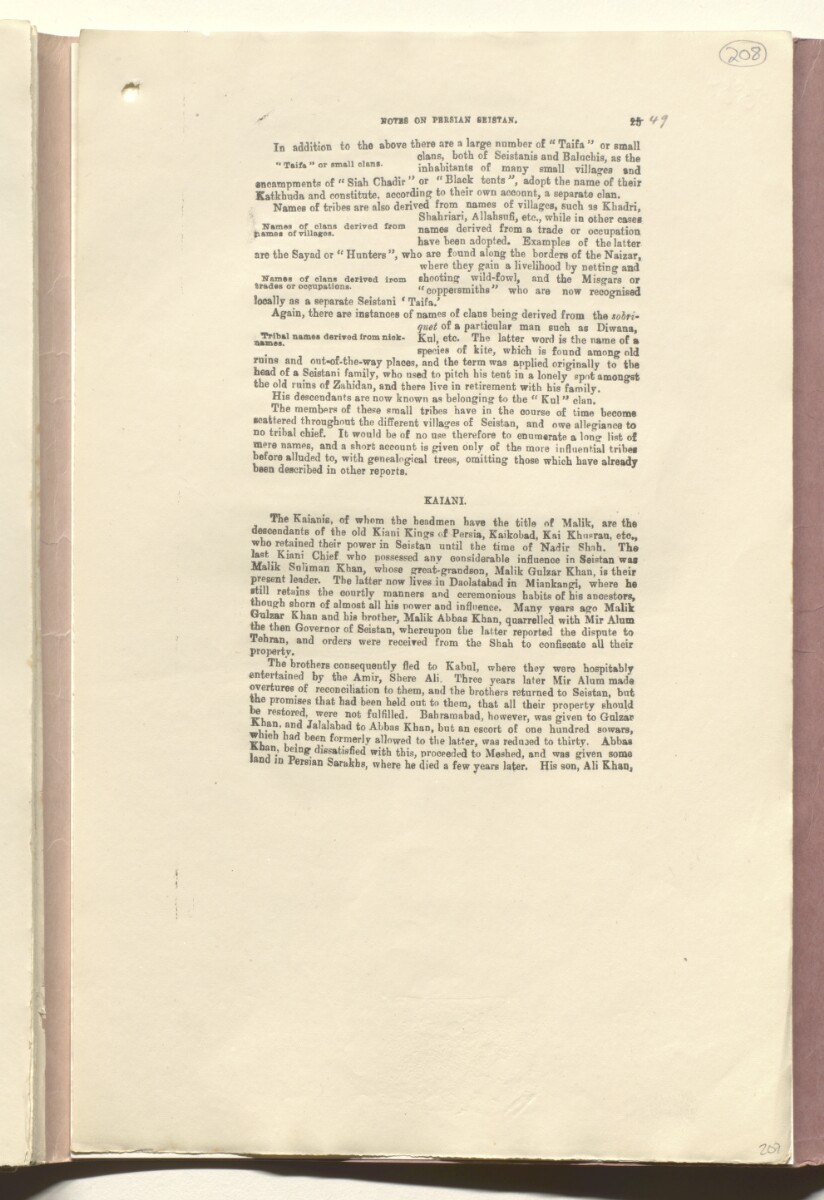
In addition to the above there are a large number of “ Taifa ” or small
clans, both of Seistanis and Baluchis, as the
•• Taifft ” or small clans. inhabitants of many small villages and
encampments of u Siah Chadir ” or <f Black tents , adopt the name of their
Katkhuda and constitute, according to their own account, a separate clan.
Names of tribes are also derived from names of villages, such as Khadri,
Shahriari, Allahsufi, etc., while in other cases
rSeTofviiiails. 8 derived from names derived from a trade or occupation
have been adopted. Examples of the latter
are the Sayad or “ Hunters ”, who are found along the borders of the Naizar,
where they gain a livelihood by netting and
Names of clans derived irom shooting wild-fowl, and the Miscrars or
trades or occupations. . “coppersmiths” who are now recognised
locally as a separate Seistani * Taifa/
Again, there are instances of names of clans being derived from the sobri
quet of a particular man such as Diwana,
nSw? 1 name " deri ved from nick- Kul, etc. The latter word is the name of a
. species of kite, which is found among old
ruins and out-of-the-way places, and the term was applied originally to the
head of a Seistani family, who used to pitch his tent in a lonely spot amongst
the old ruins of Zahidan, and there live in retirement with his family.
His descendants are now known as belonging to the <e Kul ” clan.
The members of these small tribes have in the course of time become
scattered throughout the different villages of Seistan, and owe allegiance to
no tribal chief. It would be of no use therefore to enumerate a lonw list of
mere names, and a short account is given only of the more influential tribeg
before alluded to, with genealogical trees, omitting those which have already
been described in other reports.
KAIANI.
The Kaianis, of whom the headmen have the title of Malik, are the
descendants of the old Kiani Kings of Persia, Kaikobad, Kai Khnsrau, etc.,
who retained their power in Seistan until the time of Nadir Shnh. The
"ilr Vi C'bief who possessed any considerable influence in Seistan was
Malik Snliman Khan, whose great-grandson, Malik Gulzar Khan, is their
• ^ er * ^ a ^ er now ^ves in Daolatabad in Miankangi, where he
- retains the courtly manners and ceremonious habits of his ancestors,
though shorn of almost all his power and influence. Many years ago Malik
»uJ?.ar Khan and his brother, Malik Abbas Khan, quarrelled with Mir Alum
the then Governor of Seistan, whereupon the latter reported the dispute to
iehran, and orders were received from the Shah to confiscate all their
property.
The brothers consequently fled to Kabnl, where they were hospitably
entertained by the Amir, Sbere Ali. Three years later Mir Alum made
over ures of reconciliation to them, and the brothers returned to Seistan, but
e promises that had been held out to them, that all their property should
res ored, were not fulfilled. Babramabad, however, was given to Gulzar
u j i^ a ^ a ^ a ^ a< ^ ^^ >as ^^ an ’ an e8COr i' one hundred sowars,
Kh 10 u » formerly allowed to tiie latter, was reduaed to thirty. Abbas
4 in ^- vrith this, proceeded to Meshed, and was given soma
id ersian Sarakbs, where he died a few years later. His son, Ali Khan,
About this item
- Content
The file contains papers relating to Seistan [Sistan] and Persia [Iran].
The file includes printed copies of despatches from the Agent to the Governor-General of India and HM Consul-General for Khorasan and Seistan (Lieutenant-Colonel Henry Martindale Temple), to the Secretary to the Government of India Foreign Department, with enclosed despatches from Captain Percy Molesworth Sykes to the Secretary of State for Foreign Affairs (the Marquis of Salisbury). Skyes’s despatches regard matters including: Seistan; trade routes into South-East Persia; the boundary between Persia and Afghanistan, in relation to the River Helmund [Helmand] changing its course (in despatch No. 5, which includes four sketch maps, folios 12, 13, 14 and 15); Sykes’s journey to Birjand (in despatch No. 7, which includes a sketch map on folio 20); the ruling family of Kain, which also governed Seistan, Tabbas and Tun; Sykes’s journey from Seistan to Kerman [Kirman] (in despatch No. 11, which includes a sketch map); and the direct Kerman-Quetta caravan trade that Sykes was trying to establish.
The file also includes copies of the following papers:
- A despatch from Temple to the Secretary to the Government of India Foreign Department, enclosing a letter from Temple to Sir Henry Mortimer Durand (HM Minister, Tehran), with copies of enclosures, regarding the establishment of a Seistan and Kain consulate
- A letter from Charles Edward Pitman, Director General of Telegraphs, to the Secretary to the Government of India Public Works Department, enclosing a copy of a ‘Report on the Preliminary Survey of the Route for a Telegraph Line from Quetta to the Persian Frontier’ by H A Armstrong, Assistant Superintendent, Indian Telegraph Department, which includes six photographs of views along the route [Mss Eur F111/352, f 52; Mss Eur F111/352, f 53; Mss Eur F111/352, f 54; Mss Eur F111/352, f 55; Mss Eur F111/352, f 56; and Mss Eur F111/352, f 57], and a map showing the proposed route of the telegraph line [Mss Eur F111/352, f 59]
- Letters from Hugh Shakespear Barnes, Agent to the Governor-General in Baluchistan, to the Secretary to the Government of India Foreign Department, enclosing copies of the diary of the Political Assistant, Chagai, for the weeks ending 16 February, 28 February, and 8 March 1900
- Diary No. 3, 4, 6, 7, 8, 9, 11 and 12 of Major-General George Frederick Chenevix-Trench, HM Consul for Seistan (Diary No. 6 includes a sketch map, folio 86)
- A copy of a ‘Report on Reconnaissances Made while Attached to the Seistan Arbitration Commission’ by W A Johns, Deputy Consulting Engineer for Railways, Bombay
- A copy of the report ‘Notes on Persian Seistan’, compiled by Captain Edward Abadie Plunkett, and issued by the Government of India Intelligence Branch, Quarter-Master General’s Department
- Two copies of map signed by Plunkett titled ‘Persian Seistan-Cultivated Area’ [Mss Eur F111/352, f 270]
- A booklet entitled ‘Notes on the Leading Notables, Officials, Merchants, and Clergy of Khorasan, Seistan, Kain, and Kerman.’
- Printed copies of letters from the Government of India Foreign Department to the Secretary of State for India (Lord George Francis Hamilton), relating to the maintenance of British interests in Persia, dated 4 September 1899 and 7 November 1901 (the former with an enclosure of a minute by the Viceroy on Seistan).
- Extent and format
- 1 file (388 folios)
- Arrangement
The papers are arranged in approximate chronological order from the front to the rear of the file.
- Physical characteristics
Foliation: the foliation sequence (used for referencing) commences at the front cover with 1, and terminates at the inside back cover with 390; these numbers are written in pencil, are circled, and are located in the top right corner of the recto The front of a sheet of paper or leaf, often abbreviated to 'r'. side of each folio. The file contains one foliation anomaly, f 301A
- Written in
- English in Latin script View the complete information for this record
Use and share this item
- Share this item
'Seistan' [208r] (415/782), British Library: India Office Records and Private Papers, Mss Eur F111/352, in Qatar Digital Library <https://www.qdl.qa/archive/81055/vdc_100069721605.0x000012> [accessed 6 July 2026]
https://www.qdl.qa/en/archive/81055/vdc_100069721605.0x000012
Copy and paste the code below into your web page where you would like to embed the image.
<meta charset="utf-8"><a href="https://www.qdl.qa/en/archive/81055/vdc_100069721605.0x000012">'Seistan' [‎208r] (415/782)</a> <a href="https://www.qdl.qa/en/archive/81055/vdc_100069721605.0x000012"> <img src="https://iiif.qdl.qa/iiif/images/81055/vdc_100000001452.0x0003bc/Mss Eur F111_352_0433.jp2/full/!280,240/0/default.jpg" alt="" /> </a>
This record has a IIIF manifest available as follows. If you have a compatible viewer you can drag the icon to load it.https://www.qdl.qa/en/iiif/81055/vdc_100000001452.0x0003bc/manifestOpen in Universal viewerOpen in Mirador viewerMore options for embedding images
Copyright: How to use this content
- Reference
- Mss Eur F111/352
- Title
- 'Seistan'
- Pages
- front, front-i, 2r:51v, 58r:58v, 60r:112r, 113r:125v, 147r:218r, 218r, 219r:269v, 271r:301v, 301Ar, 301Av, 302r:388v, 389v:390r, 389r, back
- Author
- East India Company, the Board of Control, the India Office, or other British Government Department
- Usage terms
- Open Government Licence