
!['Seistan' [‎359v] (720/782)](https://iiif.qdl.qa/iiif/images/81055/vdc_100000001452.0x0003bc/Mss Eur F111_352_0744.jp2/full/!1200,1200/0/default.jpg "'Seistan' [‎359v] (720/782)")
The record is made up of 1 file (388 folios). It was created in 17 Jan 1899-4 Apr 1904. It was written in English. The original is part of the British Library: India Office The department of the British Government to which the Government of India reported between 1858 and 1947. The successor to the Court of Directors. Records and Private Papers Documents collected in a private capacity. .
Transcription
This transcription is created automatically. It may contain errors.
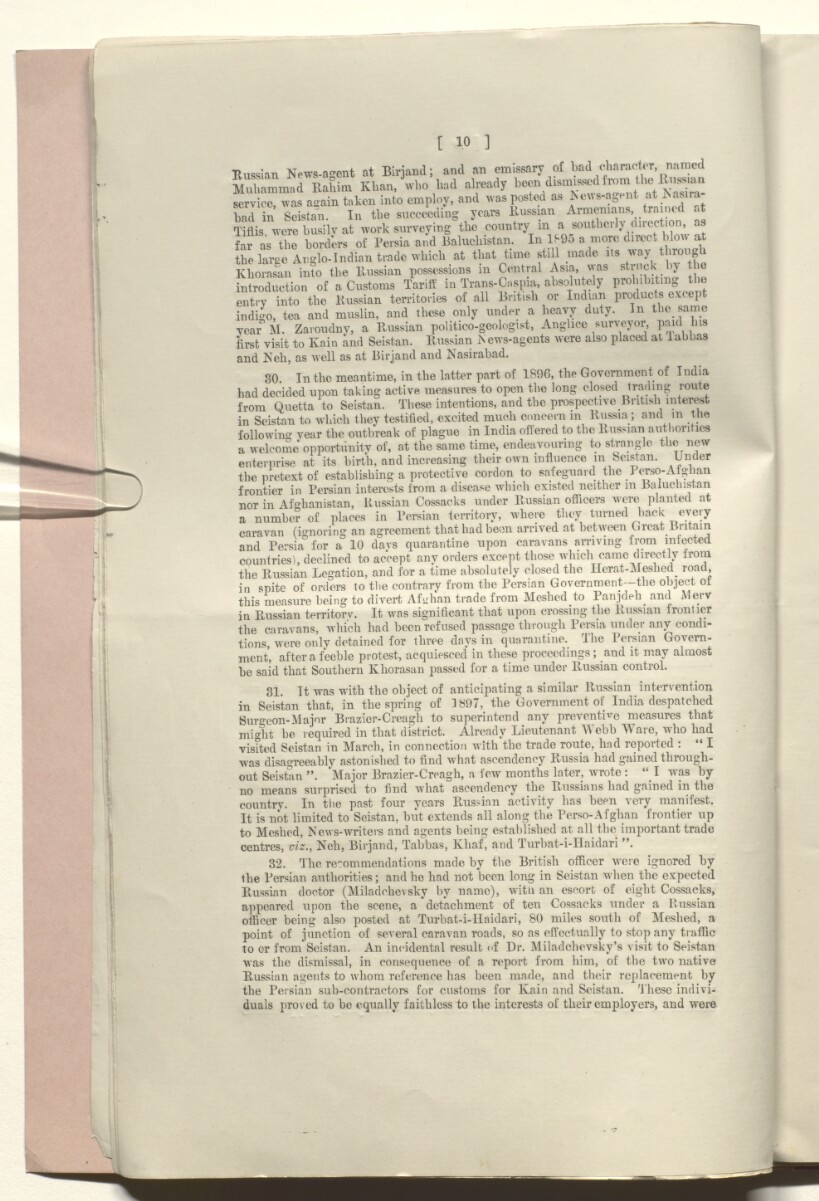
[ 10 ]
■Russian News-agent at Birjaml; amt an emissary of bad cliaracter, named
Muhammad Rahim Khan, who had already aZit^t^' W
service, was asain taken into employ, and was posted as beus-agent at JSasira
bad in Seistan. In the succeeding years Russian Armenians, trained ,.t
Tiflis werebusilvat work surveying the country in a southerly direction, as
far as the borders of Persia and Baluchistan. In 1>95 a more direct blow at
the large Anglo-Indian trade which at that time still made us way through
Khorasan into the Russian possessions in Central Asia, was struck by the
introduction of a Customs Tariff in Trans-Onspia, absolutely prohibiting the
entry into the Russian territories of all British or Indian products excep
indigo, tea and muslin, and these only under a heavy duty. In the same
year M. Zaroudnv, a Russian politico-geologist, Anghce surveyor, paid Ins
first visit to Kain and Seistan. Russian News-agents were also placed at 1 abbas
and Neh, as well as at Birjand and Nasirabad.
30. In the meantime, in the latter part of 1896, the Government of India
had decided upon taking active measures to open the long closed trading route
from Quetta to Seistan. These intentions, and the prospective British interest
in Seistan to which they testified, excited much concern in Russia; and in the
following year the outbreak of plague in India off ered to the Russian authorities
a welcome opportunity of, at the same time, endeavouring to strangle the new
enterprise at its birth, and increasing their own influence in Seistan. Under
the pretext of establishing a protective cordon to safeguard the 1 tmso-Atghan
frontier in Persian interests from a disease which existed neither m Baluchistan
nor in Afghanistan, Russian Cossacks under Russian officers were planted at
a numbe? of places in Persian territory, where they turned back every
caravan (ignoring an agreement that had been arrived at between Great Britain
and rersia° for a 10 davs quarantine upon caravans arriving from infected
countries), declined to accept any orders except those which came directly from
the Russian Legation, and for a time absolutely closed the Herat-Meshed, road,
in spite of orders to the contrary from the Persian Government—the object ot
this measure being to divert Afghan trade from Meshed to Panjdeh. and Merv
in Russian territorv. It was significant that upon crossing the Russian frontier
the caravans, which had been refused passage through Persia under any condi
tions, were only detained for three days in quarantine. The Persian Govern
ment, after a feeble protest, acquiesced in these proceedings; and it may almost
be said that Southern Khorasan passed for a time under Russian control.
31. It was with the object of anticipating a similar Russian intervention
in Seistan that, in the spring of 3 897, the Government of India despatched
Surgeon-Major Brazier-Creagh to superintend, any preventive measures that
might be required in that district. Already Lieutenant Webb Ware, who had
visited Seistan in March, in connection with the trade route, had reported : “ I
was disagreeably astonished to find what ascendency Russia had gained through
out Seistan Major Brazier-Creagh, a few months later, wrote : “ I was by
no means surprised to find what ascendency the Russians had gained in the
country. In the past four years Russian activity has been very manifest.
It is not limited to Seistan, but extends all along the Perso-Afghan frontier up
to Meshed, News-writers and agents being established at all the important trade
centres, viz., Neh, Birjand, Tabbas, Khaf, and Turbat-i-Haidari
32. The recommendations made by the British officer were ignored by
the Persian authorities; and he had not been long in Seistan when the expected
Russian doctor (Miladchevsky by name), witu an escort of eight Cossacks,
appeared upon the scene, a detachment of ten Cossacks under a Russian
officer being also posted at Turbat-i-IIaidari, 80 miles south of Meshed, a
point of junction of several caravan roads, so as effectually to stop any traffic
to or from Seistan. An incidental result of Dr. Miladchevsky’s visit to Seistan
was the dismissal, in consequence of a report from him, of the two native
Russian agents to whom reference has been made, and their replacement by
the Persian sub-contractors for customs for Kain and Seistan. These indivi
duals proved to be equally faithless to the interests of their employers, and were
About this item
- Content
The file contains papers relating to Seistan [Sistan] and Persia [Iran].
The file includes printed copies of despatches from the Agent to the Governor-General of India and HM Consul-General for Khorasan and Seistan (Lieutenant-Colonel Henry Martindale Temple), to the Secretary to the Government of India Foreign Department, with enclosed despatches from Captain Percy Molesworth Sykes to the Secretary of State for Foreign Affairs (the Marquis of Salisbury). Skyes’s despatches regard matters including: Seistan; trade routes into South-East Persia; the boundary between Persia and Afghanistan, in relation to the River Helmund [Helmand] changing its course (in despatch No. 5, which includes four sketch maps, folios 12, 13, 14 and 15); Sykes’s journey to Birjand (in despatch No. 7, which includes a sketch map on folio 20); the ruling family of Kain, which also governed Seistan, Tabbas and Tun; Sykes’s journey from Seistan to Kerman [Kirman] (in despatch No. 11, which includes a sketch map); and the direct Kerman-Quetta caravan trade that Sykes was trying to establish.
The file also includes copies of the following papers:
- A despatch from Temple to the Secretary to the Government of India Foreign Department, enclosing a letter from Temple to Sir Henry Mortimer Durand (HM Minister, Tehran), with copies of enclosures, regarding the establishment of a Seistan and Kain consulate
- A letter from Charles Edward Pitman, Director General of Telegraphs, to the Secretary to the Government of India Public Works Department, enclosing a copy of a ‘Report on the Preliminary Survey of the Route for a Telegraph Line from Quetta to the Persian Frontier’ by H A Armstrong, Assistant Superintendent, Indian Telegraph Department, which includes six photographs of views along the route [Mss Eur F111/352, f 52; Mss Eur F111/352, f 53; Mss Eur F111/352, f 54; Mss Eur F111/352, f 55; Mss Eur F111/352, f 56; and Mss Eur F111/352, f 57], and a map showing the proposed route of the telegraph line [Mss Eur F111/352, f 59]
- Letters from Hugh Shakespear Barnes, Agent to the Governor-General in Baluchistan, to the Secretary to the Government of India Foreign Department, enclosing copies of the diary of the Political Assistant, Chagai, for the weeks ending 16 February, 28 February, and 8 March 1900
- Diary No. 3, 4, 6, 7, 8, 9, 11 and 12 of Major-General George Frederick Chenevix-Trench, HM Consul for Seistan (Diary No. 6 includes a sketch map, folio 86)
- A copy of a ‘Report on Reconnaissances Made while Attached to the Seistan Arbitration Commission’ by W A Johns, Deputy Consulting Engineer for Railways, Bombay
- A copy of the report ‘Notes on Persian Seistan’, compiled by Captain Edward Abadie Plunkett, and issued by the Government of India Intelligence Branch, Quarter-Master General’s Department
- Two copies of map signed by Plunkett titled ‘Persian Seistan-Cultivated Area’ [Mss Eur F111/352, f 270]
- A booklet entitled ‘Notes on the Leading Notables, Officials, Merchants, and Clergy of Khorasan, Seistan, Kain, and Kerman.’
- Printed copies of letters from the Government of India Foreign Department to the Secretary of State for India (Lord George Francis Hamilton), relating to the maintenance of British interests in Persia, dated 4 September 1899 and 7 November 1901 (the former with an enclosure of a minute by the Viceroy on Seistan).
- Extent and format
- 1 file (388 folios)
- Arrangement
The papers are arranged in approximate chronological order from the front to the rear of the file.
- Physical characteristics
Foliation: the foliation sequence (used for referencing) commences at the front cover with 1, and terminates at the inside back cover with 390; these numbers are written in pencil, are circled, and are located in the top right corner of the recto The front of a sheet of paper or leaf, often abbreviated to 'r'. side of each folio. The file contains one foliation anomaly, f 301A
- Written in
- English in Latin script View the complete information for this record
Use and share this item
- Share this item
'Seistan' [359v] (720/782), British Library: India Office Records and Private Papers, Mss Eur F111/352, in Qatar Digital Library <https://www.qdl.qa/archive/81055/vdc_100069721606.0x00007b> [accessed 27 June 2026]
https://www.qdl.qa/en/archive/81055/vdc_100069721606.0x00007b
Copy and paste the code below into your web page where you would like to embed the image.
<meta charset="utf-8"><a href="https://www.qdl.qa/en/archive/81055/vdc_100069721606.0x00007b">'Seistan' [‎359v] (720/782)</a> <a href="https://www.qdl.qa/en/archive/81055/vdc_100069721606.0x00007b"> <img src="https://iiif.qdl.qa/iiif/images/81055/vdc_100000001452.0x0003bc/Mss Eur F111_352_0744.jp2/full/!280,240/0/default.jpg" alt="" /> </a>
This record has a IIIF manifest available as follows. If you have a compatible viewer you can drag the icon to load it.https://www.qdl.qa/en/iiif/81055/vdc_100000001452.0x0003bc/manifestOpen in Universal viewerOpen in Mirador viewerMore options for embedding images
Copyright: How to use this content
- Reference
- Mss Eur F111/352
- Title
- 'Seistan'
- Pages
- front, front-i, 2r:51v, 58r:58v, 60r:112r, 113r:125v, 147r:218r, 218r, 219r:269v, 271r:301v, 301Ar, 301Av, 302r:388v, 389v:390r, 389r, back
- Author
- East India Company, the Board of Control, the India Office, or other British Government Department
- Usage terms
- Open Government Licence