
!['Seistan' [‎386v] (774/782)](https://iiif.qdl.qa/iiif/images/81055/vdc_100000001452.0x0003bc/Mss Eur F111_352_0798.jp2/full/!1200,1200/0/default.jpg "'Seistan' [‎386v] (774/782)")
The record is made up of 1 file (388 folios). It was created in 17 Jan 1899-4 Apr 1904. It was written in English. The original is part of the British Library: India Office The department of the British Government to which the Government of India reported between 1858 and 1947. The successor to the Court of Directors. Records and Private Papers Documents collected in a private capacity. .
Transcription
This transcription is created automatically. It may contain errors.
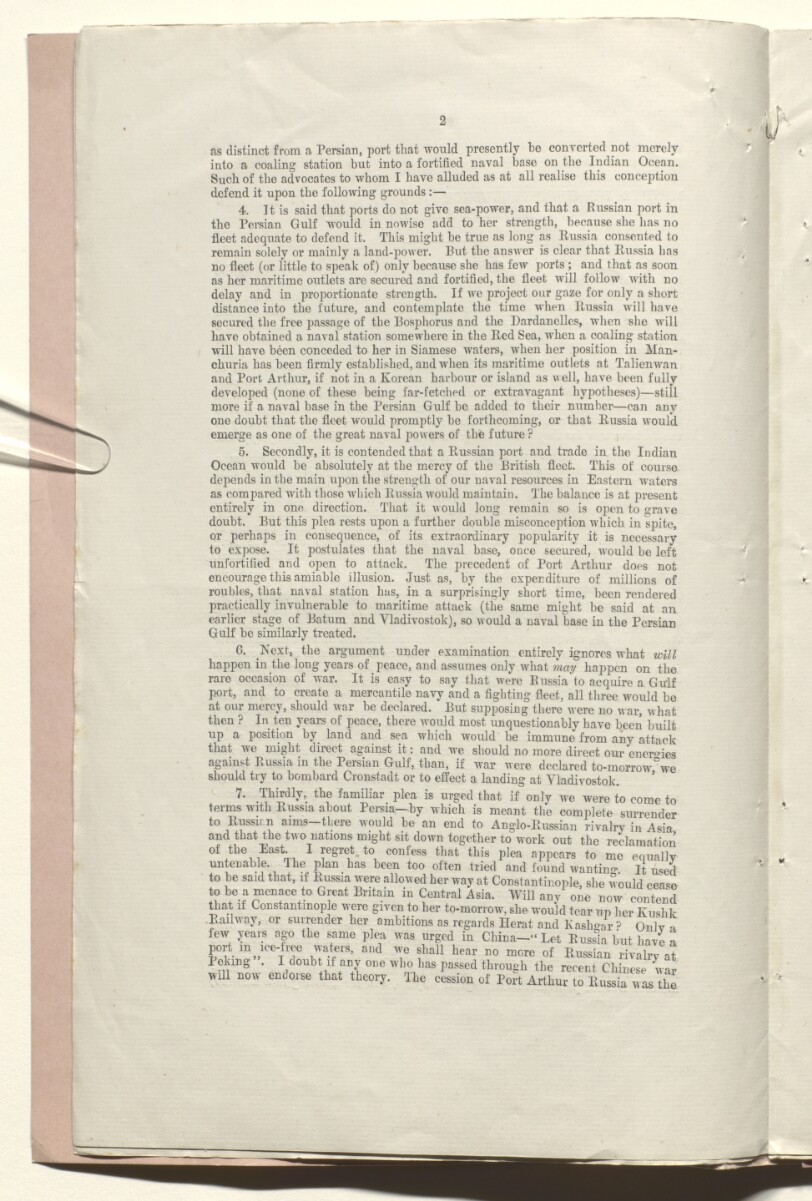
as distinct from a Persian, port that would presently be converted not merely
into a coaling station but into a fortified naval base on the Indian Ocean.
Such of the advocates to whom I have alluded as at all realise this conception
defend it upon the following grounds :—
4. It is said that ports do not give sea-power, and that a Russian port in
the
Persian Gulf
The historical term used to describe the body of water between the Arabian Peninsula and Iran.
would in nowise add to her strength, because she has no
fleet adequate to defend it. This might be true as long as Russia consented to
remain solely or mainly a land-power. But the answer is clear that Russia has
no fleet (or iittle to speak of) only because she has few ports ; and that as soon
as her maritime outlets are secured and fortified, the fleet will follow with no
delay and in proportionate strength. If we project our gaze for only a short
distance into the future, and contemplate the time when Russia will have
secured the free passage of the Bosphorus and the Dardanelles, when she will
have obtained a naval station somewhere in the Red Sea, when a coaling station
will have been conceded to her in Siamese waters, when her position in Man
churia has been firmly established, and when its maritime outlets at Talienwan
and Port Arthur, if not in a Korean harbour or island as well, have been fully
developed (none of these being far-fetched or extravagant hypotheses)—still
more if a naval base in the
Persian Gulf
The historical term used to describe the body of water between the Arabian Peninsula and Iran.
he added to their number—can any
one doubt that the fleet would promptly he forthcoming, or that Russia would
emerge as one of the great naval powers of the future ?
5. Secondly, it is contended that a Russian port and trade in the Indian
Ocean would be absolutely at the mercy of the British fleet. This of course
depends in the main upon the strength of our naval resources in Eastern waters
as compared with those which Russia would maintain. The balance is at present
entirely in one direction. That it would long remain so is open to grave
doubt. But this plea rests upon a further double misconception which in spite,
or perhaps in consequence, of its extraordinary popularity it is necessary
to expose. It postulates that the naval base, once secured, would be left
unfortified and open to attack. The precedent of Port Arthur does not
encourage this amiable illusion. Just as, by the expenditure of millions of
roubles, that naval station has, in a surprisingly short time, been rendered
practically invulnerable to maritime attack (the same might be said at an
earlier stage of Batum and Vladivostok), so would a naval base in the Persian
Gulf be similarly treated.
6. .Next, the argument under examination entirely ignores what will
happen in the long years of peace, and assumes only what way happen on the
rare occasion of war. It is easy to say that were Russia to acquire a Gulf
port, and to create a mercantile navy and a fighting fleet, all three would he
at our mercy, should war he declared. But supposing there were no war, what
then ? In ten years of peace, there would most unquestionably have been built
up a position by land and sea which would be immune from any attack
that we might direct against it: and we should no more direct our energies
against Russia in the
Persian Gulf
The historical term used to describe the body of water between the Arabian Peninsula and Iran.
, than, if war were declared to-morrow°we
should try to bombard Cronstadt or to effect a landing at Vladivostok.
7. Thirdly, the familiar, plea is urged that if only we were to come to
terms with Russia about Persia by which is meant the complete surrender
to Russian aims there would be an end to Anglo-Russian rivalry in Asia
and that the two nations might sit down together to work out the reclamation
of the East. I regret to confess that this plea appears to me equally
untenable. The plan has been too often tried and found wanting It used
to be said that, if Russia were allowed her way at Constantinople, she would cease
to be a menace to Great Britain in Central Asia. Will any one now contend
that if Constantinople were given to her to-morrow, she won]d tear up her Kush k
Kailway, or surrender her ambitions as regards Herat and Kashgar i 1 Onlv a
few years ago the same plea was urged in China—“ Let B ussia but have a
port m ice-lree waters, and we shall hear no more of Russian rivalry at
Peking . I doubt if any one who has passed through the recent Chinese war
will now endorse that theory. Ihe cession of Port Arthur to Russia was the
About this item
- Content
The file contains papers relating to Seistan [Sistan] and Persia [Iran].
The file includes printed copies of despatches from the Agent to the Governor-General of India and HM Consul-General for Khorasan and Seistan (Lieutenant-Colonel Henry Martindale Temple), to the Secretary to the Government of India Foreign Department, with enclosed despatches from Captain Percy Molesworth Sykes to the Secretary of State for Foreign Affairs (the Marquis of Salisbury). Skyes’s despatches regard matters including: Seistan; trade routes into South-East Persia; the boundary between Persia and Afghanistan, in relation to the River Helmund [Helmand] changing its course (in despatch No. 5, which includes four sketch maps, folios 12, 13, 14 and 15); Sykes’s journey to Birjand (in despatch No. 7, which includes a sketch map on folio 20); the ruling family of Kain, which also governed Seistan, Tabbas and Tun; Sykes’s journey from Seistan to Kerman [Kirman] (in despatch No. 11, which includes a sketch map); and the direct Kerman-Quetta caravan trade that Sykes was trying to establish.
The file also includes copies of the following papers:
- A despatch from Temple to the Secretary to the Government of India Foreign Department, enclosing a letter from Temple to Sir Henry Mortimer Durand (HM Minister, Tehran), with copies of enclosures, regarding the establishment of a Seistan and Kain consulate
- A letter from Charles Edward Pitman, Director General of Telegraphs, to the Secretary to the Government of India Public Works Department, enclosing a copy of a ‘Report on the Preliminary Survey of the Route for a Telegraph Line from Quetta to the Persian Frontier’ by H A Armstrong, Assistant Superintendent, Indian Telegraph Department, which includes six photographs of views along the route [Mss Eur F111/352, f 52; Mss Eur F111/352, f 53; Mss Eur F111/352, f 54; Mss Eur F111/352, f 55; Mss Eur F111/352, f 56; and Mss Eur F111/352, f 57], and a map showing the proposed route of the telegraph line [Mss Eur F111/352, f 59]
- Letters from Hugh Shakespear Barnes, Agent to the Governor-General in Baluchistan, to the Secretary to the Government of India Foreign Department, enclosing copies of the diary of the Political Assistant, Chagai, for the weeks ending 16 February, 28 February, and 8 March 1900
- Diary No. 3, 4, 6, 7, 8, 9, 11 and 12 of Major-General George Frederick Chenevix-Trench, HM Consul for Seistan (Diary No. 6 includes a sketch map, folio 86)
- A copy of a ‘Report on Reconnaissances Made while Attached to the Seistan Arbitration Commission’ by W A Johns, Deputy Consulting Engineer for Railways, Bombay
- A copy of the report ‘Notes on Persian Seistan’, compiled by Captain Edward Abadie Plunkett, and issued by the Government of India Intelligence Branch, Quarter-Master General’s Department
- Two copies of map signed by Plunkett titled ‘Persian Seistan-Cultivated Area’ [Mss Eur F111/352, f 270]
- A booklet entitled ‘Notes on the Leading Notables, Officials, Merchants, and Clergy of Khorasan, Seistan, Kain, and Kerman.’
- Printed copies of letters from the Government of India Foreign Department to the Secretary of State for India (Lord George Francis Hamilton), relating to the maintenance of British interests in Persia, dated 4 September 1899 and 7 November 1901 (the former with an enclosure of a minute by the Viceroy on Seistan).
- Extent and format
- 1 file (388 folios)
- Arrangement
The papers are arranged in approximate chronological order from the front to the rear of the file.
- Physical characteristics
Foliation: the foliation sequence (used for referencing) commences at the front cover with 1, and terminates at the inside back cover with 390; these numbers are written in pencil, are circled, and are located in the top right corner of the recto The front of a sheet of paper or leaf, often abbreviated to 'r'. side of each folio. The file contains one foliation anomaly, f 301A
- Written in
- English in Latin script View the complete information for this record
Use and share this item
- Share this item
'Seistan' [386v] (774/782), British Library: India Office Records and Private Papers, Mss Eur F111/352, in Qatar Digital Library <https://www.qdl.qa/archive/81055/vdc_100069721606.0x0000b1> [accessed 25 June 2026]
https://www.qdl.qa/en/archive/81055/vdc_100069721606.0x0000b1
Copy and paste the code below into your web page where you would like to embed the image.
<meta charset="utf-8"><a href="https://www.qdl.qa/en/archive/81055/vdc_100069721606.0x0000b1">'Seistan' [‎386v] (774/782)</a> <a href="https://www.qdl.qa/en/archive/81055/vdc_100069721606.0x0000b1"> <img src="https://iiif.qdl.qa/iiif/images/81055/vdc_100000001452.0x0003bc/Mss Eur F111_352_0798.jp2/full/!280,240/0/default.jpg" alt="" /> </a>
This record has a IIIF manifest available as follows. If you have a compatible viewer you can drag the icon to load it.https://www.qdl.qa/en/iiif/81055/vdc_100000001452.0x0003bc/manifestOpen in Universal viewerOpen in Mirador viewerMore options for embedding images
Copyright: How to use this content
- Reference
- Mss Eur F111/352
- Title
- 'Seistan'
- Pages
- front, front-i, 2r:51v, 58r:58v, 60r:112r, 113r:125v, 147r:218r, 218r, 219r:269v, 271r:301v, 301Ar, 301Av, 302r:388v, 389v:390r, 389r, back
- Author
- East India Company, the Board of Control, the India Office, or other British Government Department
- Usage terms
- Open Government Licence