
![Papers of the Interdepartmental Conference on Middle Eastern Affairs [‎101r] (201/290)](https://iiif.qdl.qa/iiif/images/81055/vdc_100000001491.0x0002a9/Mss Eur F112_275_0201.jp2/full/!1200,1200/0/default.jpg "Papers of the Interdepartmental Conference on Middle Eastern Affairs [‎101r] (201/290)")
Papers of the Interdepartmental Conference on Middle Eastern Affairs [101r] (201/290)
The record is made up of 1 file (145 folios). It was created in 7 Jan 1919-7 Dec 1920. It was written in English. The original is part of the British Library: India Office The department of the British Government to which the Government of India reported between 1858 and 1947. The successor to the Court of Directors. Records and Private Papers Documents collected in a private capacity. .
Transcription
This transcription is created automatically. It may contain errors.
o
Evacuation of;
Batum.
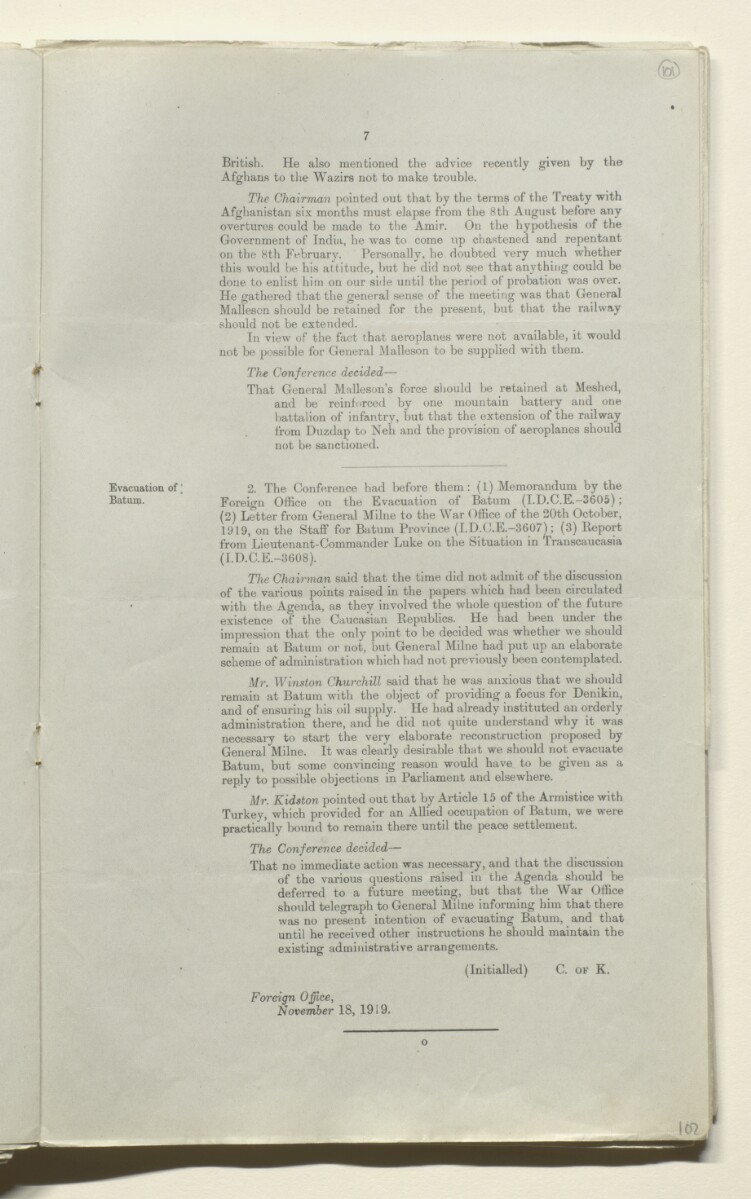
British. He also mentioned the advice recently given by the
Afghans to the Wazirs not to make trouble.
The Chairman pointed out that by the terms of the Treaty with
Afghanistan six months must elapse from the 8th August before any
overtures could be made to the Amir. On the hypothesis of the
Government of India, he was to come up chastened and repentant
on the 8th February. Personally, he doubted very much whether
this would be his attitude, but he did not see that anything could be
done to enlist him on our side until the period of probation was over.
He gathered that the general sense of the meeting was that General
Malleson should be retained for the present, but that the railway
should not be extended.
In view of the fact that aeroplanes were not available, it would
not be possible for General Malleson to be supplied with them.
The Conference decided —
That General Malleson’s force should be retained at Meshed,
and be reinforced by one mountain battery and one
battalion of infantry, but that the extension of the railway
from Duzdap to Neh and the provision of aeroplanes should
not be sanctioned.
2. The Conference had before them: (1) Memorandum by the
Foreign Office on the Evacuation of Batum (I.D.C.E.—3605);
(2) Letter from General Milne to the \\ ar Office of the 20th October,
1919, on the Staff for Batum Province (I.D.C.E.-3607); (3) Beport
from Lieutenant-Commander Luke on the Situation in Transcaucasia
(I.D.C.E.-3608).
The Chairman said that the time did not admit of the discussion
of the various points raised in the papers which had been circulated
with the Agenda, as they involved the whole question of the future
existence of the Caucasian Bepublics. He had been under the
impression that the only point to be decided was whether we should
remain at Batum or not, but General Milne had put up an elaborate
scheme of administration which had not previously been contemplated.
Mr. Winston Churchill said that he was anxious that we should
remain at Batum with the object of providing a focus for Denikin,
and of ensuring his oil supply. He had already instituted an orderly
administration there, and he did not quite understand why it was
necessary to start the very elaborate reconstruction proposed by
General Milne. It was clearly desirable that we should not evacuate
Batum, but some convincing reason would have to be given as a
reply to possible objections in Parliament and elsewhere.
Mr. Kidston pointed out that by Article 15 of the Armistice with
Turkev, which provided for an Allied occupation of Batum, we were
practically bound to remain there until the peace settlement.
The Conference decided —
That no immediate action was necessary, and that the discussion
of the various questions raised in the Agenda should be
deferred to a future meeting, but that the War Office
should telegraph to General Milne informing him that there
was no present intention of evacuating Batum, and that
until he received other instructions he should maintain the
existing administrative arrangements.
(Initialled) C. of K.
Foreign Ofjice,
November 18, 19 i 9.
About this item
- Content
This file is composed of papers produced by the Foreign Office's Interdepartmental Conference on Middle Eastern Affairs. It consists entirely of printed minutes of meetings of the conference, most of which are chaired by George Curzon.
Those attending include senior representatives of the Foreign Office, the India Office The department of the British Government to which the Government of India reported between 1858 and 1947. The successor to the Court of Directors. (most notably the Secretary of State for India), the War Office, the Admiralty, the Air Ministry, and the Treasury (including the Chancellor of the Exchequer). Other notable figures attending include Harry St John Bridger Philby and Gertrude Margaret Lowthian Bell.
The meetings concern British policy in the Middle East, and mainly cover the following geographical areas: Mesopotamia, Kurdistan, Trans-Caspia, Trans-Caucasia, the Caspian Sea, Palestine, Persia, Hejaz, and Afghanistan. Some of the meetings also touch on matters beyond the Middle East (e.g. wireless telegraphy in Tibet, ff 79-80).
Recurring topics of discussion include railways (chiefly in relation to Mesopotamia), Bolshevik influence in the Middle East (particularly in Persia and Trans-Caspia), and relations between King Hussein [Ḥusayn bin ‘Alī al-Hāshimī] and Ibn Saud [‘Abd al-‘Azīz bin ‘Abd al-Raḥmān bin Fayṣal Āl Sa‘ūd].
Several sets of minutes also contain related memoranda as appendices.
- Extent and format
- 1 file (145 folios)
- Arrangement
The papers are arranged in approximate chronological order from the front to the rear of the file.
- Physical characteristics
Foliation: the foliation sequence (used for referencing) commences at the first folio with 1, and terminates at the last folio with 145, these numbers are written in pencil, are circled, and are located in the top right corner of the recto The front of a sheet of paper or leaf, often abbreviated to 'r'. side of each folio.
- Written in
- English in Latin script View the complete information for this record
Use and share this item
- Share this item
Papers of the Interdepartmental Conference on Middle Eastern Affairs [101r] (201/290), British Library: India Office Records and Private Papers, Mss Eur F112/275, in Qatar Digital Library <https://www.qdl.qa/archive/81055/vdc_100070539236.0x000002> [accessed 7 July 2026]
https://www.qdl.qa/en/archive/81055/vdc_100070539236.0x000002
Copy and paste the code below into your web page where you would like to embed the image.
<meta charset="utf-8"><a href="https://www.qdl.qa/en/archive/81055/vdc_100070539236.0x000002">Papers of the Interdepartmental Conference on Middle Eastern Affairs [‎101r] (201/290)</a> <a href="https://www.qdl.qa/en/archive/81055/vdc_100070539236.0x000002"> <img src="https://iiif.qdl.qa/iiif/images/81055/vdc_100000001491.0x0002a9/Mss Eur F112_275_0201.jp2/full/!280,240/0/default.jpg" alt="" /> </a>
This record has a IIIF manifest available as follows. If you have a compatible viewer you can drag the icon to load it.https://www.qdl.qa/en/iiif/81055/vdc_100000001491.0x0002a9/manifestOpen in Universal viewerOpen in Mirador viewerMore options for embedding images
Copyright: How to use this content
- Reference
- Mss Eur F112/275
- Title
- Papers of the Interdepartmental Conference on Middle Eastern Affairs
- Pages
- front, front-i, 2r:144v, back-i, back
- Author
- East India Company, the Board of Control, the India Office, or other British Government Department
- Usage terms
- Open Government Licence