
![Papers of the Interdepartmental Conference on Middle Eastern Affairs [‎103r] (205/290)](https://iiif.qdl.qa/iiif/images/81055/vdc_100000001491.0x0002a9/Mss Eur F112_275_0205.jp2/full/!1200,1200/0/default.jpg "Papers of the Interdepartmental Conference on Middle Eastern Affairs [‎103r] (205/290)")
Papers of the Interdepartmental Conference on Middle Eastern Affairs [103r] (205/290)
The record is made up of 1 file (145 folios). It was created in 7 Jan 1919-7 Dec 1920. It was written in English. The original is part of the British Library: India Office The department of the British Government to which the Government of India reported between 1858 and 1947. The successor to the Court of Directors. Records and Private Papers Documents collected in a private capacity. .
Transcription
This transcription is created automatically. It may contain errors.
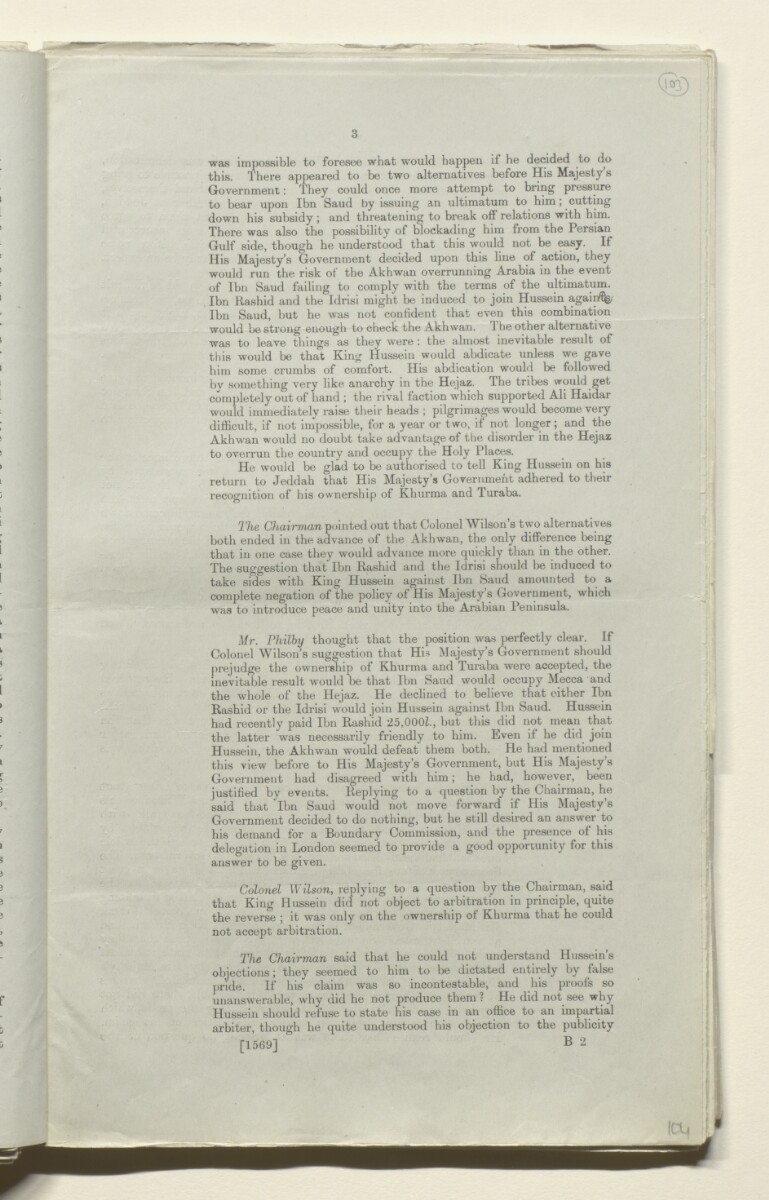
was impossible to foresee what would happen if he decided to do
this. There appeared to be two alternatives before His Majesty s
Grovernment: They could once more attempt to bring pressure
to bear upon Ibn Saud by issuing an ultimatum to him; cutting
down his subsidy ; and threatening to break off relations with him.
There was also the possibility of blockading him from the Persian
Gulf side, though he understood that this would not be easy. If
His Majesty’s Government decided upon this line of action, they
would run the risk of the Akhwan overrunning Arabia in the event
of Ibn Saud failing to comply with the terms of the ultimatum.
Ibn Rashid and the Idrisi might be induced to join Hussein again%
Ibn Saud, but he was not confident that even this combination
would be strong enough to check the Akhwan. 1 he other alternative
was to leave things as they were : the almost inevitable result of
this would be that King Hussein would abdicate unless we gave
him some crumbs of comfort. His abdication would be followed
bv something very like anarchy in the Hejaz. The tribes would get
completely out of hand ; the rival faction which supported Ali Haidar
would immediately raise their heads ; pilgrimages would become very
difficult, if not impossible, for a year or two, if not longer; and the
Akhwan would no doubt take advantage of the disorder in the Hejaz
to overrun the country and occupy the Holy Places.
He would be glad to be authorised to tell King Hussein on his
return to Jeddah that His Majesty’s Government adhered to their
recognition of his ownership of Khurma and Turaba.
The Chairman pointed out that Colonel Wilson’s two alternatives
both ended in the advance of the Akhwan, the only difference being
that in one case they would advance more quickly than in the other.
The suggestion that Ibn Rashid and the Idrisi should be induced to
take sides with King Hussein against Ibn Saud amounted to a
complete negation of the policy of His Majesty’s Government, which
was to introduce peace and unity into the Arabian Peninsula.
Mr. Philby thought that the position was perfectly clear. If
Colonel Wilson’s suggestion that His Majesty’s Government should
prejudge the ownership of Khurma and Turaba were accepted, the
inevitable result would be that Ibn Saud would occupy Mecca and
the whole of the Hejaz. He declined to believe that either Ibn
Rashid or the Idrisi would join Hussein against Ibn Saud. Hussein
had recently paid Ibn Rashid 25,000L, but this did not mean that
the latter was necessarily friendly to him. Even if he did join
Hussein, the Akhwan would defeat them both. He had mentioned
this view before to His Majesty’s Government, but His Majesty s
Government had disagreed with him; he had, however, been
justified by events. Replying to a question by the Chairman, he
said that Ibn Saud would not move forward if His Majesty’s
Government decided to do nothing, but he still desired an answer to
his demand for a Boundary Commission, and the presence of his
delegation in London seemed to provide a good opportunity for this
answer to be given.
Colonel Wilson, replying to a question by the Chairman, said
that King Hussein did not object to arbitration in principle, quite
the reverse ; it was only on the ownership of Khurma that he could
not accept arbitration.
The Chairman said that he could not understand Hussein’s
objections; they seemed to him to be dictated entirely by false
pride. If his claim was so incontestable, and his proofs so
unanswerable, why did he not produce them ? He did not see why
Hussein should refuse to state his case in an office to an impartial
arbiter, though he quite understood his objection to the publicity
[1569] B 2
About this item
- Content
This file is composed of papers produced by the Foreign Office's Interdepartmental Conference on Middle Eastern Affairs. It consists entirely of printed minutes of meetings of the conference, most of which are chaired by George Curzon.
Those attending include senior representatives of the Foreign Office, the India Office The department of the British Government to which the Government of India reported between 1858 and 1947. The successor to the Court of Directors. (most notably the Secretary of State for India), the War Office, the Admiralty, the Air Ministry, and the Treasury (including the Chancellor of the Exchequer). Other notable figures attending include Harry St John Bridger Philby and Gertrude Margaret Lowthian Bell.
The meetings concern British policy in the Middle East, and mainly cover the following geographical areas: Mesopotamia, Kurdistan, Trans-Caspia, Trans-Caucasia, the Caspian Sea, Palestine, Persia, Hejaz, and Afghanistan. Some of the meetings also touch on matters beyond the Middle East (e.g. wireless telegraphy in Tibet, ff 79-80).
Recurring topics of discussion include railways (chiefly in relation to Mesopotamia), Bolshevik influence in the Middle East (particularly in Persia and Trans-Caspia), and relations between King Hussein [Ḥusayn bin ‘Alī al-Hāshimī] and Ibn Saud [‘Abd al-‘Azīz bin ‘Abd al-Raḥmān bin Fayṣal Āl Sa‘ūd].
Several sets of minutes also contain related memoranda as appendices.
- Extent and format
- 1 file (145 folios)
- Arrangement
The papers are arranged in approximate chronological order from the front to the rear of the file.
- Physical characteristics
Foliation: the foliation sequence (used for referencing) commences at the first folio with 1, and terminates at the last folio with 145, these numbers are written in pencil, are circled, and are located in the top right corner of the recto The front of a sheet of paper or leaf, often abbreviated to 'r'. side of each folio.
- Written in
- English in Latin script View the complete information for this record
Use and share this item
- Share this item
Papers of the Interdepartmental Conference on Middle Eastern Affairs [103r] (205/290), British Library: India Office Records and Private Papers, Mss Eur F112/275, in Qatar Digital Library <https://www.qdl.qa/archive/81055/vdc_100070539236.0x000006> [accessed 14 June 2026]
https://www.qdl.qa/en/archive/81055/vdc_100070539236.0x000006
Copy and paste the code below into your web page where you would like to embed the image.
<meta charset="utf-8"><a href="https://www.qdl.qa/en/archive/81055/vdc_100070539236.0x000006">Papers of the Interdepartmental Conference on Middle Eastern Affairs [‎103r] (205/290)</a> <a href="https://www.qdl.qa/en/archive/81055/vdc_100070539236.0x000006"> <img src="https://iiif.qdl.qa/iiif/images/81055/vdc_100000001491.0x0002a9/Mss Eur F112_275_0205.jp2/full/!280,240/0/default.jpg" alt="" /> </a>
This record has a IIIF manifest available as follows. If you have a compatible viewer you can drag the icon to load it.https://www.qdl.qa/en/iiif/81055/vdc_100000001491.0x0002a9/manifestOpen in Universal viewerOpen in Mirador viewerMore options for embedding images
Copyright: How to use this content
- Reference
- Mss Eur F112/275
- Title
- Papers of the Interdepartmental Conference on Middle Eastern Affairs
- Pages
- front, front-i, 2r:144v, back-i, back
- Author
- East India Company, the Board of Control, the India Office, or other British Government Department
- Usage terms
- Open Government Licence