
![Papers of the Interdepartmental Conference on Middle Eastern Affairs [‎120r] (239/290)](https://iiif.qdl.qa/iiif/images/81055/vdc_100000001491.0x0002a9/Mss Eur F112_275_0239.jp2/full/!1200,1200/0/default.jpg "Papers of the Interdepartmental Conference on Middle Eastern Affairs [‎120r] (239/290)")
Papers of the Interdepartmental Conference on Middle Eastern Affairs [120r] (239/290)
The record is made up of 1 file (145 folios). It was created in 7 Jan 1919-7 Dec 1920. It was written in English. The original is part of the British Library: India Office The department of the British Government to which the Government of India reported between 1858 and 1947. The successor to the Court of Directors. Records and Private Papers Documents collected in a private capacity. .
Transcription
This transcription is created automatically. It may contain errors.
9
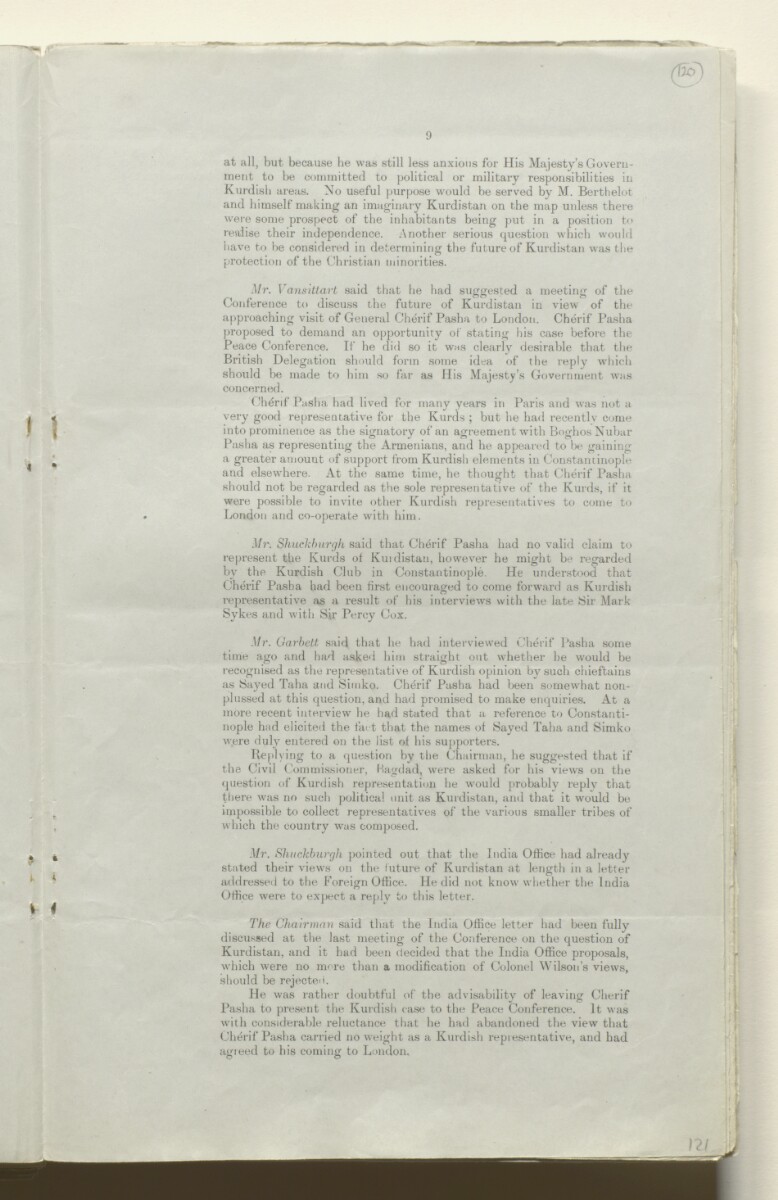
at all, but because he was still less anxious for His Majesty’s Govern
ment to be committed to political or military responsibilities in
Kurdish areas. No useful purpose would be served by M. Berthelot
and himself* making an imaginary Kurdistan on the map unless there
were some prospect of the inhabitants being put in a position to
realise their independence. Another serious question which would
have to be considered in determining the future of Kurdistan was the
protection of the Christian minorities.
Mr. Vansittart said that he had suggested a meeting of the
Conference to discuss the future of Kurdistan in view of the
approaching visit of General Cherif
Pasha
An Ottoman title used after the names of certain provincial governors, high-ranking officials and military commanders.
to London. Cherif
Pasha
An Ottoman title used after the names of certain provincial governors, high-ranking officials and military commanders.
proposed to demand an opportunity of stating his case before the
Peace Conference. If he did so it was clearly desirable that the
British Delegation should form some idea of the replv which
should be made to him so far as His Majesty’s Government was
concerned.
Cherif
Pasha
An Ottoman title used after the names of certain provincial governors, high-ranking officials and military commanders.
had lived for many years in Paris and was not a
very good representative for the Kurds ; but he had recentlv come
into prominence as the signatory of an agreement with BoghosNubar
Pasha
An Ottoman title used after the names of certain provincial governors, high-ranking officials and military commanders.
as representing the Armenians, and he appeared to be gaining
a greater amount of support from Kurdish elements in Constantinople
and elsewhere. At the same time, he thought that Cherif
Pasha
An Ottoman title used after the names of certain provincial governors, high-ranking officials and military commanders.
should not be regarded as the sole representative of the Kurds, if it
were possible to invite other Kurdish representatives to come to
London and co-operate with him.
Mr. Shuckburgh said that Cherif
Pasha
An Ottoman title used after the names of certain provincial governors, high-ranking officials and military commanders.
had no valid claim to
represent the Kurds of Kurdistan, however he might be regarded
by the Kurdish Club in Constantinople. He understood that
Cherif
Pasha
An Ottoman title used after the names of certain provincial governors, high-ranking officials and military commanders.
had been first encouraged to come forward as Kurdish
representative as a result of his interviews with the late ISir Mark
Sykes and with Sir Percy Cox.
Mr. Garbett said that he had interviewed Cherif
Pasha
An Ottoman title used after the names of certain provincial governors, high-ranking officials and military commanders.
some
time ago and had asked him straight out whether he would be
recognised as the representative of Kurdish opinion by such chieftains
as Sayed Taha and Simko. Cherif
Pasha
An Ottoman title used after the names of certain provincial governors, high-ranking officials and military commanders.
had been somewhat non
plussed at this question, and had promised to make enquiries. At a
more recent interview he had stated that a reference to Constanti
nople had elicited the fact that the names of Sayed Taha and Simko
were duly entered on the list of his supporters.
Replying to a question by the Chairman, he suggested that if
the Civil Commissioner, Bagdad, were asked for his views on the
question of Kurdish representation he would probably reply that
there was no such political unit as Kurdistan, and that it would be
impossible to collect representatives of the various smaller tribes of
which the country was composed.
Mr. Shuckburgh pointed out that the
India Office
The department of the British Government to which the Government of India reported between 1858 and 1947. The successor to the Court of Directors.
had already
stated their views on the future of Kurdistan at length in a letter
addressed to the Foreign Office. He did not know whether the India
Office were to expect a reply to this letter.
The Chairman said that the
India Office
The department of the British Government to which the Government of India reported between 1858 and 1947. The successor to the Court of Directors.
letter had been fully
discussed at the last meeting of the Conference on the question of
Kurdistan, and it had been decided that the
India Office
The department of the British Government to which the Government of India reported between 1858 and 1947. The successor to the Court of Directors.
proposals,
which were no more than a modification of Colonel Wilson’s views,
should be rejected.
He was rather doubtful of the advisability of leaving Cherif
Pasha
An Ottoman title used after the names of certain provincial governors, high-ranking officials and military commanders.
to present the Kurdish case to the Peace Conference. It was
with considerable reluctance that he had abandoned the view that
Cherif
Pasha
An Ottoman title used after the names of certain provincial governors, high-ranking officials and military commanders.
carried no weight as a Kurdish representative, and had
agreed to his coming to London.
About this item
- Content
This file is composed of papers produced by the Foreign Office's Interdepartmental Conference on Middle Eastern Affairs. It consists entirely of printed minutes of meetings of the conference, most of which are chaired by George Curzon.
Those attending include senior representatives of the Foreign Office, the India Office The department of the British Government to which the Government of India reported between 1858 and 1947. The successor to the Court of Directors. (most notably the Secretary of State for India), the War Office, the Admiralty, the Air Ministry, and the Treasury (including the Chancellor of the Exchequer). Other notable figures attending include Harry St John Bridger Philby and Gertrude Margaret Lowthian Bell.
The meetings concern British policy in the Middle East, and mainly cover the following geographical areas: Mesopotamia, Kurdistan, Trans-Caspia, Trans-Caucasia, the Caspian Sea, Palestine, Persia, Hejaz, and Afghanistan. Some of the meetings also touch on matters beyond the Middle East (e.g. wireless telegraphy in Tibet, ff 79-80).
Recurring topics of discussion include railways (chiefly in relation to Mesopotamia), Bolshevik influence in the Middle East (particularly in Persia and Trans-Caspia), and relations between King Hussein [Ḥusayn bin ‘Alī al-Hāshimī] and Ibn Saud [‘Abd al-‘Azīz bin ‘Abd al-Raḥmān bin Fayṣal Āl Sa‘ūd].
Several sets of minutes also contain related memoranda as appendices.
- Extent and format
- 1 file (145 folios)
- Arrangement
The papers are arranged in approximate chronological order from the front to the rear of the file.
- Physical characteristics
Foliation: the foliation sequence (used for referencing) commences at the first folio with 1, and terminates at the last folio with 145, these numbers are written in pencil, are circled, and are located in the top right corner of the recto The front of a sheet of paper or leaf, often abbreviated to 'r'. side of each folio.
- Written in
- English in Latin script View the complete information for this record
Use and share this item
- Share this item
Papers of the Interdepartmental Conference on Middle Eastern Affairs [120r] (239/290), British Library: India Office Records and Private Papers, Mss Eur F112/275, in Qatar Digital Library <https://www.qdl.qa/archive/81055/vdc_100070539236.0x000028> [accessed 14 June 2026]
https://www.qdl.qa/en/archive/81055/vdc_100070539236.0x000028
Copy and paste the code below into your web page where you would like to embed the image.
<meta charset="utf-8"><a href="https://www.qdl.qa/en/archive/81055/vdc_100070539236.0x000028">Papers of the Interdepartmental Conference on Middle Eastern Affairs [‎120r] (239/290)</a> <a href="https://www.qdl.qa/en/archive/81055/vdc_100070539236.0x000028"> <img src="https://iiif.qdl.qa/iiif/images/81055/vdc_100000001491.0x0002a9/Mss Eur F112_275_0239.jp2/full/!280,240/0/default.jpg" alt="" /> </a>
This record has a IIIF manifest available as follows. If you have a compatible viewer you can drag the icon to load it.https://www.qdl.qa/en/iiif/81055/vdc_100000001491.0x0002a9/manifestOpen in Universal viewerOpen in Mirador viewerMore options for embedding images
Copyright: How to use this content
- Reference
- Mss Eur F112/275
- Title
- Papers of the Interdepartmental Conference on Middle Eastern Affairs
- Pages
- front, front-i, 2r:144v, back-i, back
- Author
- East India Company, the Board of Control, the India Office, or other British Government Department
- Usage terms
- Open Government Licence