
![Papers of the Interdepartmental Conference on Middle Eastern Affairs [‎122v] (244/290)](https://iiif.qdl.qa/iiif/images/81055/vdc_100000001491.0x0002a9/Mss Eur F112_275_0244.jp2/full/!1200,1200/0/default.jpg "Papers of the Interdepartmental Conference on Middle Eastern Affairs [‎122v] (244/290)")
Papers of the Interdepartmental Conference on Middle Eastern Affairs [122v] (244/290)
The record is made up of 1 file (145 folios). It was created in 7 Jan 1919-7 Dec 1920. It was written in English. The original is part of the British Library: India Office The department of the British Government to which the Government of India reported between 1858 and 1947. The successor to the Court of Directors. Records and Private Papers Documents collected in a private capacity. .
Transcription
This transcription is created automatically. It may contain errors.
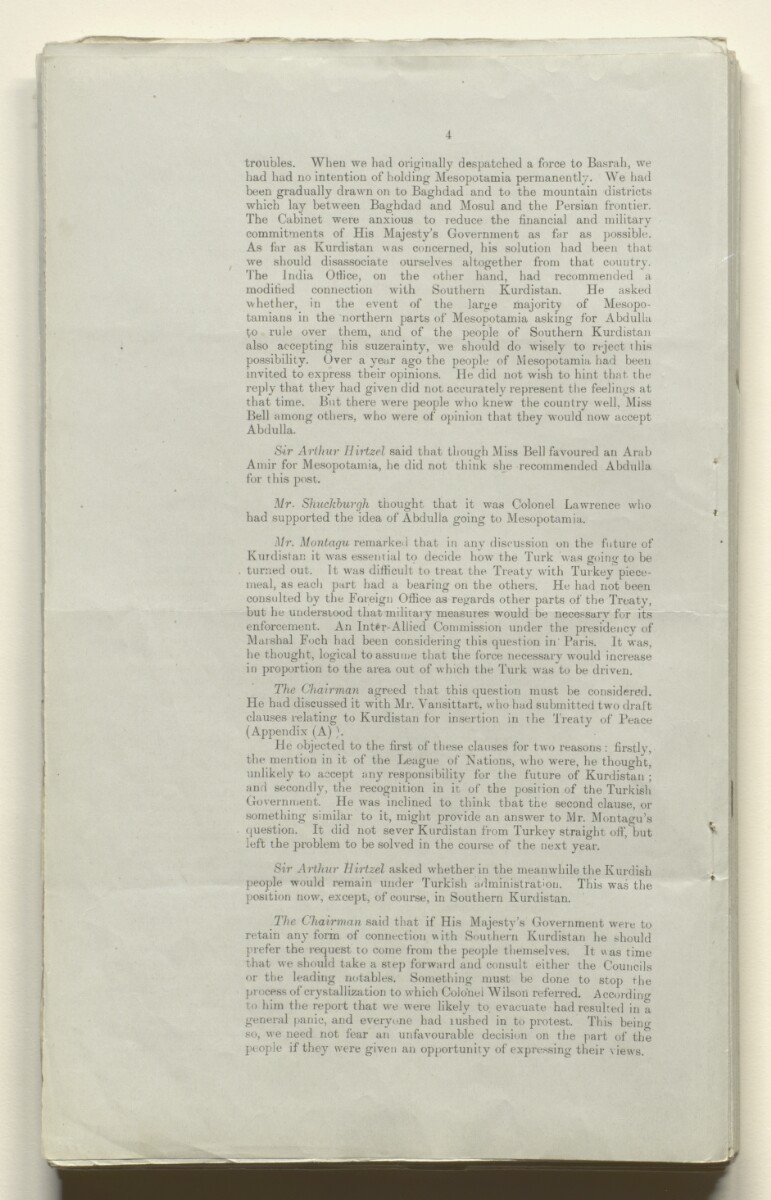
4
troubles. When we had originally despatched a force to Basrah, we
had had no intention of holding Mesopotamia permanently. We had
been gradually drawn on to Baghdad and to the mountain districts
which lay between Baghdad and Mosul and the Persian frontier.
The Cabinet were anxious to reduce the financial and military
commitments of His Majesty’s Government as far as possible.
As far as Kurdistan was concerned, his solution had been that
we should disassociate ourselves altogether from that country.
The
India Office
The department of the British Government to which the Government of India reported between 1858 and 1947. The successor to the Court of Directors.
, on the other hand, had recommended a
modified connection with Southern Kurdistan. He asked
whether, in the event of the large majority of Mesopo
tamians in the northern parts of Mesopotamia asking for Abdulla
to rule over them, and of the people of Southern Kurdistan
also accepting his suzerainty, w T e should do wisely to reject this
possibility. Over a year ago the people of Mesopotamia had been
invited to express their opinions. He did not wish to hint that, the
reply that they had given did not accurately represent the feelings at
that time. But there were people who knew the country well, Miss
Bell among others, who were of opinion that they w r ould now accept
Abdulla.
Sir Arthur Hirtzel said that though Miss Bell favoured an Arab
Amir for Mesopotamia, he did not think she recommended Abdulla
for this post.
Mr. Shuckhurgh thought that it was Colonel Lawrence who
had supported the idea of Abdulla going to Mesopotamia.
Mr. Montagu remarked that in any discussion on the future of
Kurdistan it was essential to decide how the Turk was going to be
. turned out. It was difficult to treat the Treaty wdth Turkey piece
meal, as each part had a bearing on the others. He had not been
consulted by the Foreign Office as regards other parts of the Treaty,
but he understood that military measures would be necessary for its
enforcement. An Int^r-Allied Commission under the
presidency
The name given to each of the three divisions of the territory of the East India Company, and later the British Raj, on the Indian subcontinent.
of
Marshal Foch had been considering this question in Paris. It was,
he thought, logical to assume that the force necessary would increase
in proportion to the area out of which the Turk v'as to be driven.
The Chairman agreed that this question must be considered.
He had discussed it wuth Mr. Vansittart, who had submitted two draft
clauses relating to Kurdistan for insertion in the Treaty of Peace
(Appendix (A)).
He objected to the first of these clauses for two reasons : firstly,
the mention in it of the League of Nations, w'ho were, he thought,
unlikely to accept any responsibility for the future of Kurdistan ;
and secondly, the recognition in it of the position of the Turkish
Government. He was inclined to think that the second clause, or
something similar to it, might provide an answer to Mr. Montagu’s
. question. It did not sever Kurdistan from Turkey straight off," but
left the problem to be solved in the course of the next year.
Sir Arthur tlirtzel asked whether in the meanwhile the Kurdish
people would remain under Turkish administration. This was the
position now, except, of course, in Southern Kurdistan.
The Chairman said that if His Majesty’s Government were to
retain any form of connection with Southern Kurdistan he should
prefer the request to come from the people themselves. It uas time
that we should take a step forward and consult either the Councils
or the leading notables. Something must be done to stop the
process of crystallization to which Colonel W ilson referred. A ccording
to him the report that we were likely to. evacuate had resulted in a
general panic, and everyone had lushed in to protest. This beiim
so, we need not fear an unfavourable decision on the part of the
people if they were given an opportunity of expressing their views.
About this item
- Content
This file is composed of papers produced by the Foreign Office's Interdepartmental Conference on Middle Eastern Affairs. It consists entirely of printed minutes of meetings of the conference, most of which are chaired by George Curzon.
Those attending include senior representatives of the Foreign Office, the India Office The department of the British Government to which the Government of India reported between 1858 and 1947. The successor to the Court of Directors. (most notably the Secretary of State for India), the War Office, the Admiralty, the Air Ministry, and the Treasury (including the Chancellor of the Exchequer). Other notable figures attending include Harry St John Bridger Philby and Gertrude Margaret Lowthian Bell.
The meetings concern British policy in the Middle East, and mainly cover the following geographical areas: Mesopotamia, Kurdistan, Trans-Caspia, Trans-Caucasia, the Caspian Sea, Palestine, Persia, Hejaz, and Afghanistan. Some of the meetings also touch on matters beyond the Middle East (e.g. wireless telegraphy in Tibet, ff 79-80).
Recurring topics of discussion include railways (chiefly in relation to Mesopotamia), Bolshevik influence in the Middle East (particularly in Persia and Trans-Caspia), and relations between King Hussein [Ḥusayn bin ‘Alī al-Hāshimī] and Ibn Saud [‘Abd al-‘Azīz bin ‘Abd al-Raḥmān bin Fayṣal Āl Sa‘ūd].
Several sets of minutes also contain related memoranda as appendices.
- Extent and format
- 1 file (145 folios)
- Arrangement
The papers are arranged in approximate chronological order from the front to the rear of the file.
- Physical characteristics
Foliation: the foliation sequence (used for referencing) commences at the first folio with 1, and terminates at the last folio with 145, these numbers are written in pencil, are circled, and are located in the top right corner of the recto The front of a sheet of paper or leaf, often abbreviated to 'r'. side of each folio.
- Written in
- English in Latin script View the complete information for this record
Use and share this item
- Share this item
Papers of the Interdepartmental Conference on Middle Eastern Affairs [122v] (244/290), British Library: India Office Records and Private Papers, Mss Eur F112/275, in Qatar Digital Library <https://www.qdl.qa/archive/81055/vdc_100070539236.0x00002d> [accessed 26 June 2026]
https://www.qdl.qa/en/archive/81055/vdc_100070539236.0x00002d
Copy and paste the code below into your web page where you would like to embed the image.
<meta charset="utf-8"><a href="https://www.qdl.qa/en/archive/81055/vdc_100070539236.0x00002d">Papers of the Interdepartmental Conference on Middle Eastern Affairs [‎122v] (244/290)</a> <a href="https://www.qdl.qa/en/archive/81055/vdc_100070539236.0x00002d"> <img src="https://iiif.qdl.qa/iiif/images/81055/vdc_100000001491.0x0002a9/Mss Eur F112_275_0244.jp2/full/!280,240/0/default.jpg" alt="" /> </a>
This record has a IIIF manifest available as follows. If you have a compatible viewer you can drag the icon to load it.https://www.qdl.qa/en/iiif/81055/vdc_100000001491.0x0002a9/manifestOpen in Universal viewerOpen in Mirador viewerMore options for embedding images
Copyright: How to use this content
- Reference
- Mss Eur F112/275
- Title
- Papers of the Interdepartmental Conference on Middle Eastern Affairs
- Pages
- front, front-i, 2r:144v, back-i, back
- Author
- East India Company, the Board of Control, the India Office, or other British Government Department
- Usage terms
- Open Government Licence