
![‘Seistan Persia & Seistan’ [‎12r] (28/617)](https://iiif.qdl.qa/iiif/images/81055/vdc_100000001452.0x0003ba/Mss Eur F111_350_0028.jp2/full/!1200,1200/0/default.jpg "‘Seistan Persia & Seistan’ [‎12r] (28/617)")
‘Seistan Persia & Seistan’ [12r] (28/617)
The record is made up of 2 volumes (301 folios). It was created in 22 Jun 1896-3 Mar 1900. It was written in English. The original is part of the British Library: India Office The department of the British Government to which the Government of India reported between 1858 and 1947. The successor to the Court of Directors. Records and Private Papers Documents collected in a private capacity. .
Transcription
This transcription is created automatically. It may contain errors.
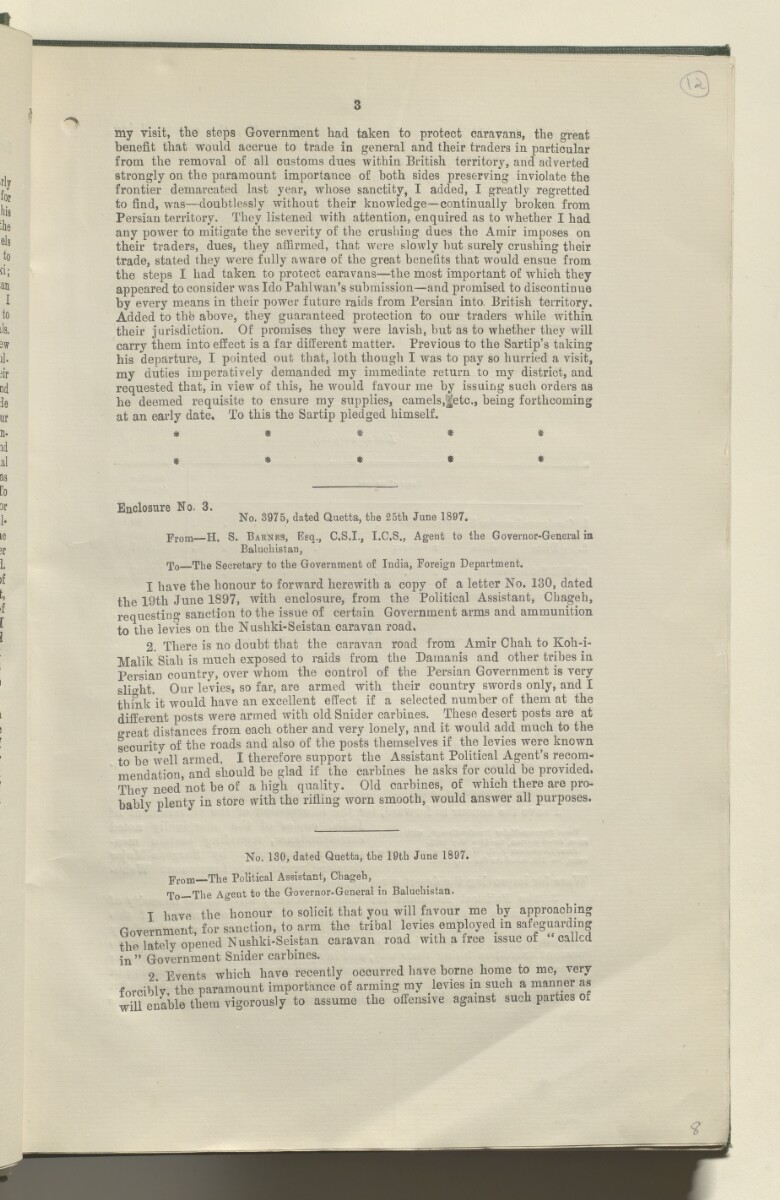
my visit, the steps Government had taken to protect caravans, the great
benefit that would accrue to trade in general and their traders in particular
from the removal of all customs dues within British territory, and adverted
strongly on the paramount importance of both sides preserving inviolate the
frontier demarcated last year, whose sanctity, I added, I greatly regretted
to find, was—doubtlessly without their knowledge—continually broken from
Persian territory. They listened with attention, enquired as to whether I had
any power to mitigate the severity of the crushing dues the Amir imposes on
their traders, dues, they affirmed, that were slowly hut surely crushing their
trade, stated they were fully aware of the great benefits that would ensue from
the steps I had taken to protect caravans—the most important of which they
appeared to consider was Ido Pahlwan’s submission—and promised to discontinue
by every means in their power future raids from Persian into, British territory.
Added to the above, they guaranteed protection to our traders while within
their jurisdiction. Of promises they were lavish, but as to whether they will
carry them into effect is a far different matter. Previous to the Sartip’s taking
his departure, I pointed out that, loth though I was to pay so hurried a visit,
my duties imperatively demanded my immediate return to my district, and
requested that, in view of this, he would favour me by issuing such orders as
he deemed requisite to ensure my supplies, camels,Jetc., being forthcoming
at an early date. To this the Sartip pledged himself.
*****
* * * * *
Enclosure No. 3.
No. 3975, dated Quetta, the 25th June 1897.
From—H. S. Barnes, Esq., C.S.I., I.C.S., Agent to the Governor-General in
Baluchistan,
To The Secretary to the Government of India, Foreign Department.
I have the honour to forward herewith a copy of a letter No. 130, dated
the 19th June 1897, with enclosure, from the Political Assistant, Chageh,
requesting sanction to the issue of certain Government arms and ammunition
to the levies on the Nushki-Seistan caravan road,
2. There is no doubt that the caravan road from Amir Chah to Koh-i-
Malik Siah is much exposed to raids from the Damanis and other tribes in
Persian country, over whom the control of the Persian Government is very
slight. Our levies, so far, are armed with their country swords only, and I
think it would have an excellent effect if a selected number of them at the
different posts were armed with old Snider carbines. These desert posts are at
great distances from each other and very lonely, and it would add much to the
security of the roads and also of the posts themselves if the levies were known
to be well armed. I therefore support the Assistant Political Agent’s recom
mendation, and should be glad if the carbines he asks for could be provided.
They need’not be of a high quality. Old carbines, of which there are pro
bably plenty in store with the rifling worn smooth, would answer all purposes.
No. 130, dated Quetta, the 19th June 1897.
From— The Political Assistant, Chageh,
rp 0 rjq ie Agent to the Governor-General in Baluchistan.
I have the honour to solicit that you will favour me by approaching
Government, for sanction, to arm the tribal levies employed in safeguaiding
the lately opened Nushki-Seistan caravan road with a free issue of “ called
in ” Government Snider carbines.
2. Events which have recently occurred have borne home to me, very
forcibiv, the paramount importance of arming my levies in such a manner as
will enable them vigorously to assume the offensive against such parties of
About this item
- Content
The volumes contain papers relating to Persia [Iran], including Seistan, and the tract of land south of the Baluch-Afghan boundary between Nushki and Persia, which had become British territory following the demarcation of the Afghan-Baluch border.
The papers largely consist of printed copies of correspondence between the Governor General of India in Council (Government of India Foreign Department) and the Secretary of State for India (Lord George Francis Hamilton), and enclosed correspondence and papers.
Letters from the Governor General of India in Council to the Secretary of State for India include:
- Number 170, 16 September 1896, relating to the opening up of a trade route between Nushki and the Persian frontier, crossing the tract of British territory south of the Baluch-Afghan boundary, and the protection of the newly-demarcated frontier, with enclosed memorandum by Captain Arthur Henry McMahon, British Commissioner, Baluch-Afghan Boundary Commission, containing his proposals for the management and administration of the tract and for the protection of the trade route
- Number 58, 31 March 1898, concerning the trade route between Baluchistan and Persia, including the suggestion that Consular Agents should be appointed at central points along it between Seistan and Meshed, with enclosures including a report by Lieutenant Frank Webb-Ware, Political Assistant at Chagai, on his visit to Seistan at the beginning of 1896, and the measures introduced for the development of trade between Baluchistan and Persia (which includes a blueprint map, Mss Eur F111/350, f 33)
- Number 163, 15 September 1898, forwarding copies of papers regarding the situation in Makran and Panjgur, following recent ‘disturbances’ in Makran.
The file also includes:
- Copies of Government of India Foreign Department papers numbered 40-58 relating to the Kerman Consulate and British interests in Southern Persia, including correspondence between the Government of India Foreign Department and the Secretary of State for India
- A letter from the Secretary of State for India to the Governor General of India in Council, with enclosed despatch from Sir (Henry) Mortimer Durand, HM Minister at Tehran, to the Foreign Office, dated 12 February 1899, in which he gives his opinion on suggestions for the appointment of additional consular officers in Persia (this includes a map titled ‘Skeleton Map of Telegraph Lines in Persia.’ Mss Eur F111/350, f 187)
- A letter from Durand to the Secretary to the Foreign Department of the Government of India, 24 February 1899, enclosing a copy of his memorandum (with appendices) drawn up in 1895 on the situation in Persia, and the steps he proposed should be taken to improve the British position there
- Copies of a draft despatch from the Governor General of India in Council, 2 September 1899, regarding relations between Great Britain and Persia, including improving the British Political and Consular service in Persia, and the extent of the share of responsibility for Persia that should be devolved upon the Government of India, followed by printed comments upon the draft
- Copies of a minute by George Nathaniel Curzon, Viceroy of India, on Seistan, dated 4 September 1899, including the question of a railway connection between India and Seistan
- Handwritten pencil notes by Curzon relating to Persia and the ‘Seistan Question’.
In addition to the two maps noted above, the file also includes the following maps: map of the area south of the border between Afghanistan and Baluchistan (Mss Eur F111/350, f 300); map of the area west of the border between Persia and Afghanistan (Mss Eur F111/350, f 301); and ‘Route Plan of Robat Nala’ (Mss Eur F111/350, f 302).
- Extent and format
- 2 volumes (301 folios)
- Arrangement
Most of volume A is arranged in reverse chronological order from the front to the rear of the volume (from folios 6 to 76); volume B is arranged is rough chronological order from the front to the rear of the volume.
- Physical characteristics
Foliation: this file consists of two physical volumes. The foliation sequence commences at the inside front cover of volume one (ff 1-150) and terminates at the inside back cover of volume two (ff 151-304); these numbers are written in pencil, are circled, and are located in the top right corner of the recto The front of a sheet of paper or leaf, often abbreviated to 'r'. side of each folio.
- Written in
- English in Latin script View the complete information for this record
Use and share this item
- Share this item
‘Seistan Persia & Seistan’ [12r] (28/617), British Library: India Office Records and Private Papers, Mss Eur F111/350, in Qatar Digital Library <https://www.qdl.qa/archive/81055/vdc_100072740552.0x00001d> [accessed 21 July 2026]
https://www.qdl.qa/en/archive/81055/vdc_100072740552.0x00001d
Copy and paste the code below into your web page where you would like to embed the image.
<meta charset="utf-8"><a href="https://www.qdl.qa/en/archive/81055/vdc_100072740552.0x00001d">‘Seistan Persia & Seistan’ [‎12r] (28/617)</a> <a href="https://www.qdl.qa/en/archive/81055/vdc_100072740552.0x00001d"> <img src="https://iiif.qdl.qa/iiif/images/81055/vdc_100000001452.0x0003ba/Mss Eur F111_350_0028.jp2/full/!280,240/0/default.jpg" alt="" /> </a>
This record has a IIIF manifest available as follows. If you have a compatible viewer you can drag the icon to load it.https://www.qdl.qa/en/iiif/81055/vdc_100000001452.0x0003ba/manifestOpen in Universal viewerOpen in Mirador viewerMore options for embedding images
Copyright: How to use this content
- Reference
- Mss Eur F111/350
- Title
- ‘Seistan Persia & Seistan’
- Pages
- front , back , spine, edge , head , tail, front-i, 2r:32v, 34r:62v, 64r:84r, 86r, 89r:93v, 96r:96v, 99v:100v, 101v:128v, 129v:149v, back-i, front, back, spine, edge, head, tail, front-i, 152r:186v, 188r:189r, 190r:299v, 303r:304v, back-i
- Author
- East India Company, the Board of Control, the India Office, or other British Government Department
- Usage terms
- Open Government Licence