
![Letters and Papers Concerning the Trans-Persian Railway and Other Railways in Persia [‎178v] (356/442)](https://iiif.qdl.qa/iiif/images/81055/vdc_100000001491.0x0001bd/Mss Eur F112_252_0360.jp2/full/!1200,1200/0/default.jpg "Letters and Papers Concerning the Trans-Persian Railway and Other Railways in Persia [‎178v] (356/442)")
Letters and Papers Concerning the Trans-Persian Railway and Other Railways in Persia [178v] (356/442)
The record is made up of 1 file (221 folios). It was created in Nov 1911-Mar 1917. It was written in English. The original is part of the British Library: India Office The department of the British Government to which the Government of India reported between 1858 and 1947. The successor to the Court of Directors. Records and Private Papers Documents collected in a private capacity. .
Transcription
This transcription is created automatically. It may contain errors.
283
Coal Mines
284
[ LORDS ] {Northumberland) Bill.
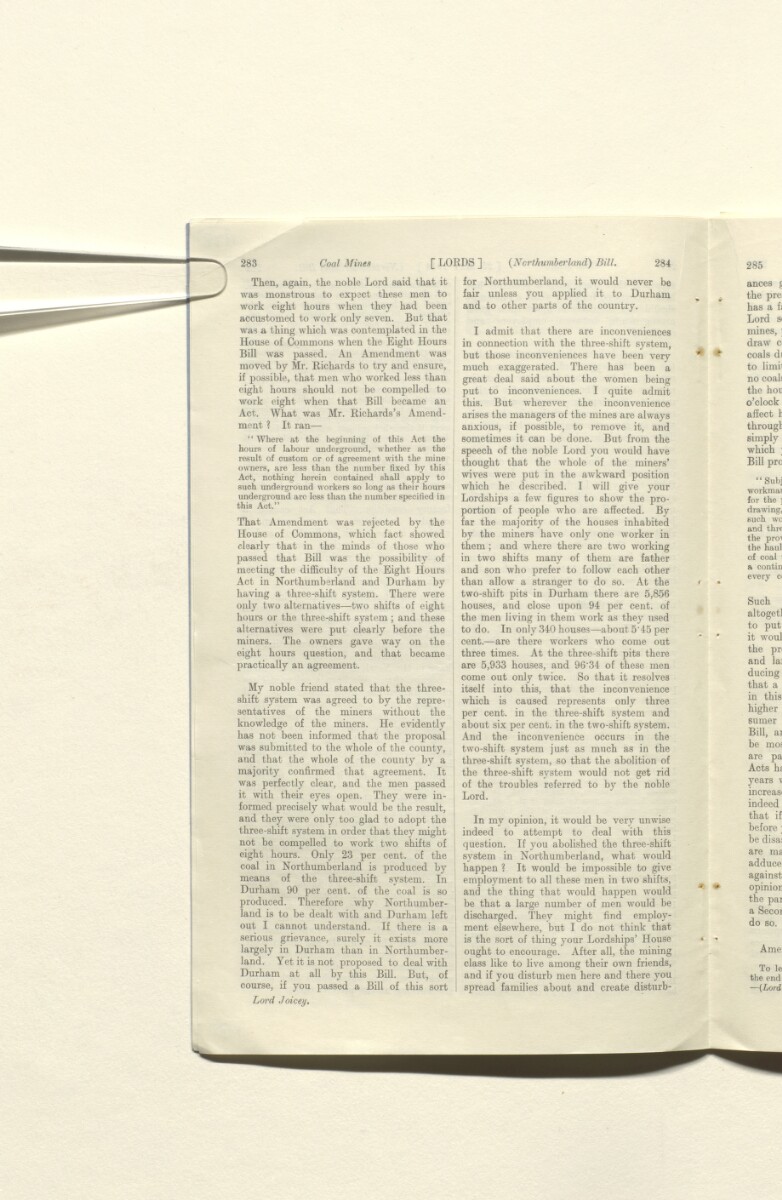
Then, again, the noble Lord said that it
was monstrous to expect these men to
work eight hours when they had been
accustomed to work only seven. But that
was a thing which was contemplated in the
House of Commons when the Eight Hours
Bill was passed. An Amendment was
moved by Mr. Richards to try and ensure,
if possible, that men who worked less than
eight hours should not be compelled to
work eight when that Bill became an
Act. What was Mr. Richards’s Amend
ment ? It ran—
“ Where at the beginning of this Act the
hours of labour underground, whether as the
result of custom or of agreement with the mine
owners, are less than the number fixed by this
Act, nothing herein contained shall apply to
such underground workers so long as their hours
underground arc less than the number specified in
this Act.”
That Amendment was rejected by the
House of Commons, which fact showed
clearly that in the minds of those who
passed that Bill was the possibility of
meeting the difficulty of the Eight Hours
Act in Northumberland and Durham by
having a three-shift system. There were
only two alternatives—two shifts of eight
hours or the three-shift system ; and these
alternatives were put clearly before the
miners. The owners gave way on the
eight hours question, and that became
practically an agreement.
My noble friend stated that the three-
shift system was agreed to by the repre
sentatives of the miners without the
knowledge of the miners. He evidently
has not been informed that the proposal
was submitted to the whole of the county,
and that the whole of the county by a
majority confirmed that agreement. It
was perfectly clear, and the men passed
it with their eyes open. They were in
formed precisely what would be the result,
and they were only too glad to adopt the
three-shift system in order that they might
not be compelled to work two shifts of
eight hours. Only 23 per cent, of the
coal in Northumberland is produced by
means of the three-shift system. In
Durham 90 per cent, of the coal is so
produced. Therefore why Northumber
land is to be dealt with and Durham left
out I cannot understand. If there is a
serious grievance, surely it exists more
largely in Durham than in Northumber
land. Yet it is not proposed to deal with
Durham at all by this Bill. But, of
course, if you passed a Bill of this sort
Lord Joicey.
for Northumberland, it would never be
fair unless you applied it to Durham
and to other parts of the country.
I admit that there are inconveniences
in connection with the three-shift system,
but those inconveniences have been very
much exaggerated. There has been a
great deal said about the women being
put to inconveniences. I quite admit
this. But wherever the inconvenience
arises the managers of the mines are always
anxious, if possible, to remove it, and
sometimes it can be done. But from the
speech of the noble Lord you would have
thought that the whole of the miners’
wives were put in the awkward position
which he described. I will give your
Lordships a few figures to show the pro
portion of people who are affected. By
far the majority of the houses inhabited
by the miners have only one worker in
them ; and where there are two working
in two shifts many of them are father
and son who prefer to follow each other
than allow a stranger to do so. At the *
two-shift pits in Durham there are 5,856
houses, and close upon 94 per cent, of
the men living in them work as they used
to do. In only 340 houses—about 5’45 per
cent.—are there workers who come out
three times. At the three-shift pits there
are 5,933 houses, and 96'34 of these men
come out only twice. So that it resolves
itself into this, that the inconvenience
which is caused represents only three
per cent, in the three-shift system and
about six per cent, in the two-shift system.
And the inconvenience occurs in the
two-shift system just as much as in the
three-shift system, so that the abolition of
the three-shift system would not get rid
of the troubles referred to by the noble
Lord.
In my opinion, it would be very unwise
indeed to attempt to deal with this
question. If you abolished the three-shift
system in Northumberland, what would
happen ? It would be impossible to give
employment to all these men in two shifts,
and the thing that would happen would
be that a large number of men would be
discharged. They might find employ
ment elsewhere, but I do not think that
is the sort of thing your Lordships’ House
ought to encourage. After all, the mining
class like to live among their own friends,
and if you disturb men here and there you
spread families about and create disturb-
About this item
- Content
The file contains correspondence, memoranda, and other papers relating to railway projects in Persia [Iran] and the surrounding region. The papers deal with the proposals for, planning, and progress of, several railway lines, including one from the Mediterranean to India, the Trans-Persian Railway, the Baghdad Railway, and the Nushki and Dalbandin extension from Quetta. The documents discuss the merits and flaws of the proposals, technical issues such as gauge sizes, and the impact of such projects on Britain's relations with Russia, Germany, France, and Turkey.
At the back of the file are a number of official reports on Parliamentary debates within the House of Commons, dating from 10 July 1912 to 25 May 1914, all of which feature railways (folios 128-218). Also at the rear of the file are three maps:
- General Map of Asia with proposed British, German, and Russian rail lines added by hand
- War Office map of the Middle East, showing railways and railway projects
- As above with further rail lines added and details of gauges given.
Correspondents include: Arthur Campbell Yate, army Officer; Henry McNiel; Francis Richard Maunsell, army officer; George Lloyd, politician; Lieutenant-Colonel Charles à Court Repington, army officer and war correspondent; Lord Robert Offley Ashburton Crewe-Milnes, Leader of the House of Lords; Henry Charles Keith Petty-Fitzmaurice (Lord Lansdowne), statesman; Lucien Wolf, journalist and historian; Charles Staniforth, businessman and railway investor; Charles Prestwich Scott, Editor of the Manchester Guardian; Hugh Shakespear Barnes, Director, Imperial Bank of Persia; and Colonel Frank Cooke Webb Ware, former Political Agent A mid-ranking political representative (equivalent to a Consul) from the diplomatic corps of the Government of India or one of its subordinate provincial governments, in charge of a Political Agency. , Chagai.
- Extent and format
- 1 file (221 folios)
- Arrangement
The file is arranged in chronological order from the front to the rear.
- Physical characteristics
Foliation: the foliation sequence (used for referencing) commences at the first folio with 1, and terminates at the last folio with 221; these numbers are written in pencil, are circled, and are located in the top right corner of the recto The front of a sheet of paper or leaf, often abbreviated to 'r'. side of each folio.
- Written in
- English in Latin script View the complete information for this record
Use and share this item
- Share this item
Letters and Papers Concerning the Trans-Persian Railway and Other Railways in Persia [178v] (356/442), British Library: India Office Records and Private Papers, Mss Eur F112/252, in Qatar Digital Library <https://www.qdl.qa/archive/81055/vdc_100075113116.0x00009d> [accessed 19 August 2026]
https://www.qdl.qa/en/archive/81055/vdc_100075113116.0x00009d
Copy and paste the code below into your web page where you would like to embed the image.
<meta charset="utf-8"><a href="https://www.qdl.qa/en/archive/81055/vdc_100075113116.0x00009d">Letters and Papers Concerning the Trans-Persian Railway and Other Railways in Persia [‎178v] (356/442)</a> <a href="https://www.qdl.qa/en/archive/81055/vdc_100075113116.0x00009d"> <img src="https://iiif.qdl.qa/iiif/images/81055/vdc_100000001491.0x0001bd/Mss Eur F112_252_0360.jp2/full/!280,240/0/default.jpg" alt="" /> </a>
This record has a IIIF manifest available as follows. If you have a compatible viewer you can drag the icon to load it.https://www.qdl.qa/en/iiif/81055/vdc_100000001491.0x0001bd/manifestOpen in Universal viewerOpen in Mirador viewerMore options for embedding images
Copyright: How to use this content
- Reference
- Mss Eur F112/252
- Title
- Letters and Papers Concerning the Trans-Persian Railway and Other Railways in Persia
- Pages
- 87r:90v, 95r:221v
- Author
- East India Company, the Board of Control, the India Office, or other British Government Department
- Usage terms
- Open Government Licence