
!['Notes on Persian Seistan' [‎60v] (125/142)](https://iiif.qdl.qa/iiif/images/81055/vdc_100000001491.0x000123/Mss Eur F111_382_0125.jp2/full/!1200,1200/0/default.jpg "'Notes on Persian Seistan' [‎60v] (125/142)")
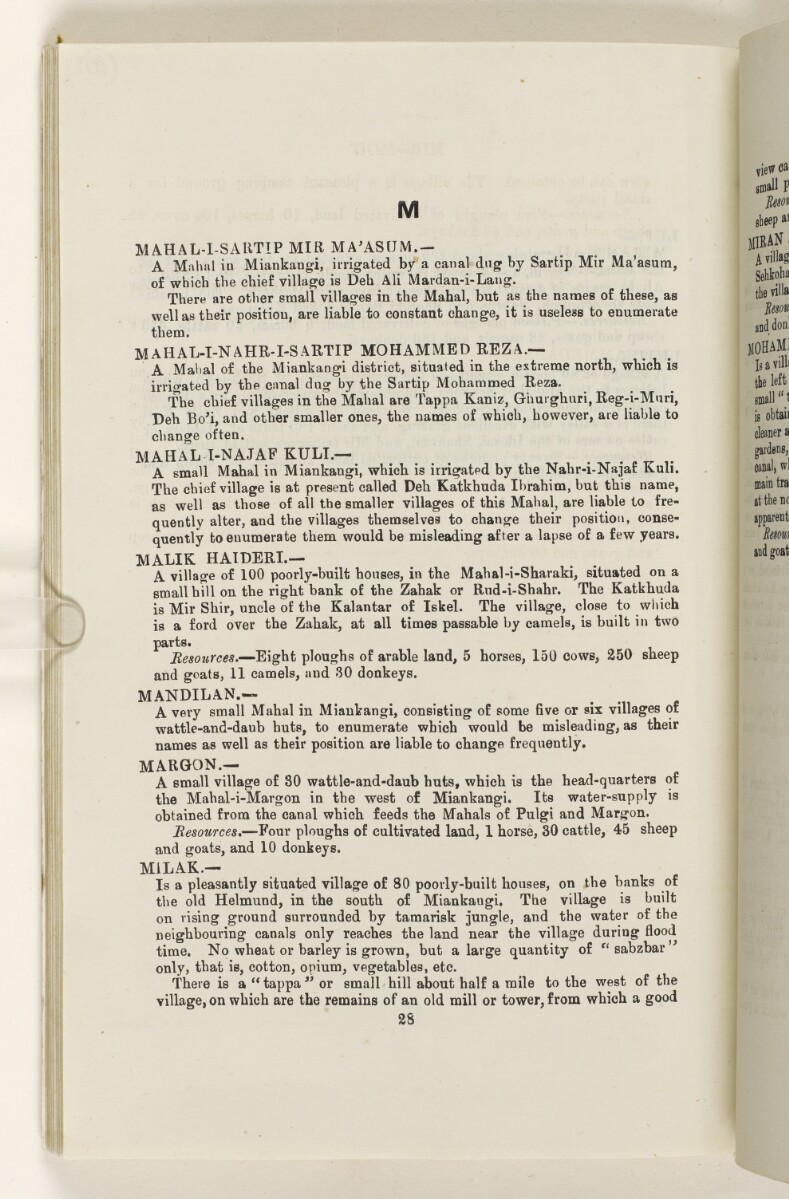
'Notes on Persian Seistan' [60v] (125/142)
The record is made up of 1 volume (67 folios). It was created in 1903. It was written in English and Persian. The original is part of the British Library: India Office The department of the British Government to which the Government of India reported between 1858 and 1947. The successor to the Court of Directors. Records and Private Papers Documents collected in a private capacity. .
Transcription
This transcription is created automatically. It may contain errors.
M
28
MAHAL-I-SAUTIP MIR MA’ASUM.—
A Mahal in Miankangi, irrigated by a canal dug by Sartip Mir Ma’asum,
of which the chief village is Deh Ali Mardan-i-Lang.
There are other small villages in the Mahal, but as the names of these, as
well as their position, are liable to constant change, it is useless to enumerate
them.
M A H A L-I-N A HR- I-S A RTIP MOHAMMED REZ A.—
A Mahal of the Miankangi district, situated in the extreme north, which is
irrigated by the canal dug by the Sartip Mohammed Reza.
The chief villages in the Mahal are Tappa Kaniz, Ghurghuri, Reg-i-Muri,
Deh Ro'i, and other smaller ones, the names of which, however, are liable to
change often.
MAHAL I-NAJAF KULI.—
A small Mahal in Miankangi, which is irrigated by the Nahr-i-Najaf Kuli.
The chief village is at present called Deh Katkhuda Ibrahim, but this name,
as well as those of all the smaller villages of this Mahal, are liable to fre
quently alter, and the villages themselves to change their position, conse
quently to enumerate them would be misleading after a lapse of a few years.
MALIK HAIDERI.—
A village of 100 poorly-built houses, in the Mahal-i-Sharaki, situated on a
small hill on the right bank of the Zahak or Rud-i-Shahr. The Katkhuda
is Mir Shir, uncle of the Kalantar of Iskel. The village, close to which
is a ford over the Zahak, at all times passable by camels, is built in two
parts.
Eight ploughs of arable land, 5 horses, 150 cows, 250 sheep
and goats, 11 camels, and 30 donkeys.
MANDILAN.— ... . *
A very small Mahal in Miankangi, consisting of some five or six villages of
wattle-and-daub huts, to enumerate which would be misleading, as their
names as well as their position are liable to change frequently.
margon.—
A small village of 80 wattle-and-daub huts, which is the head-quarters of
the Mahal-i-Margon in the west of Miankangi. Its water-supply is
obtained from the canal which feeds the Mahals of Pulgi and Margon.
Resources .—Four ploughs of cultivated land, 1 horse, 30 cattle, 45 sheep
and goats, and 10 donkeys.
M1LAK.—
Is a pleasantly situated village of 80 poorly-built houses, on the hanks of
the old Helmund, in the south of Miankaugi. The village is built
on rising ground surrounded by tamarisk jungle, and the water of the
neighbouring canals only reaches the land near the village during flood
time. No wheat or barley is grown, but a large quantity of “ sabzbar
only, that is, cotton, opium, vegetables, etc.
There is a “ tappa ” or small hill about half a mile to the west of the
village, on which are the remains of an old mill or tower, from which a good
About this item
- Content
A confidential report on the Persian region of Seistan [Sistan]. The report was compiled by Captain Edward Abadie Plunkett, 1st Battalion (Lincoln Regiment), in the Intelligence Branch, Quarter-Master General's Department. The report was printed at the Office of the Superintendent of Government Printing, Calcutta, India, 1903.
The report contains information on geography, canal systems, communications, routes, climate, resources, ethnography, administration, agriculture, and local dialect. Included within the volume are the following:
- District tables for Miankangi, Pusht-I-Ab, Mahal-I-Nahrui, Mahal-I-Sharaki, and Sheb-I-Ab, with statistics on numbers of houses, ploughs, horses, oxen, sheep and goats, camels, and donkeys for each village in each district (folios 7-28)
- Genealogical tables for the various tribes in the region (folios 34-39)
- Vocabulary and useful phrases in the local dialect (folios 42-45)
- A map showing the cultivated areas of the region (folio 69).
Part II of the report is a gazetteer (folios 46-65).
- Extent and format
- 1 volume (67 folios)
- Physical characteristics
Foliation: the foliation sequence (used for referencing) commences at the front cover with 1, and terminates at the inside back cover with 68; these numbers are written in pencil, are circled, and are located in the top right corner of the recto The front of a sheet of paper or leaf, often abbreviated to 'r'. side of each folio.
- Written in
- English and Persian in Latin and Arabic script View the complete information for this record
Use and share this item
- Share this item
'Notes on Persian Seistan' [60v] (125/142), British Library: India Office Records and Private Papers, Mss Eur F111/382, in Qatar Digital Library <https://www.qdl.qa/archive/81055/vdc_100075142622.0x00007e> [accessed 13 August 2026]
https://www.qdl.qa/en/archive/81055/vdc_100075142622.0x00007e
Copy and paste the code below into your web page where you would like to embed the image.
<meta charset="utf-8"><a href="https://www.qdl.qa/en/archive/81055/vdc_100075142622.0x00007e">'Notes on Persian Seistan' [‎60v] (125/142)</a> <a href="https://www.qdl.qa/en/archive/81055/vdc_100075142622.0x00007e"> <img src="https://iiif.qdl.qa/iiif/images/81055/vdc_100000001491.0x000123/Mss Eur F111_382_0125.jp2/full/!280,240/0/default.jpg" alt="" /> </a>
This record has a IIIF manifest available as follows. If you have a compatible viewer you can drag the icon to load it.https://www.qdl.qa/en/iiif/81055/vdc_100000001491.0x000123/manifestOpen in Universal viewerOpen in Mirador viewerMore options for embedding images
Copyright: How to use this content
- Reference
- Mss Eur F111/382
- Title
- 'Notes on Persian Seistan'
- Pages
- front, back, spine, edge, head, tail, front-i, 2r:67v, back-i, 69r:69v
- Author
- East India Company, the Board of Control, the India Office, or other British Government Department
- Usage terms
- Open Government Licence