
!['Notes on Persian Seistan' [‎61v] (127/142)](https://iiif.qdl.qa/iiif/images/81055/vdc_100000001491.0x000123/Mss Eur F111_382_0127.jp2/full/!1200,1200/0/default.jpg "'Notes on Persian Seistan' [‎61v] (127/142)")
'Notes on Persian Seistan' [61v] (127/142)
The record is made up of 1 volume (67 folios). It was created in 1903. It was written in English and Persian. The original is part of the British Library: India Office The department of the British Government to which the Government of India reported between 1858 and 1947. The successor to the Court of Directors. Records and Private Papers Documents collected in a private capacity. .
Transcription
This transcription is created automatically. It may contain errors.
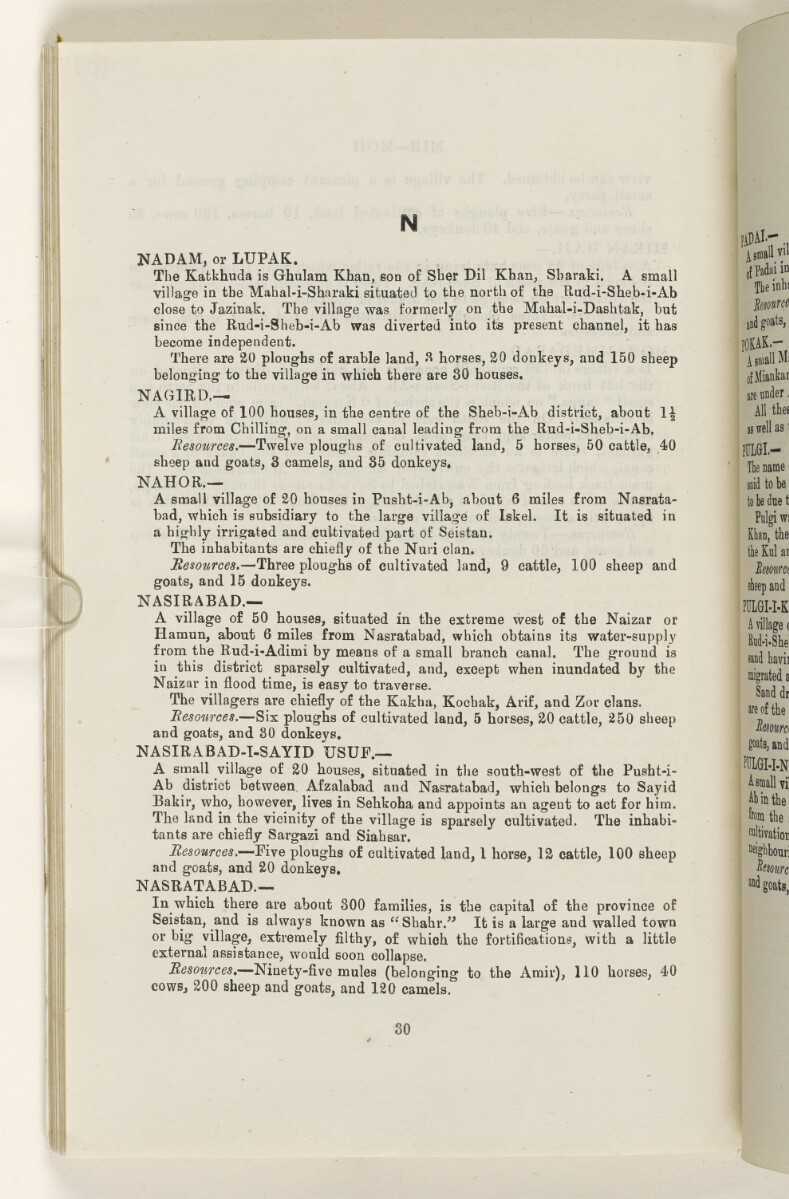
N
30
NADAM, or LUPAK.
The Katkhuda is Ghulam Khan, son of Sher Dil Khan ; Sbaraki. A small
village in the Mahal-i-Sharaki situated to the north of the Rud-i-Sheb-i-Ab
close to Jazinak. The village was formerly on the Mahal-i-Dashtak, but
since the Rud-i-Sheb-i-Ab was diverted into its present channel, it has
become independent.
There are 20 ploughs of arable land, % horses, 20 donkeys, and 150 sheep
belonging to the village in which there are 30 houses.
NAGIRD,—
A village of 100 houses, in the centre of the Sheb-i-Ab district, about 1£
miles from Chilling, on a small canal leading from the Rud-i-Sheb-i-Ab,
Resources ,—Twelve ploughs of cultivated land, 5 horses, 50 cattle, 40
sheep and goats, 3 camels, and 35 donkeys,
NAHOR.—
A small village of 20 houses in Pusht-i-Ab, about 6 miles from Nasrata-
bad, which is subsidiary to the large village of Iskel. It is situated in
a highly irrigated and cultivated part of Seistan.
The inhabitants are chiefly of the Nuri clan.
Resources ,—Three ploughs of cultivated land, 9 cattle, 100 sheep and
goats, and 15 donkeys.
NASIRABAD.—
A village of 50 houses, situated in the extreme west of the Naizar or
Hamun, about 6 miles from Nasratabad, which obtains its water-supply
from the Rud-i-Adimi by means of a small branch canal. The ground is
in this district sparsely cultivated, and, except when inundated by the
Naizar in flood time, is easy to traverse.
The villagers are chiefly of the Kakha, Kocbak, Arif, and Zor clans.
Resources .—Bix ploughs of cultivated land, 5 horses, 20 cattle, 250 sheep
and goats, and 30 donkeys.
NASIRABAD-I-SAYID USUF.—
A small village of 20 houses, situated in the south-west of the Pusht-i-
Ab district between, Afzalabad and Nasratabad, which belongs to Sayid
Bakir, who, however, lives in Sehkoha and appoints an agent to act for him.
The land in the vicinity of the village is sparsely cultivated. The inhabi
tants are chiefly Sargazi and Siahsar.
Resources.—¥ive ploughs of cultivated land, 1 horse, 12 cattle, 100 sheep
and goats, and 20 donkeys,
NASRATABAD.—
In which there are about 300 families, is the capital of the province of
Seistan, and is always known as “Shahr.” It is a large and walled town
or big village, extremely filthy, of which the fortifications, with a little
external assistance, would soon collapse.
Resources, —Ninety-five mules (belonging to the Amir), 110 horses, 40
cowSj 200 sheep and goats, and 120 camels.
About this item
- Content
A confidential report on the Persian region of Seistan [Sistan]. The report was compiled by Captain Edward Abadie Plunkett, 1st Battalion (Lincoln Regiment), in the Intelligence Branch, Quarter-Master General's Department. The report was printed at the Office of the Superintendent of Government Printing, Calcutta, India, 1903.
The report contains information on geography, canal systems, communications, routes, climate, resources, ethnography, administration, agriculture, and local dialect. Included within the volume are the following:
- District tables for Miankangi, Pusht-I-Ab, Mahal-I-Nahrui, Mahal-I-Sharaki, and Sheb-I-Ab, with statistics on numbers of houses, ploughs, horses, oxen, sheep and goats, camels, and donkeys for each village in each district (folios 7-28)
- Genealogical tables for the various tribes in the region (folios 34-39)
- Vocabulary and useful phrases in the local dialect (folios 42-45)
- A map showing the cultivated areas of the region (folio 69).
Part II of the report is a gazetteer (folios 46-65).
- Extent and format
- 1 volume (67 folios)
- Physical characteristics
Foliation: the foliation sequence (used for referencing) commences at the front cover with 1, and terminates at the inside back cover with 68; these numbers are written in pencil, are circled, and are located in the top right corner of the recto The front of a sheet of paper or leaf, often abbreviated to 'r'. side of each folio.
- Written in
- English and Persian in Latin and Arabic script View the complete information for this record
Use and share this item
- Share this item
'Notes on Persian Seistan' [61v] (127/142), British Library: India Office Records and Private Papers, Mss Eur F111/382, in Qatar Digital Library <https://www.qdl.qa/archive/81055/vdc_100075142622.0x000080> [accessed 25 July 2026]
https://www.qdl.qa/en/archive/81055/vdc_100075142622.0x000080
Copy and paste the code below into your web page where you would like to embed the image.
<meta charset="utf-8"><a href="https://www.qdl.qa/en/archive/81055/vdc_100075142622.0x000080">'Notes on Persian Seistan' [‎61v] (127/142)</a> <a href="https://www.qdl.qa/en/archive/81055/vdc_100075142622.0x000080"> <img src="https://iiif.qdl.qa/iiif/images/81055/vdc_100000001491.0x000123/Mss Eur F111_382_0127.jp2/full/!280,240/0/default.jpg" alt="" /> </a>
This record has a IIIF manifest available as follows. If you have a compatible viewer you can drag the icon to load it.https://www.qdl.qa/en/iiif/81055/vdc_100000001491.0x000123/manifestOpen in Universal viewerOpen in Mirador viewerMore options for embedding images
Copyright: How to use this content
- Reference
- Mss Eur F111/382
- Title
- 'Notes on Persian Seistan'
- Pages
- front, back, spine, edge, head, tail, front-i, 2r:67v, back-i, 69r:69v
- Author
- East India Company, the Board of Control, the India Office, or other British Government Department
- Usage terms
- Open Government Licence