
!['Military Report of the Nushki-Chagai-Western Sinjarani Country' [‎84v] (173/302)](https://iiif.qdl.qa/iiif/images/81055/vdc_100000001491.0x000126/Mss Eur F111_386_0177.jp2/full/!1200,1200/0/default.jpg "'Military Report of the Nushki-Chagai-Western Sinjarani Country' [‎84v] (173/302)")
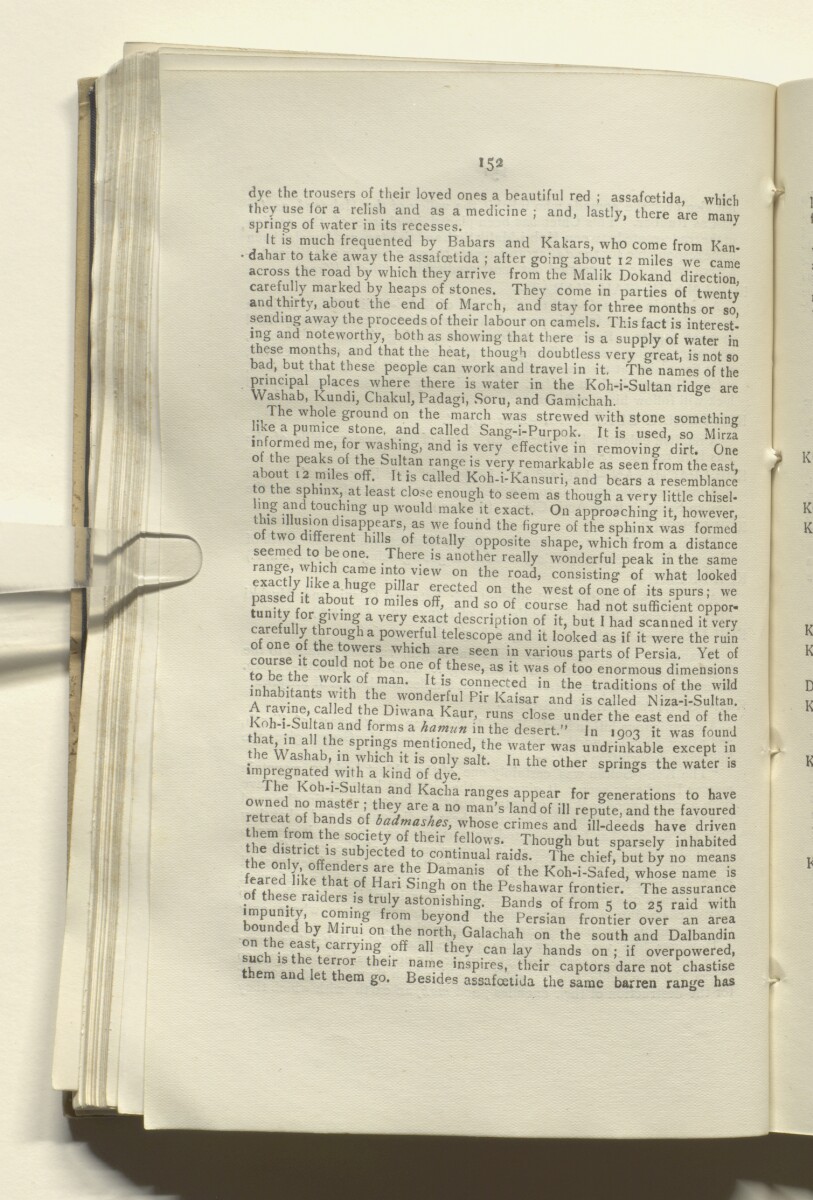
'Military Report of the Nushki-Chagai-Western Sinjarani Country' [84v] (173/302)
The record is made up of 1 volume (147 folios). It was created in 1904. It was written in English. The original is part of the British Library: India Office The department of the British Government to which the Government of India reported between 1858 and 1947. The successor to the Court of Directors. Records and Private Papers Documents collected in a private capacity. .
Transcription
This transcription is created automatically. It may contain errors.
*52
dye the trousers of their loved ones a beautiful red ; assafoetida, which
they use lor a relish and as a medicine ; and, lastly, there are many
springs of water in its recesses.
It is much frequented by Babars and Kakars, who come from Kan-
• dahar to take away the assafcetida ; after going about 12 miles we came
across the road by which they arrive from the Malik Dokand direction
carefully marked by heaps of stones. They come in parties of twenty
and thirty, about the end of March, and stay for three months or so
sending away the proceeds of their labour on camels. This fact is interest
ing and noteworthy, both as showing that there is a supply of water in
these months, and that the heat, though doubtless very great, is not so
bad, but that these people can vrork and travel in it. The names of the
P r , inc u ip ^ T P
lac
One lakh is equal to one hundred thousand rupees
J e . s there is water in the Koh-i-Sultan ridge are
Washab, kundi, Chakul, Padagi, Soru, and Gamichah.
The whole ground on the march was strewed with stone something
like a pumice stone, and called Sang-i-Purpok. It is used, so Mirza
informed me, for washing, and is very effective in removing dirt. One
o the peaks ol the Sultan range is very remarkable as seen from the east,
a iout 12 miles off. It is called Koh-i-Kansuri, and bears a resemblance
o the sphinx, at least close enough to seem as though a very little chisel-
^, n . ouc in g u p would make it exact. On approaching it, however,
n/f \ lsa PP^ ars > as we found the figure of the sphinx was formed
f 1 t rent 11 t( ? talI y opposite shape, which from a distance
seemed to be one. There is another really wonderful peak in the same
f me m -n V16W on the road ’ consisting of what looked
/•, 1 lu £ e P 1 . ar erected on west of one of its spurs; we
inn?f r f' 10 m, les off, and so of course hadnotsufficientoppor-
rarptnU 01 *!?" ln ^ ^ ' er y e ^ ac ^ description of it, but I had scanned it very
nf -mo ^ la P°" e . r ^ u ^ telescope and it looked as if it were the ruin
the 1 t ? we f s u whlch f ar f seen in various parts of Persia. Yet of
tn hp ft. C ° U 1 n< f one as it was of too enormous dimensions
be the work °f man. It is connected in the traditions of the wild
inhabitants w,th the wonderful Pir Kaisar and is called Niza-i-Sultan.
ir 1 V]l e, .^ a e e ^ uv ana Kaur, runs close under the east end of the
Koh-i-Su an and forms ain the desert." In 1903 it was found
flip u/ 1 u 1 ^ s P r, [ 1 ff s > rn cntioned, the water was undrinkable except in
j aS a in ' v ^ h lt: 18 on Jy salt. In the other springs the water is
impregnated with a kind of dye. r
Koh-i-Sultan and Kacha ranges appear for generations to have
f 6 , n ? mas er > ^ ie y are a no man’s land of ill repute, and the favoured
retreat of bands of badmashes, whose crimes and ill-deeds have driven
th^'djJf^f - ie S0 P! et y °J ^cir fellows. Though but sparsely inhabited
. ric f( . ls jeete*^ to continual raids. The chief, but by no means
fparp^l r’k° fi 0 u rC -*0^ ^ aman,s the Koh-i-Safed, whose name is
f f , 1 e . , at ^ arl Singh on the Peshawar frontier. The assurance
of these raiders is truly astonishing. Bands of from 5 to 25 raid with
impunity, coming from beyond the Persian frontier over an area
bounded by Mirui on the north, Galachah on the south and Dalbandin
c. pV. ^ ’ carr y in ff eff they can lay hands on ; if overpowered,
15 1°] t f r l° r t ^ ieir ” ai ” e inspires, their captors dare not chastise
. m an e t em go. Besides assafcetida the same barren range has
About this item
- Content
A report, marked as secret, on the area of Nushki, Chagai, and Western Sinjarani. The report was compiled in the Intelligence Branch, Quarter Master General's Department. The report was commenced in 1897 by Captain R E Roome, 6th Bombay Cavalry (Jacob's Horse), and revised and completed by Major W C Walton, 104th Wellesley's Rifles, Deputy Assistant Quarter Master General in 1903. It was printed at the Government Central Printing Office, Simla, in 1904.
The report includes a preface by Colonel John E Nixon, Assistant Quarter Master General, Intelligence Branch (folio 5) and a glossary of vernacular terms used (folio 6). The main body of the report contains chapters on geography, communications, fortified posts and forts, climate, sanitation, resources, ethnography, history, administration, and military strength.
The second part of the report includes a gazetteer of topographical and ethnographic information (folios 36-127) and appendices covering wells, canals, and meteorology, and including a report on the signalling stations of the Dalbandin-Robat line, with sketches (folios 131-147).
The volume includes the following maps:
- Map of Southern Baluchistan (folio 2)
- Sketch Map of Signalling Line from Dalbandin to Robat (folio 148)
- Map of Persian Seistan [Sistan] Cultivated Area (folio 149).
- Extent and format
- 1 volume (147 folios)
- Arrangement
The volume includes a table of contents (folios 5-6) with reference to the original pagination.
- Physical characteristics
Foliation: the foliation sequence (used for referencing) commences at the front cover with 1, and terminates at the inside back cover with 149; these numbers are written in pencil, are circled, and are located in the top right corner of the recto The front of a sheet of paper or leaf, often abbreviated to 'r'. side of each folio.
- Written in
- English in Latin script View the complete information for this record
Use and share this item
- Share this item
'Military Report of the Nushki-Chagai-Western Sinjarani Country' [84v] (173/302), British Library: India Office Records and Private Papers, Mss Eur F111/386, in Qatar Digital Library <https://www.qdl.qa/archive/81055/vdc_100076627109.0x0000ae> [accessed 3 August 2026]
https://www.qdl.qa/en/archive/81055/vdc_100076627109.0x0000ae
Copy and paste the code below into your web page where you would like to embed the image.
<meta charset="utf-8"><a href="https://www.qdl.qa/en/archive/81055/vdc_100076627109.0x0000ae">'Military Report of the Nushki-Chagai-Western Sinjarani Country' [‎84v] (173/302)</a> <a href="https://www.qdl.qa/en/archive/81055/vdc_100076627109.0x0000ae"> <img src="https://iiif.qdl.qa/iiif/images/81055/vdc_100000001491.0x000126/Mss Eur F111_386_0177.jp2/full/!280,240/0/default.jpg" alt="" /> </a>
This record has a IIIF manifest available as follows. If you have a compatible viewer you can drag the icon to load it.https://www.qdl.qa/en/iiif/81055/vdc_100000001491.0x000126/manifestOpen in Universal viewerOpen in Mirador viewerMore options for embedding images
Copyright: How to use this content
- Reference
- Mss Eur F111/386
- Title
- 'Military Report of the Nushki-Chagai-Western Sinjarani Country'
- Pages
- front, back, spine, edge, head, tail, front-i, 3r:146v, back-i
- Author
- East India Company, the Board of Control, the India Office, or other British Government Department
- Usage terms
- Open Government Licence