
!['General information on Persia for any future edition, 1895' [‎25r] (47/211)](https://iiif.qdl.qa/iiif/images/81055/vdc_100000001491.0x00033d/Mss Eur F111_67_0049.jp2/full/!1200,1200/0/default.jpg "'General information on Persia for any future edition, 1895' [‎25r] (47/211)")
'General information on Persia for any future edition, 1895' [25r] (47/211)
The record is made up of 1 volume (109 folios). It was created in c 1892-1895. It was written in English. The original is part of the British Library: India Office The department of the British Government to which the Government of India reported between 1858 and 1947. The successor to the Court of Directors. Records and Private Papers Documents collected in a private capacity. .
Transcription
This transcription is created automatically. It may contain errors.
OUR TRADE WITH THE
PERSIAN GULF
The historical term used to describe the body of water between the Arabian Peninsula and Iran.
.
5
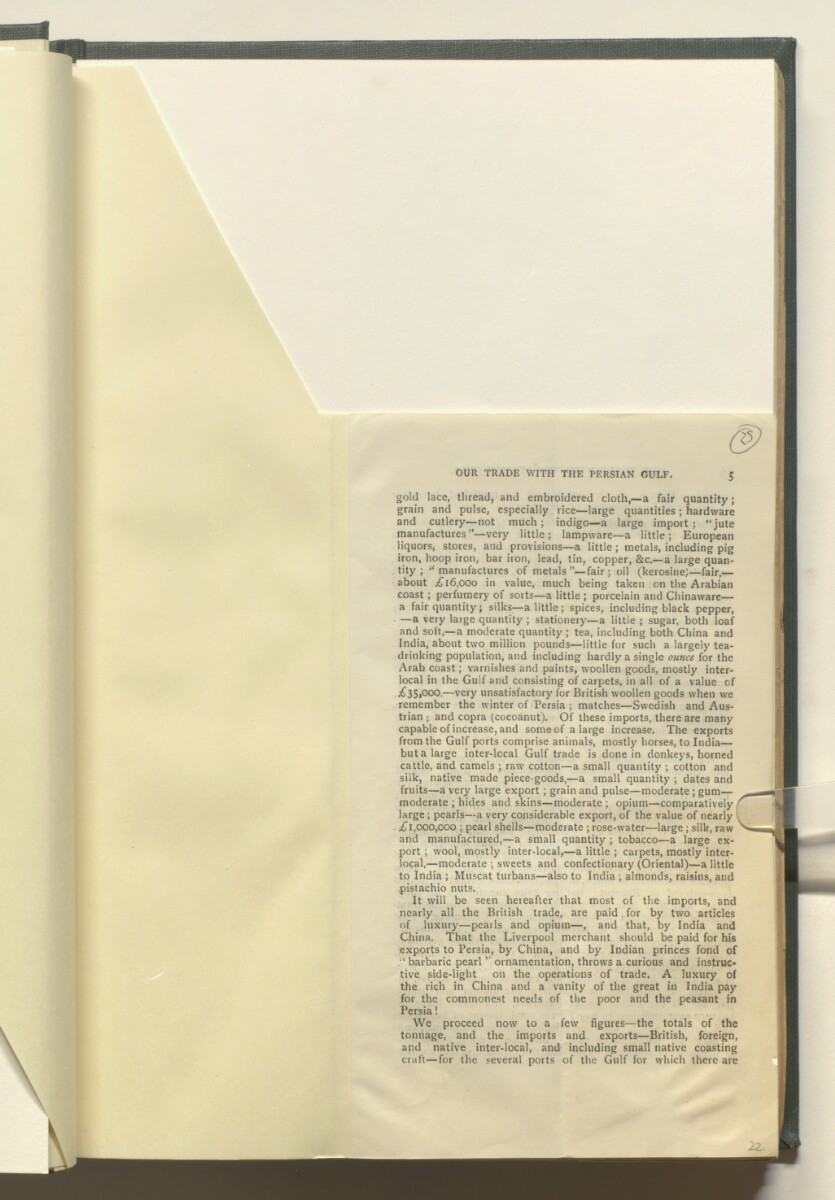
gold lace, thread, and embroidered cloth,—a fair quantity ;
grain and pulse, especially rice—large quantities ; hardware
and cutlery—not much; indigo—a large import; “jute
manufactures’’—very little; lampware—a little; European
liquors, stores, and provisions—a little; metals, including pig
iron, hoop iron, bar iron, lead, tin, copper, &c.—a large quan
tity ; “ manufactures of metals ’’—fair ; oil (kerosinej—fair,—
about £16,000 in value, much being taken on the Arabian
coast ; perfumery of sorts—a little ; porcelain and Chinaware—
a fair quantity; silks—a little ; spices, including black pepper,
—a very large quantity ; stationery—a little ; sugar, both loaf
and soft,—a moderate quantity ; tea, including both China and
India, about two million pounds—little for such a largely tea
drinking population, and including hardly a single omice for the
Arab coast; varnishes and paints, woollen goods, mostly inter
local in the Gulf and consisting of carpets, in all of a value of
£35,000.—very unsatisfactory for British woollen goods when we
remember the winter of Persia ; matches—Swedish and Aus
trian ; and copra (cocoanut). Of these imports, there are many
capable of increase, and some of a large increase. The exports
from the Gulf ports comprise animals, mostly horses, to India—
but a large inter-local Gulf trade is done in donkeys, horned
cattle, and camels ; raw cotton—a small quantity ; cotton and
silk, native made piece-goods,—a small quantity ; dates and
fruits—a very large export; grain and pulse—moderate ; gum—
moderate ; hides and skins—moderate ; opium—comparatively
large ; pearls—a very considerable export, of the value of nearly
£ 1, 000 , OCX) ; pearl shells—moderate ; rose-water—large ; silk, raw
and manufactured,—a small quantity ; tobacco—a large ex
port ; wool, mostly inter-local,—a little ; carpets, mostly inter
local,—moderate ; sweets and confectionary (Oriental)—a little
to India ; Muscat turbans—also to India ; almonds, raisins, and
pistachio nuts.
It will be seen hereafter that most of the imports, and
nearly all the British trade, are paid. for by two articles
of luxury—pearls and opium—, and that, by India and
China. That the Liverpool merchant should be paid for his
exports to Persia, by China, and by Indian princes fond of
barbaric pearl ’’ ornamentation, throws a curious and instruc
tive side-light on the operations of trade. A luxury of
the rich in China and a vanity of the great in India pay
for the commonest needs of the poor and the peasant in
Persia!
We proceed now to a few figures—the totals of the
tonnage, and the imports and exports—British, foreign,
and native inter-local, and including small native coasting
craft — for the several ports of the Gulf for which there are
About this item
- Content
This volume consists of an envelope of notes and printed papers that make up some ancillary materials collected by George Curzon at the time of the publication of his book, Persia and the Persian Question . The notes consist of official correspondence on Persia from the British Government, archaeological surveys, and more recent published material on the trade and regional affairs of Persia, particularly the ports of the Persian Gulf The historical term used to describe the body of water between the Arabian Peninsula and Iran. and its trade with India. The papers were originally kept in a large envelope, which is found at the back of the volume.
- Extent and format
- 1 volume (109 folios)
- Arrangement
The papers appear in no discernible order.
- Physical characteristics
Foliation: the foliation sequence (used for referencing) commences at the inside front cover with 1, and terminates at the inside back cover with 111; these numbers are written in pencil, are circled, and are located in the top right corner of the recto The front of a sheet of paper or leaf, often abbreviated to 'r'. side of each folio.
- Written in
- English in Latin script View the complete information for this record
Use and share this item
- Share this item
'General information on Persia for any future edition, 1895' [25r] (47/211), British Library: India Office Records and Private Papers, Mss Eur F111/67, in Qatar Digital Library <https://www.qdl.qa/archive/81055/vdc_100076639076.0x000030> [accessed 5 June 2026]
https://www.qdl.qa/en/archive/81055/vdc_100076639076.0x000030
Copy and paste the code below into your web page where you would like to embed the image.
<meta charset="utf-8"><a href="https://www.qdl.qa/en/archive/81055/vdc_100076639076.0x000030">'General information on Persia for any future edition, 1895' [‎25r] (47/211)</a> <a href="https://www.qdl.qa/en/archive/81055/vdc_100076639076.0x000030"> <img src="https://iiif.qdl.qa/iiif/images/81055/vdc_100000001491.0x00033d/Mss Eur F111_67_0049.jp2/full/!280,240/0/default.jpg" alt="" /> </a>
This record has a IIIF manifest available as follows. If you have a compatible viewer you can drag the icon to load it.https://www.qdl.qa/en/iiif/81055/vdc_100000001491.0x00033d/manifestOpen in Universal viewerOpen in Mirador viewerMore options for embedding images
Copyright: How to use this content
- Reference
- Mss Eur F111/67
- Title
- 'General information on Persia for any future edition, 1895'
- Pages
- 23r, 24r:28r, 29r, 30r, 31r, 32r, 33r, 34r, 35r:35v
- Author
- The Calcutta Review
- Usage terms
- Public Domain