
!['General information on Persia for any future edition, 1895' [‎98r] (185/211)](https://iiif.qdl.qa/iiif/images/81055/vdc_100000001491.0x00033d/Mss Eur F111_67_0191.jp2/full/!1200,1200/0/default.jpg "'General information on Persia for any future edition, 1895' [‎98r] (185/211)")
'General information on Persia for any future edition, 1895' [98r] (185/211)
The record is made up of 1 volume (109 folios). It was created in c 1892-1895. It was written in English. The original is part of the British Library: India Office The department of the British Government to which the Government of India reported between 1858 and 1947. The successor to the Court of Directors. Records and Private Papers Documents collected in a private capacity. .
Transcription
This transcription is created automatically. It may contain errors.
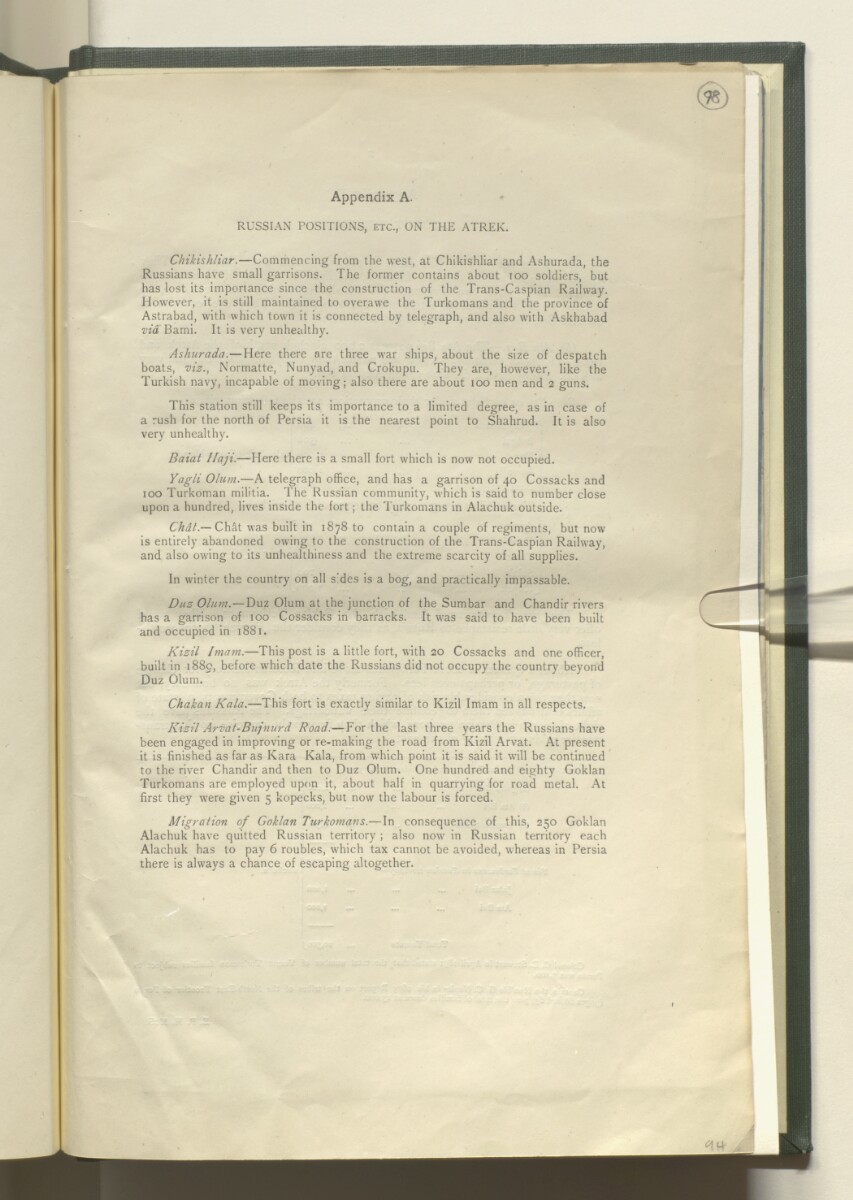
Appendix A.
RUSSIAN POSITIONS, etc., ON THE ATREK.
Chikishliar. —Commencing from the west, at Chikishliar and Ashurada, the
Russians have small garrisons. The former contains about 100 soldiers, but
has lost its importance since the construction of the Trans-Caspian Railway.
However, it is still maintained to overawe the Turkomans and the province of
Astrabad, with which town it is connected by telegraph, and also with Askhabad
lid Bami. It is very unhealthy.
Ashurada.—Here there are three war ships, about the size of despatch
boats, viz., Normatte, Nunyad, and Crokupu. They are, however, like the
Turkish navy, incapable of moving; also there are about 100 men and 2 guns.
This station still keeps its importance to a limited degree, as in case of
a rush for the north of Persia it is the nearest point to Shahrud. It is also
very unhealthy.
Baiat Haji. —Here there is a small fort which is now not occupied.
Yagli Olum. —A telegraph office, and has a garrison of 40 Cossacks and
100 Turkoman militia. The Russian community, which is said to number close
upon a hundred, lives inside the fort; the Turkomans in Alachuk outside.
Oi/.—Chat was built in 1878 to contain a couple of regiments, but now
is entirely abandoned owing to the construction of the Trans-Caspian Railway,
and also owing to its unhealthiness and the extreme scarcity of all supplies.
In winter the country on all s : des is a bog, and practically impassable.
Duz Olum.—Y)\iz Olum at the junction of the Sumbar and Chandir rivers
has a garrison of 100 Cossacks in barracks. It was said to have been built
and occupied in 1881 .
Kizil Imam. —This post is a little fort, with 20 Cossacks and one officer,
built in 1880 , before which date the Russians did not occupy the country beyond
Duz Olum.
Chakan Kala. —This fort is exactly similar to Kizil Imam in all respects.
Kizil Arvat-Bujnurd Road. —For the last three years the Russians have
been engaged in improving or re-making the road from Kizil Arvat. At present
it is finished as far as Kara Kala, from which point it is said it will be continued
to the river Chandir and then to Duz Olum. One hundred and eighty Goklan
Turkomans are employed upon it, about half in quarrying for road metal. At
first they were given 5 kopecks, but now the labour is forced.
Migration of Goklan Turkomans. —In consequence of this, 250 Goklan
Alachuk have quitted Russian territory ; also now in Russian territory each
Alachuk has to pay 6 roubles, which tax cannot be avoided, whereas in Persia
there is always a chance of escaping altogether.
About this item
- Content
This volume consists of an envelope of notes and printed papers that make up some ancillary materials collected by George Curzon at the time of the publication of his book, Persia and the Persian Question . The notes consist of official correspondence on Persia from the British Government, archaeological surveys, and more recent published material on the trade and regional affairs of Persia, particularly the ports of the Persian Gulf The historical term used to describe the body of water between the Arabian Peninsula and Iran. and its trade with India. The papers were originally kept in a large envelope, which is found at the back of the volume.
- Extent and format
- 1 volume (109 folios)
- Arrangement
The papers appear in no discernible order.
- Physical characteristics
Foliation: the foliation sequence (used for referencing) commences at the inside front cover with 1, and terminates at the inside back cover with 111; these numbers are written in pencil, are circled, and are located in the top right corner of the recto The front of a sheet of paper or leaf, often abbreviated to 'r'. side of each folio.
- Written in
- English in Latin script View the complete information for this record
Use and share this item
- Share this item
'General information on Persia for any future edition, 1895' [98r] (185/211), British Library: India Office Records and Private Papers, Mss Eur F111/67, in Qatar Digital Library <https://www.qdl.qa/archive/81055/vdc_100076639076.0x0000ba> [accessed 4 August 2026]
https://www.qdl.qa/en/archive/81055/vdc_100076639076.0x0000ba
Copy and paste the code below into your web page where you would like to embed the image.
<meta charset="utf-8"><a href="https://www.qdl.qa/en/archive/81055/vdc_100076639076.0x0000ba">'General information on Persia for any future edition, 1895' [‎98r] (185/211)</a> <a href="https://www.qdl.qa/en/archive/81055/vdc_100076639076.0x0000ba"> <img src="https://iiif.qdl.qa/iiif/images/81055/vdc_100000001491.0x00033d/Mss Eur F111_67_0191.jp2/full/!280,240/0/default.jpg" alt="" /> </a>
This record has a IIIF manifest available as follows. If you have a compatible viewer you can drag the icon to load it.https://www.qdl.qa/en/iiif/81055/vdc_100000001491.0x00033d/manifestOpen in Universal viewerOpen in Mirador viewerMore options for embedding images
Copyright: How to use this content
- Reference
- Mss Eur F111/67
- Title
- 'General information on Persia for any future edition, 1895'
- Pages
- front, back, spine, edge, head, tail, front-i, 2r:3v, 10r, 11r:11v, 36r:36v, 47r:59v, 60v:93r, 94r:98v, 100r:110v, back-i
- Author
- East India Company, the Board of Control, the India Office, or other British Government Department
- Usage terms
- Open Government Licence