
![Papers written by Curzon on the Near and Middle East [‎150r] (299/348)](https://iiif.qdl.qa/iiif/images/81055/vdc_100000001491.0x00028c/Mss Eur F112_278_0307.jp2/full/!1200,1200/0/default.jpg "Papers written by Curzon on the Near and Middle East [‎150r] (299/348)")
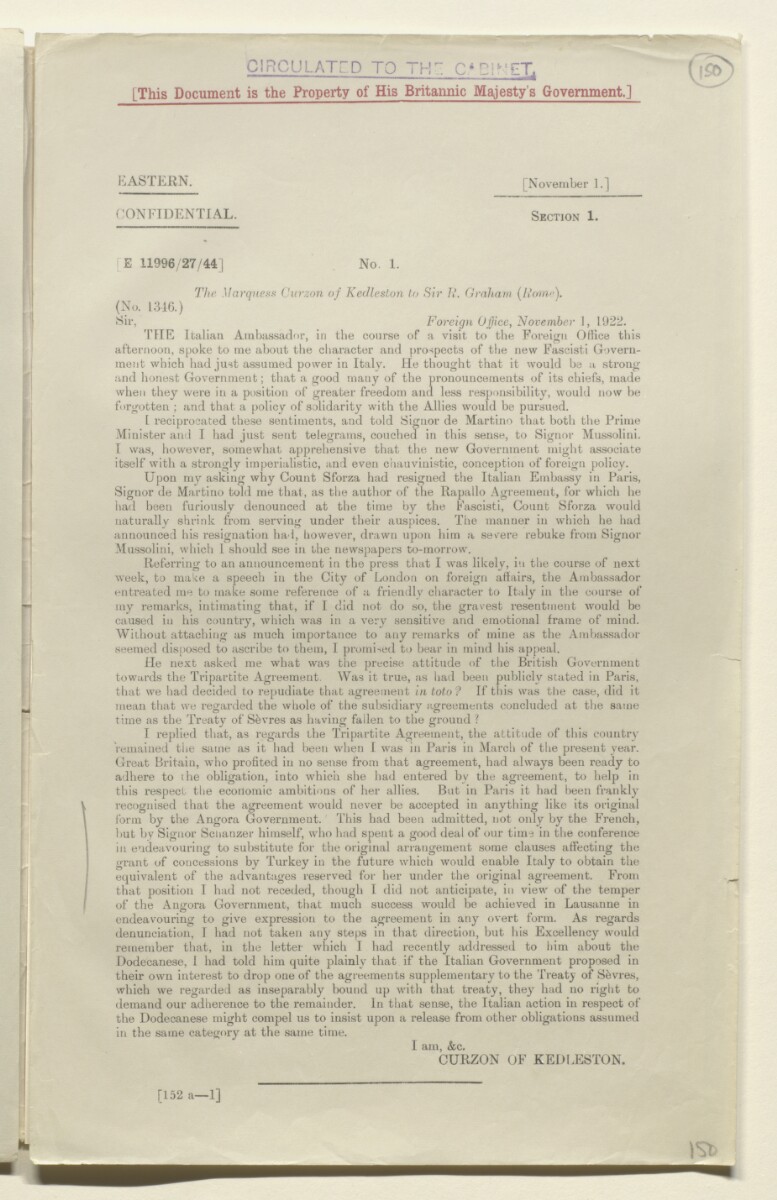
Papers written by Curzon on the Near and Middle East [150r] (299/348)
The record is made up of 1 file (174 folios). It was created in 16 Nov 1917-17 Jan 1924. It was written in English and French. The original is part of the British Library: India Office The department of the British Government to which the Government of India reported between 1858 and 1947. The successor to the Court of Directors. Records and Private Papers Documents collected in a private capacity. .
Transcription
This transcription is created automatically. It may contain errors.
w
C1RCULA7TD TO THZ C^l^ET,
[This Document is the Property of His Britannic Majesty’s Government.]
EASTERN.
[November 1.]
CONFIDENTIAL.
Section 1.
[E 11996/27/44] No 1.
The Marquezs Curzon of Kedlesbon to Sir It. Graham (Home).
(No. 1346.)
Sir, Foreign Office, November 1, 1922.
THE Italian Ambassador, in the course of a visit to the Foreign Office this
afternoon, spoke to me about the character and prospects of the new Fascisti Govern
ment which had just assumed power in Italy. He thought that it would be a strong
and honest Government; that a good many of the pronouncements of its chiefs, made
when they were in a position of greater freedom and less responsibility, would now be
forgotten ; and that a policy of solidarity with the Allies would be pursued.
I reciprocated these sentiments, and told Signor de Martino that both the Prime
Minister and I had just sent telegrams, couched in this sense, to Signor Mussolini.
I was, however, somewhat apprehensive that the new Government might associate
itself with a strongly imperialistic, and even chauvinistic, conception of foreign policy.
Upon my asking why Count Sforza had resigned the Italian Embassy in Paris,
Signor de Martino told me that, as the author of the Rapallo Agreement, for which he
had been furiously denounced at the time by the Fascisti, Count Sforza would
naturally shrink from serving under their auspices. The manner in which he had
announced his resignation had, however, drawn upon him a severe rebuke from Signor
Mussolini, which 1 should see in the newspapers to-morrow.
Referring to an announcement in the press that I was likely, in the course of next
week, to make a speech in the City of London on foreign affiiirs, the Ambassador
entreated me to make some reference of a friendly character to Italy in the course of
my remarks, intimating that, if I did not do so, the gravest resentment would be
caused in his country, which was in a very sensitive and emotional frame of mind.
Without attaching as much importance to any remarks of mine as the Ambassador
seemed disposed to ascribe to them, I promised to bear in mind his appeal.
He next asked me what was the precise attitude of the British Government
towards the Tripartite Agreement. Was it true, as had been publicly stated in Paris,
that we had decided to repudiate that agreement in toto? If this was the case, did it
mean that we regarded the whole of the subsidiary agreements concluded at the same
time as the Treaty of Sevres as having fallen to the ground ?
I replied that, as regards the Tripartite Agreement, the attitude of this country
remained the same as it had been when I was in Paris in March of the present year.
Great Britain, who profited in no sense from that agreement, had always been ready to
adhere to the obligation, into which she had entered by the agreement, to help in
this respect the economic ambitions of her allies. But in Paris it had been frankly
recognised that the agreement would never be accepted in anything like its original
form by the Angora Government. This had been admitted, not only by the French,
but by Signor Sclianzer himself, who had spent a good deal of our tims in the conference
in endeavouring to substitute for the original arrangement some clauses affecting the
grant of concessions by Turkey in the future which would enable Italy to obtain the
equivalent of the advantages reserved for her under the original agreement. From
that position I had not receded, though I did not anticipate, in view of the temper
of the Angora Government, that much success would be achieved in Lausanne in
endeavouring to give expression to the agreement in any overt form. As regards
denunciation, I had not taken any steps in that direction, but his Excellency would
remember that, in the letter which I had recently addressed to him about the
Dodecanese, 1 had told him quite plainly that if the Italian Government proposed in
their own interest to drop one of the agreements supplementary to the Treaty of Sevres,
which we regarded as inseparably bound up with that treaty, they had no right to
demand our adherence to the remainder. In that sense, the Italian action in respect of
the Dodecanese might compel us to insist upon a release from other obligations assumed
in the same category at the same time.
I am, &c.
CURZON OF KEDLESTON.
[152 a—1]
About this item
- Content
The file contains correspondence, memoranda, maps, and notes on various subjects connected to the Near and Middle East. The majority of the papers are written by George Curzon himself and concern the settlement of former territories of the Ottoman Empire following its break up after the First World War. Matters such as the Greek occupation of Smyrna, the division of Thrace, the Greco-Turkish War, Georgian independence, and the Treaties of Sèvres and Lausanne are all discussed.
Other matters covered by the file include those concerning the Arab territories of the former Ottoman Empire, American advisers in Persia, and the future of Palestine, including a report by the Committee on Palestine (Colonial Office) dated 27 July 1923 (folios 168-171).
Correspondence within the file is mostly between Curzon and representatives of the other Allied Powers, as well as officials from other governmental departments and diplomatic offices.
- Extent and format
- 1 file (174 folios)
- Arrangement
The file is arranged in chronological order from the front to the back.
- Physical characteristics
Foliation: the foliation sequence (used for referencing) commences at the first folio with 1, and terminates at the last folio with 174; these numbers are written in pencil, are circled, and are located in the top right corner of the recto The front of a sheet of paper or leaf, often abbreviated to 'r'. side of each folio.
- Written in
- English and French in Latin script View the complete information for this record
Use and share this item
- Share this item
Papers written by Curzon on the Near and Middle East [150r] (299/348), British Library: India Office Records and Private Papers, Mss Eur F112/278, in Qatar Digital Library <https://www.qdl.qa/archive/81055/vdc_100076917036.0x000064> [accessed 4 August 2026]
https://www.qdl.qa/en/archive/81055/vdc_100076917036.0x000064
Copy and paste the code below into your web page where you would like to embed the image.
<meta charset="utf-8"><a href="https://www.qdl.qa/en/archive/81055/vdc_100076917036.0x000064">Papers written by Curzon on the Near and Middle East [‎150r] (299/348)</a> <a href="https://www.qdl.qa/en/archive/81055/vdc_100076917036.0x000064"> <img src="https://iiif.qdl.qa/iiif/images/81055/vdc_100000001491.0x00028c/Mss Eur F112_278_0307.jp2/full/!280,240/0/default.jpg" alt="" /> </a>
This record has a IIIF manifest available as follows. If you have a compatible viewer you can drag the icon to load it.https://www.qdl.qa/en/iiif/81055/vdc_100000001491.0x00028c/manifestOpen in Universal viewerOpen in Mirador viewerMore options for embedding images
Copyright: How to use this content
- Reference
- Mss Eur F112/278
- Title
- Papers written by Curzon on the Near and Middle East
- Pages
- 2r:12v, 15r:48v, 54r:93v, 95r:105v, 118r:145r, 147v:153r, 154v, 156r:161v, 163r:173v, back, back-i
- Author
- East India Company, the Board of Control, the India Office, or other British Government Department
- Usage terms
- Open Government Licence