
![File 87/1926 Pt 1 'Arabia: Bin Saud; Title; Recognition as King of the Hedjaz' [‎7r] (7/306)](https://iiif.qdl.qa/iiif/images/81055/vdc_100000000466.0x0001b7/IOR_L_PS_10_1165_0018.jp2/full/!1200,1200/0/default.jpg "File 87/1926 Pt 1 'Arabia: Bin Saud; Title; Recognition as King of the Hedjaz' [‎7r] (7/306)")
File 87/1926 Pt 1 'Arabia: Bin Saud; Title; Recognition as King of the Hedjaz' [7r] (7/306)
The record is made up of 1 item (152 folios). It was created in 11 Jan 1926-12 Jan 1928. It was written in English and French. The original is part of the British Library: India Office The department of the British Government to which the Government of India reported between 1858 and 1947. The successor to the Court of Directors. Records and Private Papers Documents collected in a private capacity. .
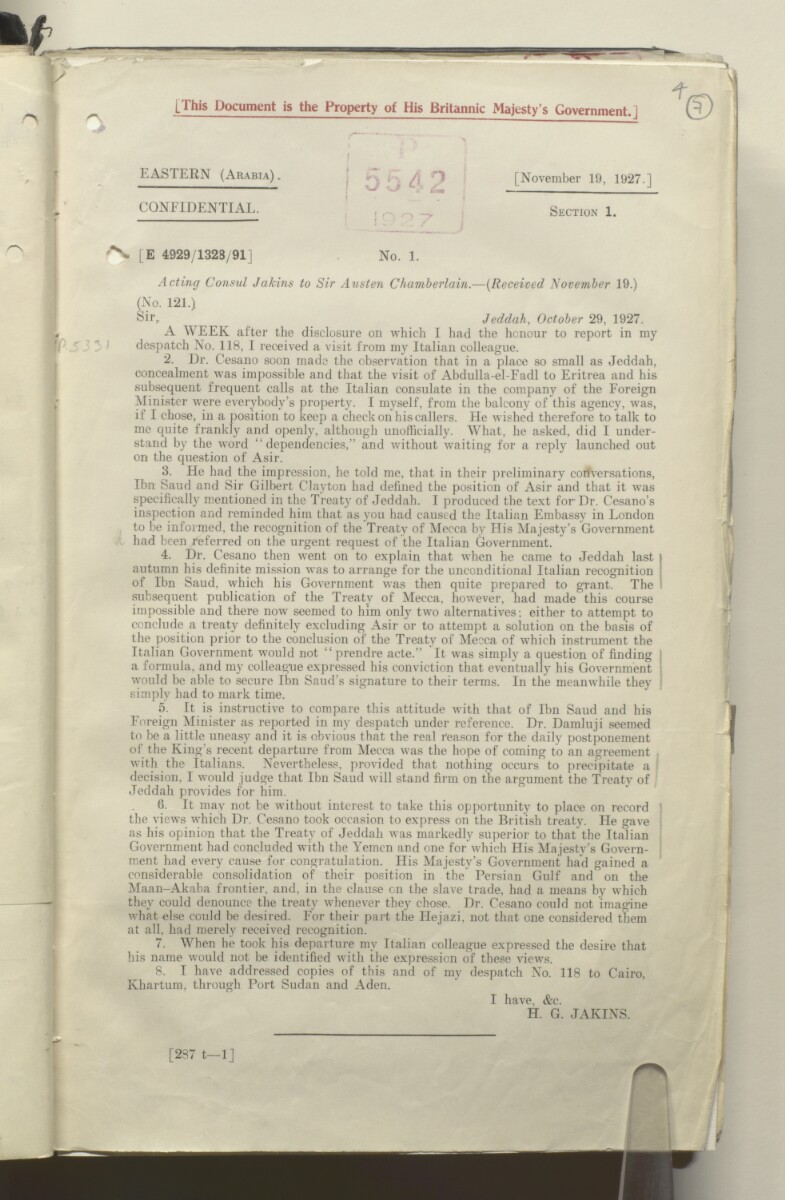
Transcription
This transcription is created automatically. It may contain errors.
[This Document is the Property of His Britannic Majesty’s Government.]
EASTERN (Arabia) .
CONFIDENTIAL.
[November 19, 1927.]
Section 1 .
'*N. [E 4929/1323/91]
No. 1.
Acting Consul Jakins to Sir Austen Chamberlain.—(Received November 19.)
(No. 121.)
Jeddah, October 29, 1927.
A WEEK after the disclosure on which I had the honour to report in my
despatch No. 118, I received a visit from my Italian colleague.
2. Dr. Cesano soon made the observation that in a place so small as Jeddah,
concealment was impossible and that the visit of Abdulla-el-Fadl to Eritrea and his
subsequent frequent calls at the Italian consulate in the company of the Foreign
Minister were everybody’s property. I myself, from the balcony of this
agency
An office of the East India Company and, later, of the British Raj, headed by an agent.
, was,
il I chose, in a position to keep a check on his callers. He wished therefore to talk to
me quite frankly and openly, although unofficially. What, he asked, did I under
stand by the word “dependencies," and without waiting for a reply launched out
on the question of Asir.
3. He had the impression, he told me, that in their preliminary conversations,
Ibn Sand and Sir Gilbert Clayton had defined the position of Asir and that it was
specifically mentioned in the Treaty of Jeddah. I produced the text for Dr. Cesano’s
inspection and reminded him that as you had caused the Italian Embassy in London
to be informed, the recognition of the Treaty of Mecca by His Majesty’s Government
had been referred on the urgent request of the Italian Government.
4. Dr. Cesano then went on to explain that when he came to Jeddah last
autumn his definite mission was to arrange for the unconditional Italian recognition
of Ibn Saud, which his Government was then quite prepared to grant. The
subsequent publication of the Treaty of Mecca, however, had made this course
impossible and there now seemed to him only two alternatives; either to attempt to
conclude a treaty definitely excluding Asir or to attempt a solution on the basis of
the position prior to the conclusion of the Treaty of Mecca of which instrument the
Italian Government would not “prendre acte.” It was simply a question of finding
a formula, and my colleague expressed his conviction that eventually his Government
would be able to secure Ibn Sand’s signature to their terms. In the meanwhile they
simply had to mark time.
5. It is instructive to compare this attitude with that of Ibn Saud and his
Foreign Minister as reported in my despatch under reference. Dr. Damluji seemed
to be a little uneasy and it is obvious that the real reason for the daily postponement
of the King’s recent departure from Mecca was the hope of coming to an agreement
with the Italians. Nevertheless, provided that nothing occurs to precipitate a
decision, I would judge that Ibn Saud will stand firm on the argument the Treaty of
Jeddah provides for him.
6. It may not be without interest to take this opportunity to place on record
the views which Dr. Cesano took occasion to express on the British treaty. He gave
as his opinion that the Treaty of Jeddah was markedly superior to that the Italian
Government had concluded with the Yemen and one for which His Majesty’s Govern
ment had every cause for congratulation. His Majesty’s Government had gained a
considerable consolidation of their position in the
Persian Gulf
The historical term used to describe the body of water between the Arabian Peninsula and Iran.
and on the
Maan-Akaba frontier, and, in the clause on the slave trade, had a means by which
they could denounce the treaty whenever they chose. Dr. Cesano could not imagine
what else could be desired. For their part the Hejazi, not that one considered them
at all, had merely received recognition.
7. When he took his departure my Italian colleague expressed the desire that
his name would not be identified with the expression of these views.
8. I have addressed copies of this and of my despatch No. 118 to Cairo,
Khartum, through Port Sudan and Aden.
I have, &c.
H. G. JAKINS.
About this item
- Content
The papers cover the election of Ibn Saud [‘Abd al-‘Azīz bin ‘Abd al-Raḥmān bin Fayṣal Āl Sa‘ūd] as king in 1926, his assumption of the title of King of the Hedjaz and Sultan of Nejd and its dependencies, his de jure recognition by HM Government and others, the delay on the part of the Egyptian Government in recognising Ibn Saud's position as king, the British attitude towards the Nejd-Hedjaz conflict, salutes to the Hedjaz flag, and the breakdown of negotiations for the recognition of Ibn Saud by the Italian Government. The papers also cover Ibn Saud's proposal to send a delegate to the International Sanitary Conference in 1926, and to become signatory of the International Sanitary Convention.
The principal correspondents are the Colonial Office, the Foreign Office, HM Consul at Jeddah, and the Viceroy.
There are newspapers cuttings from Forward and The Times ;and a letter in French, from the French Ministry of Foreign Affairs.
- Extent and format
- 1 item (152 folios)
- Written in
- English and French in Latin script View the complete information for this record
Use and share this item
- Share this item
File 87/1926 Pt 1 'Arabia: Bin Saud; Title; Recognition as King of the Hedjaz' [7r] (7/306), British Library: India Office Records and Private Papers, IOR/L/PS/10/1165/1, in Qatar Digital Library <https://www.qdl.qa/archive/81055/vdc_100079351204.0x000013> [accessed 6 August 2026]
https://www.qdl.qa/en/archive/81055/vdc_100079351204.0x000013
Copy and paste the code below into your web page where you would like to embed the image.
<meta charset="utf-8"><a href="https://www.qdl.qa/en/archive/81055/vdc_100079351204.0x000013">File 87/1926 Pt 1 'Arabia: Bin Saud; Title; Recognition as King of the Hedjaz' [‎7r] (7/306)</a> <a href="https://www.qdl.qa/en/archive/81055/vdc_100079351204.0x000013"> <img src="https://iiif.qdl.qa/iiif/images/81055/vdc_100000000466.0x0001b7/IOR_L_PS_10_1165_0018.jp2/full/!280,240/0/default.jpg" alt="" /> </a>
This record has a IIIF manifest available as follows. If you have a compatible viewer you can drag the icon to load it.https://www.qdl.qa/en/iiif/81055/vdc_100000000466.0x0001b7/manifestOpen in Universal viewerOpen in Mirador viewerMore options for embedding images
Copyright: How to use this content
- Reference
- IOR/L/PS/10/1165/1
- Title
- File 87/1926 Pt 1 'Arabia: Bin Saud; Title; Recognition as King of the Hedjaz'
- Pages
- 4r:27v, 28v:73v, 75r:126v, 127v:156v
- Author
- East India Company, the Board of Control, the India Office, or other British Government Department
- Usage terms
- Open Government Licence