
![Report of the Special Mission to Egypt under Lord Milner, and related papers [‎4v] (8/473)](https://iiif.qdl.qa/iiif/images/81055/vdc_100000001491.0x000295/Mss Eur F112_260_0008.jp2/full/!1200,1200/0/default.jpg "Report of the Special Mission to Egypt under Lord Milner, and related papers [‎4v] (8/473)")
Report of the Special Mission to Egypt under Lord Milner, and related papers [4v] (8/473)
The record is made up of 1 file (237 folios). It was created in 15 May 1920-14 Oct 1921. It was written in English. The original is part of the British Library: India Office The department of the British Government to which the Government of India reported between 1858 and 1947. The successor to the Court of Directors. Records and Private Papers Documents collected in a private capacity. .
Transcription
This transcription is created automatically. It may contain errors.
6
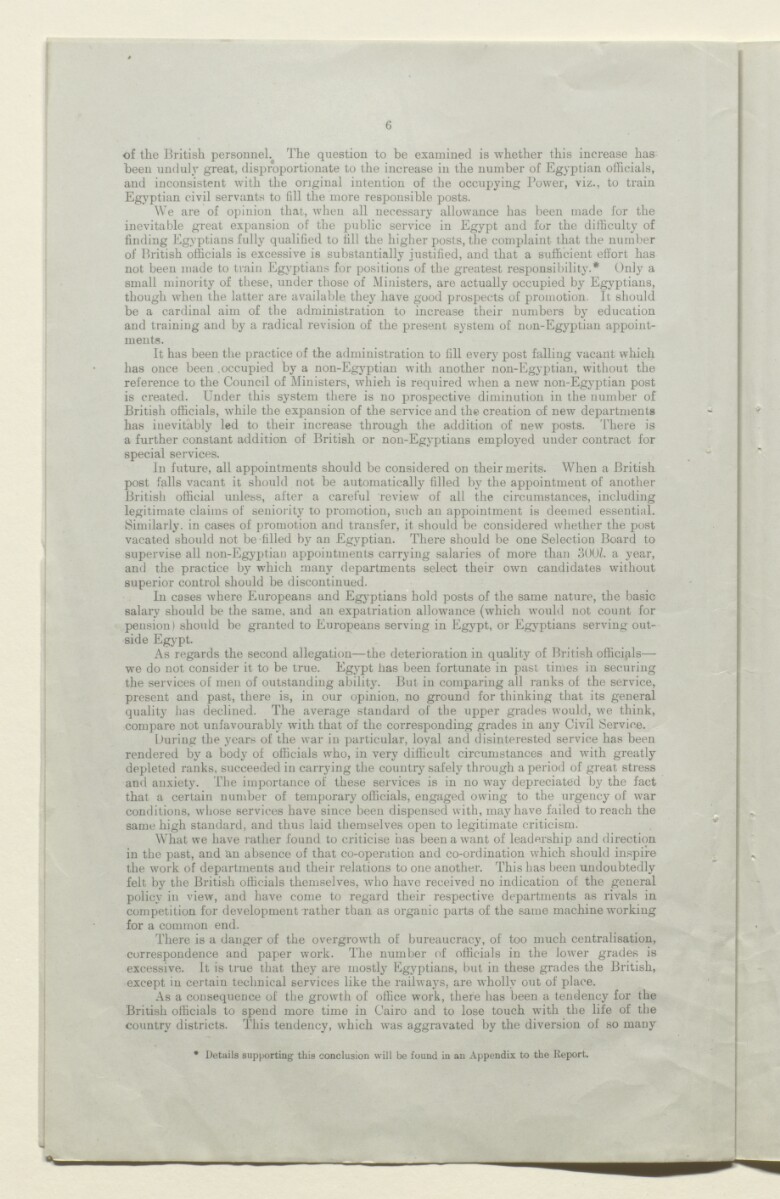
of the British personnel. The question to be examined is whether this increase has
been unduly great, disproportionate to the increase in the number of Egyptian officials,
and inconsistent with the original intention of the occupying Power, viz., to train
Egyptian civil servants to fill the more responsible posts.
We are of opinion that, when all necessary allowance has been made for the
inevitable great expansion of the public service in Egypt and for the difficulty of
finding Egyptians fully qualified to fill the higher posts, the complaint that the number
of British officials is excessive is substantially justified, and that a sufficient effort has
not been made to train Egyptians for positions of the greatest responsibility.* Only a
small minority of these, under those of Ministers, are actually occupied by Egyptians,
though when the latter are available, they have good prospects of promotion. It should
be a cardinal aim of the administration to increase their numbers by education
and trainiug and by a radical revision of the present system of non-Egyptian appoint
ments.
It has been the practice of the administration to fill every post falling vacant which
has once been .occupied by a non-Egyptian with another non-Egyptian, without the
reference to the Council of Ministers, which is required when a new non-Egyptian post
is created. Under this system there is no prospective diminution in the number of
British officials, while the expansion of the service and the creation of new departments
has inevitably led to their increase through the addition of new posts. There is
a further constant addition of British or non-Egyptians employed under contract for
special services.
In future, all appointments should be considered on their merits. When a British
post falls vacant it should not be automatically filled by the appointment of another
British official unless, after a careful review of all the circumstances, including
legitimate claims of seniority to promotion, such an appointment is deemed essential.
Similarly, in cases of promotion and transfer, it should be considered whether the post
vacated should not be filled by an Egyptian. There should be one Selection Board to
supervise all non-Egyptian appointments carrying salaries of more than BOOL a year,
and the practice by which many departments select their own candidates without
superior control should be discontinued.
In cases where Europeans and Egyptians hold posts of the same nature, the basic
salary should be the same, and an expatriation allowance (which would not count for
pension) should be granted to Europeans serving in Egypt, or Egyptians serving out
side Egypt.
As regards the second allegation—the deterioration in quality of British officials—
we do not consider it to be true. Egypt has been fortunate in past times in securing
the services of men of outstanding ability. But in comparing all ranks of the service,
present and past, there is, in our opinion, no ground for thinking that its general
quality has declined. The average standard of the upper grades would, we think,
compare not unfavourably with that of the corresponding grades in any Civil Service.
During the years of the war in particular, loyal and disinterested service has been
rendered by a body of officials who, in very difficult circumstances and with greatly
depleted ranks, succeeded in carrying the country safely through a period of great stress
and anxiety. The importance of these services is in no way depreciated by the fact
that a certain number of temporary officials, engaged owing to the urgency of war
conditions, whose services have since been dispensed with, may have failed to reach the
same high standard, and thus laid themselves open to legitimate criticism.
What we have rather found to criticise has been a want of leadership and direction
in the past, and an absence of that co-operation and co-ordination which should inspire
the work of departments and their relations to one another. This has been undoubtedly
felt by the British officials themselves, who have received no indication of the general
policy in view, and have come to regard their respective departments as rivals in
competition for development rather than as organic parts of the same machine working
for a common end.
There is a danger of the overgrowth of bureaucracy, of too much centralisation,
correspondence and paper work. The number of officials in the lower grades is
excessive. It is true that they are mostly Egyptians, but in these grades the British,
except in certain technical services like the railways, are wholly out of place.
As a consequence of the growth of office work, there has been a tendency for the
British officials to spend more time in Cairo and to lose touch with the life of the
country districts. This tendency, which was aggravated by the diversion of so many
* Details supporting this conclusion will be found in an Appendix to the Report.
About this item
- Content
The file contains official correspondence, memoranda, and reports relating to political affairs in Egypt. The correspondents and authors are officials at the Foreign Office (Lord Curzon was Secretary of State for Foreign Affairs at the time), War Office, Air Ministry, Admiralty, Colonial Office, Board of Trade, Board of Education, as well as those within the Egyptian civil service.
The file contains copies of reports of the Special Mission to Egypt (folios 1-7, 75-93, and 175-194), led by Lord Alfred Milner, whose purpose was to investigate and advise following the Egyptian Revolution of 1919. Much of the content of the file is in response to the findings and recommendations of the Mission and discusses the possibilities of a political settlement with Egypt.
- Extent and format
- 1 file (237 folios)
- Arrangement
The file is arranged in chronological order, from the front to the rear.
- Physical characteristics
Foliation: the foliation sequence (used for referencing) commences at the front cover with 1, and terminates at the inside back cover with 235; these numbers are written in pencil, are circled, and are located in the top right corner of the recto The front of a sheet of paper or leaf, often abbreviated to 'r'. side of each folio. The file has one foliation anomaly, f 76a.
- Written in
- English in Latin script View the complete information for this record
Use and share this item
- Share this item
Report of the Special Mission to Egypt under Lord Milner, and related papers [4v] (8/473), British Library: India Office Records and Private Papers, Mss Eur F112/260, in Qatar Digital Library <https://www.qdl.qa/archive/81055/vdc_100080131819.0x000009> [accessed 4 June 2026]
https://www.qdl.qa/en/archive/81055/vdc_100080131819.0x000009
Copy and paste the code below into your web page where you would like to embed the image.
<meta charset="utf-8"><a href="https://www.qdl.qa/en/archive/81055/vdc_100080131819.0x000009">Report of the Special Mission to Egypt under Lord Milner, and related papers [‎4v] (8/473)</a> <a href="https://www.qdl.qa/en/archive/81055/vdc_100080131819.0x000009"> <img src="https://iiif.qdl.qa/iiif/images/81055/vdc_100000001491.0x000295/Mss Eur F112_260_0008.jp2/full/!280,240/0/default.jpg" alt="" /> </a>
This record has a IIIF manifest available as follows. If you have a compatible viewer you can drag the icon to load it.https://www.qdl.qa/en/iiif/81055/vdc_100000001491.0x000295/manifestOpen in Universal viewerOpen in Mirador viewerMore options for embedding images
Copyright: How to use this content
- Reference
- Mss Eur F112/260
- Title
- Report of the Special Mission to Egypt under Lord Milner, and related papers
- Pages
- front, front-i, 2r:39v, 42r:50v, 53r:76v, 76ar:76av, 77r:140v, 143r:143v, 144ar, 144r:235v
- Author
- East India Company, the Board of Control, the India Office, or other British Government Department
- Usage terms
- Open Government Licence